
 AUS
AUS
 NZ
NZ
 UK
UK
 CA
CA
 USA
USA
 IND
IND








Highlights
- REITs are pooled investment tools providing access to real estate assets.
- There are different types of REITs including sector specific, diversified, international etc.
- Just like shares, REITs can also be bought and sold on ASX.
Australian real estate investment trusts (A-REITs) are publicly traded investment tools that expose investors to real estate assets such as office buildings, malls, industrial structures, hotels, and movie theatres. They are pooled investments supervised by a professional manager. Additionally, just like shares, you may purchase and sell them through your broker as they are listed on the ASX.
Types of A-REITS
Diversified – It consists of a diversified portfolio consisting of all important sectors of commercial property
Sector specific – Specialises in a particular commercial property sector. It can be retail, industrial, etc.
Specialist – These require special management skills and might include hospitals, pubs, etc.
International – Having access to international property.
Stapled – It consists of one unit in a property trust stapled to a share in an associated company.
Benefits and risks of investing in REITs
Like any investment, A-REITs come with their own set of risks and benefits, and they offer diversification, capital growth, and a source of regular income. It is to be noted that they can also produce negative returns and therefore one should do proper research or seek professional help before investing.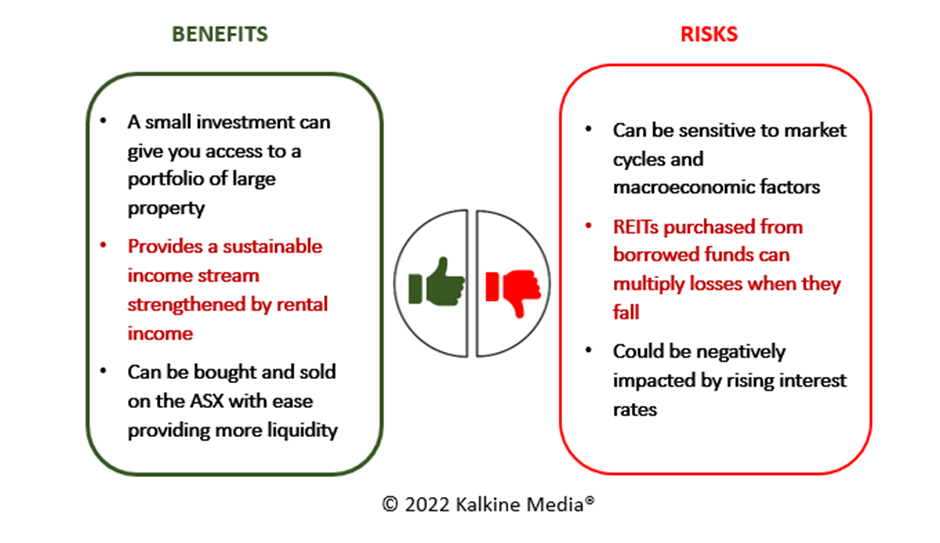
S&P/ASX 200 A-REIT
The S&P/ASX 200 A-REIT is a sectoral subindex of S&P/ASX 200 which tracks the performance of Australian real estate investment trusts (A-REITs). This subindex also tracks the performance of mortgage REITs.
The index uses the float-adjusted market cap weighting method and is rebalanced every quarter. As of 29 July 2022, it consists of 23 constituents.
Talking about price returns, as of 01 Sep 2022, the index has gained 4.18% in the last ten years and 0.86% in the last five years. However, it is in the red zone on a 1-year basis with a loss of 16.54%. Similarly, on a year-to-date (YTD) basis, the index has lost 21.50%.
In this article, we at Kalkine Media® will discuss the decent performing REITs in 2022 based on their price returns on YTD
Vicinity Centres (ASX:VCX)
Properties of Vicinity Centres include Queen Victoria Building, Buranda Village, Emporium Melbourne etc. Based in Malaysia, the A-REIT specialises in investing, managing, and developing property and management of leasing and funds. It has two operating segments.
- Property investment – investment in retail property
- Strategic partnership – fees from property management and other leases, development, and management tasks.
In FY22, the company recorded 7.1% funds from operations (FFO) and 10.3% growth in the Net tangible asset (NTA).
Shares of VCX are up by 13.9% on a YTD basis.
Elanor Retail Property Fund (ASX:ERF)
Elanor has invested in retail assets across Australia and New Zealand. Its investment property portfolio comprises about five retail shopping centres in Australia, mainly the Gladstone square, Glenorchy Plaza, Manning Mall, Northway Plaza, and Tweed Mall.
In FY22, ERF’s portfolio valuations increased by 3.3% to AU$193.2 million, and its FFO for the period was AU$9.0 million.
ERF has gained about 5.1% this YTD.
Aims Property Securities Fund (ASX:APW)
AIMS Property Securities Fund has invested in office, healthcare, childcare, industrial and bulky retail. The A-REIT has gained 2.5% this YTD.
In FY22, the company’s revenue from ordinary activities was down by 59.61%, and net income for the period declined by 68.33%.
