AUS
AUS
 NZ
NZ
 UK
UK
 CA
CA
 USA
USA
 IND
IND







Summary
- The achievement of a significant scientific milestone in cholesterol-lowering program towards replacing the current expensive and inconvenient injections with a first-ever pill treatment promises strong market prospects for Nyrada’s drug candidate.
- A recent study indicates equivalency of Nyrada’s PCSK9 inhibitor (NYX-PCSK9i) to the two monoclonal and FDA-approved PCSK9 antibodies, Repatha® and Praluent®, in a study of healthy human white blood cells.
- Confirmed results with/without the presence of statin (Mevastatin) unlocks the prospects for NYX-PCSK9i usage alone, or in combination with a statin in a single, convenient, and cost-competitive pill.
Australian-listed drug discovery and development company Nyrada Inc. (ASX:NYR) has met the significant scientific milestone with encouraging preclinical results from its cholesterol-lowering program, in a bid to replace expensive ongoing injections with the first-ever oral pill to treat hypercholesterolemia.
The recent study showed that the Nyrada small molecule PCSK9 inhibitor (NYX-PCSK9i) performed as well as evolocumab (Repatha®) and alirocumab (Praluent®) when used in healthy human white blood cells. Repatha® and Praluent® are the two FDA-approved monoclonal PCSK9 antibodies. The study showed a highly significant protection of the LDL receptors (LDLR) which are responsible to removing LDL (bad) cholesterol from circulation in the bloodstream.
Following the significant update, NYR stock edged up by 34% intraday to close at $0.235 on 6 July 2020. The stock is currently trading at $0.210 on 14 July 2020.
The achievement of this important milestone positions Nyrada well as it advances towards developing the first-ever small molecule PCSK9 inhibitor for treating high LDL cholesterol. Global sales for the two approved monoclonal PCSK9 inhibitors exceeded US$900 million in 2019 and the global market for cholesterol-lowering drugs reached US$19 billion in 2017. This is expected to grow at a CAGR of 4.9% between 2017-2027 according to Visiongain Market Research.
According to Nyrada, this advancement is expected to be beneficial for the 70% of patients at risk of cardiovascular disease who take a statin but are still unable to reach their target LDL cholesterol level, and those who are statin-intolerant. The prohibitively high cost of the monoclonal PCSK9 inhibitors (US$4,800k/year) is another factor favoring the Nyrada small molecule drug.
Additional to the cholesterol-lowering drug program, Nyrada is also developing novel treatment solutions for Brain Injury (traumatic brain injury and stroke) and anti-inflammatory/autoimmune diseases. The Nyrada programs have a strong commercial focus on discovery and early-stage clinical development and are aimed at addressing the unmet and underserved needs of patients.
ALSO READ: Nyrada’s Lead Programs Advancing Well, Minimal Impact from COVID-19
A Glimpse at the Study Results
In the recent Nyrada study, healthy donor human white blood cells (lymphocytes) showed a large and statistically significant increase in the levels of LDLR when treated with their PCSK9 inhibitor NYX-PCSK9i. It demonstrated equivalency to marketed monoclonal PCSK9 antibody drugs evolocumab (Repatha®, Amgen) and alirocumab (Praluent®, Sanofi/Regeneron).
Both Repatha® and Praluent®, used for the treatment of hypercholesterolemia patients, are delivered via subcutaneous injection. According to PR Newswire analysis shared by Nyrada, Repatha® generated sales of US$661 million in FY2019 for Amgen, representing 20% growth over FY2018. Praluent® reported sales of US$288 million in FY2019 for Regeneron/Sanofi.
Furthermore, the Cholesterol-Lowering Drug study results were confirmed both with, and without, the presence of statin (Mevastatin) which unfolds the prospects for NYX-PCSK9i to be used alone, or in combination with a statin as a single-pill treatment for high LDL cholesterol.
Mode of Action of Drug
Preservation of lymphocyte LDLR in the presence of PCSK9 was observed in a dose-dependent manner by NYX-PCSK9i, confirming its inhibition of PCSK9 function in degrading LDLR.
While 89% LDLR retention was achieved from PCSK9–induced degradation with NYX-PCSK9i at
4 mM, a 90% enhanced LDLR retention was reached when PCSK9i was combined with Mevastatin.
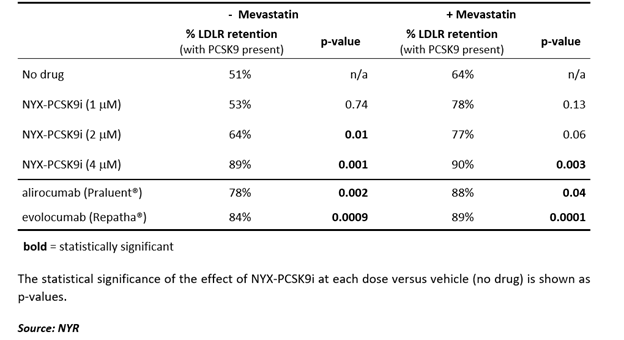
bold = statistically significant
LDL and PCSK9 within the Context of Human Health
LDL cholesterol, or “bad” cholesterol is a fatty, waxy substance produced in the liver. When excess levels are present in the bloodstream, LDL cholesterol can accumulate on the walls of arteries, thereby restricting blood flow and this can lead to heart attack and stroke. LDL cholesterol is cleared from circulation by binding to LDL receptors (LDLR) which are present on the surface of liver cells. However, during the process, PCSK9, a naturally occurring protein, binds to theses receptors leading to their degradation. Fewer LDL receptors causes higher circulating LDL cholesterol levels as the bodies capacity to remove it is reduced.
The mode of action of the Nyrada drug is the same as the monoclonal PCSK9 injectable drugs and that is by inhibiting the function of PCSK9, this leads to a beneficial increase in LDLR on the cells’ surface, which enhances the body’s ability to remove the LDL cholesterol from the bloodstream.