
 AUS
AUS
 NZ
NZ
 UK
UK
 CA
CA
 USA
USA
 IND
IND





Highlights
- Far East Gold shares rose 6.90% to AUD 0.155 following the release of new high-grade gold assay results.
- Drillhole KSD027 confirmed a 50-metre lateral extension of high-grade gold zones at the Sua Prospect.
- KSD027 returned multiple high-grade and bonanza-grade gold intervals.
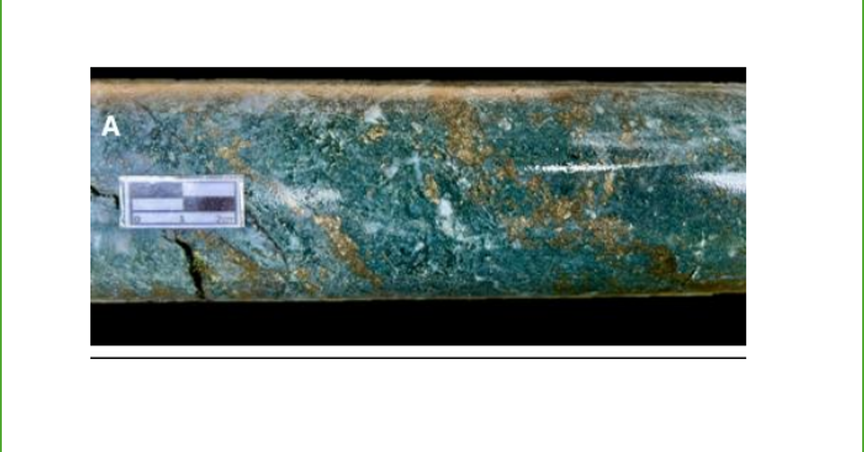
- All five FEG drillholes reported to date have intersected high-grade gold within stacked quartz–sulphide veins.
- Assay results are pending for five additional drillholes targeting extensions to the existing resource area.
- Further extension and infill drilling is planned to assess resource growth potential and upgrade the current resource classification.
Far East Gold Limited (ASX:FEG) shares rose 6.90% to AUD 0.155 on 12 January 2026, after the company announced new high-grade gold assay results from its ongoing diamond drilling campaign at the Idenburg Gold Project in Papua, Indonesia. The latest results were delivered from diamond drillhole KSD027 at the Sua Prospect, confirming a 50-metre lateral extension of the high-grade gold zones previously intersected in drillholes KSD025 and KSD026.
Encouraging Results from Step-Out Drilling
Drillhole KSD027, positioned 50m from holes KSD025 and KSD026, was designed to test extensions of the known quartz–sulphide vein system within the existing resource footprint. The hole delivered multiple high-grade and bonanza-grade gold intersections.
Significant intersections include-
- 55 g/t Au over 1.7m (from 14.4m), including 20.28 g/t Au over 0.7m (from 14.4m)
- 47 g/t Au over 4.85m (from 73.85m), including:
- 12 g/t Au over 3.85m (from 73.85m); and
- 93 g/t Au over 1.0m (from 74.5m); and
- 175 g/t Au over 0.55m (from 77.15m)
- 2 g/t Au over 0.5m (from 96.15m)
- 51 g/t Au over 0.80m (from 112.9m)
Consistency Across the Sua Prospect
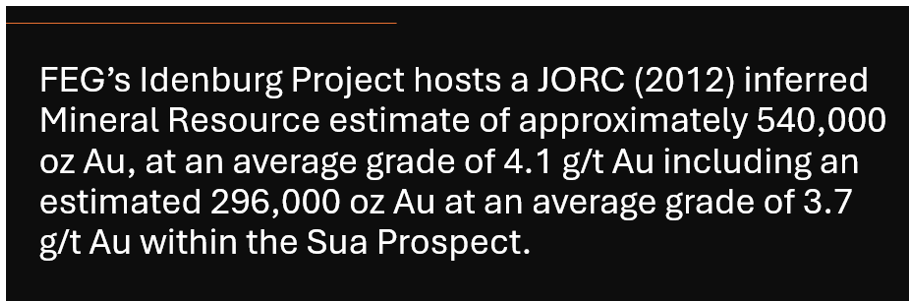
The Sua Prospect has consistently returned high-grade gold results throughout both historical and recent drilling. Of the 22 historic drillholes completed at Sua, 19 intersected gold mineralisation.
All five FEG drillholes reported to date, from KSD023 to KSD027, have intersected multiple stacked quartz–sulphide veins carrying high-grade gold.
Previously reported results included standout intercepts such as
- KSD023: 13.77 g/t Au over 9.8m (from 18.5m) including 131 g/t Au over 0.8m (from 24.5m)
- KSD024: 8.59 g/t Au over 35.5m (from 23.5m) including 252.50 g/t Au over 0.8m (from 24.5m)
- KSD025: 8.42 g/t Au over 7.7m (from 106.3m) including 35.29 g/t Au over 0.6m (from 111.7m)
- KSD026: 8.82 g/t Au over 4.5m (from 120m) including 51 g/t Au over 0.5m (from 122.5m)
Open-Ended Mineralisation with Growth Potential
Results from KSD027 are significant as the high-grade zones intersected were not previously identified in historic holes drilled on the same section. This demonstrates that weakly mineralised near-surface zones have the potential to host substantially higher gold grades at depth. The high-grade mineralisation remains open down-dip and along strike to the northeast.
Notably, the high gold grades are derived from mineralised zones that exhibit little to no supergene alteration and are associated with very low arsenic concentrations.
Drilling Program Advances Resource Understanding
KSD027 is the fifth hole from the company’s initial 10-hole diamond drilling program at Sua. To date, assays have been received for five holes, with results pending for the remaining five holes.
Based on the results, further drilling is planned to test extensions of the mineralised zones both down-dip and along strike, with the objective of evaluating the potential to increase the current Sua Mineral Resource estimate. In addition, an infill drilling program is being considered to upgrade the existing JORC inferred resource to an indicated classification.
Data source: Company update
