
 AUS
AUS
 NZ
NZ
 UK
UK
 CA
CA
 USA
USA
 IND
IND







Highlights
- CGN Resources has confirmed older geological ages at the Webb Project through new drilling analysis.
- Age-dating results align northern Webb rocks with the Lander Rock Formation.
- Revised interpretation has removed previously assumed younger cover in the northern. domain
- Findings elevate multiple second-tier targets within the exploration framework.
- The results reinforce the potential presence of both carbonatite and iron oxide copper-gold (IOCG) systems.
CGN Resources Limited (ASX:CGR) has reported new geochronological findings that are reshaping its understanding of the Webb Project, with results from the 2025 Kandula drilling program pointing to an older and potentially more prospective geological setting. The updated interpretation introduces a shift in how the northern portion of the project is viewed, with implications for upcoming exploration priorities.
Reframing the Geological Timeline
Age-dating conducted by Curtin University’s Curtin Frontier Institute for Geoscience Solutions indicates that lithologies in the northern Webb Project are significantly older than previously interpreted. Samples returned ages of approximately 1563 ± 52 million years for dolerite and up to 1828 ± 14 million years for sedimentary units.
These results place the rocks within a timeframe comparable to the Lander Rock Formation, which hosts known deposits such as Luni and Green. This alignment provides a revised geological context for the project area.
Shallower Basement, Higher Potential
The updated findings suggest that the previously assumed Neoproterozoic cover sequence in the northern domain is either minimal or absent. This indicates that prospective basement rocks may occur at shallower depths than earlier models suggested.
The change in interpretation has implications for exploration efficiency, as mineralisation—if present—could be more accessible. It also supports a broader reassessment of target prioritisation across the northern tenure.
Target Ranking Gains Momentum
While key high-ranking targets such as E1 and K1 remain central to the exploration strategy, the revised age framework has elevated several second-tier targets. Prospects including K7, K6 and E3 have moved higher within the company’s prioritisation framework for follow-up work.
The Kandula and Elmar prospects are interpreted to lie along major structural flexures, which are typically associated with favourable conditions for mineralisation.
Mineral System Implications
The results reinforce the potential presence of both carbonatite and iron oxide copper-gold (IOCG) systems. These mineral systems are commonly linked to deep-seated structural features and long-lived geological histories, which are now better supported by the revised age data.
The older geological setting also suggests a more extensive magmatic and structural evolution, increasing the likelihood of large-scale mineral system development and preservation.
Exploration Pathway Ahead
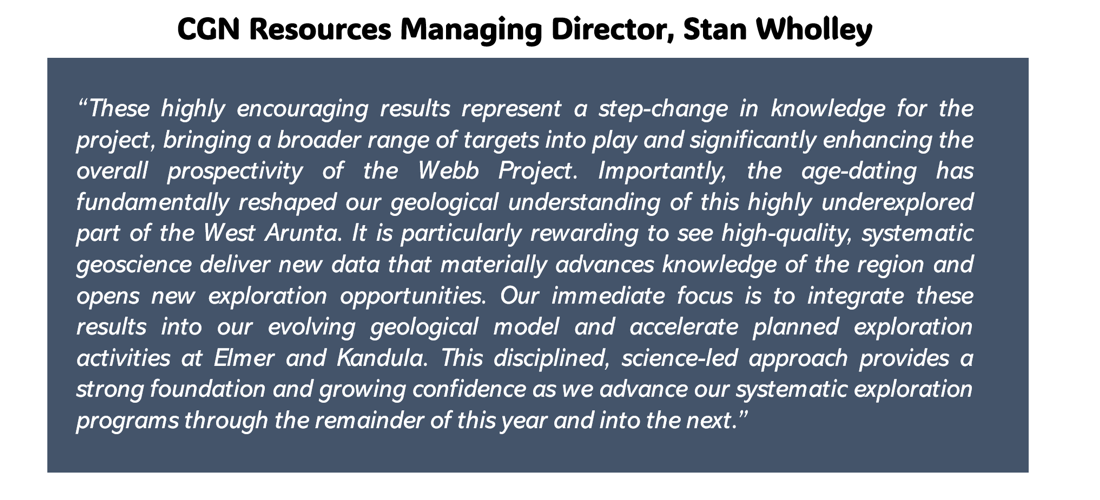
With heritage clearance already completed across key target areas, CGN Resources looks forward to advance systematic exploration across the Webb Project.
The age-dating program, based on U-Pb analysis of zircon and apatite from three drill core samples, indicates sedimentation between approximately 1728 million and 1576 million years ago, followed by metamorphism associated with dolerite emplacement.
These findings contribute to a refined exploration model and support further testing of both primary and newly elevated targets across the northern Webb Project.
Shares of CGR last traded at AUD 0.064 on 28 April 2026.
