
 AUS
AUS
 NZ
NZ
 UK
UK
 CA
CA
 USA
USA
 IND
IND


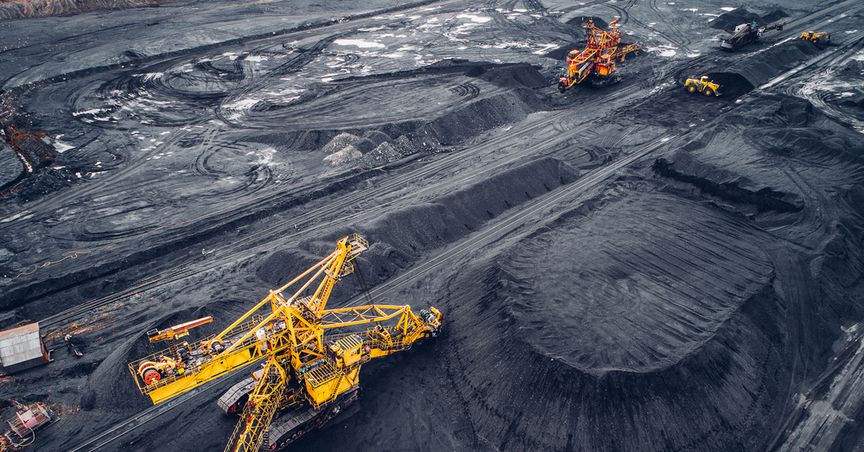


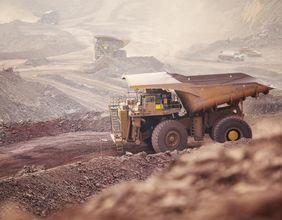

After an 80 per cent tariff hike on barley, China is now back with more stringent policies concerning the top-most exported commodities from Australia, i.e., iron ore and coal. In the status quo, Beijing custom department announced a change in inspection regime for the Australian iron ore, which would allow China’s custom to inspect iron ore at the request of the trader or importer, effective from 1 July 2020.
Likewise, there has been noise around reports citing that the Chinese government is warning the state-owned power plant to put a hiatus on new thermal coal shipments from Australia and should support local products.
China’s Policy Alteration and Australia’s Response
China is the world’s largest importer of iron ore due to its ever-growing steel industry on both the consumption and supply front. The Australian iron ore exports to China account for about 62 per cent of the overall Chinese demand, and during the first four-month of the year 2020, China has imported ~ 358.4 million tonnes of iron ore amid growing demand from steelmakers.
Recently, there has been a lot of noise around the rising trade tension between China and Australia, and while that is being flashed on local media, many independent analysts suggested that the policy would not harm the iron ore industry as such, but it would depend upon how the Chinese custom would use and implement the policy ahead.
Furthermore, while Chinese media is flagging the possibility of a trade spat between both nations, the local mining community and the federal government is denying that there could be a serious threat to the iron ore industry from the newly suggested inspection regime.
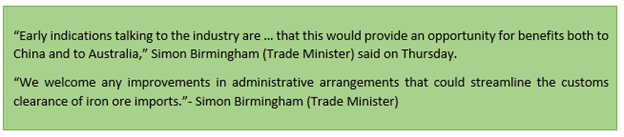
While Chinese authorities cited that the new system, which would now replace the old regime of custom officers conducting a mandatory on-site inspection for every batch of iron ore, is designed to fast track the customs clearance, the Australian miners suggest that the new inspection regime would streamline shipments and is a positive development.
- Response from Aussie Iron Ore Miners
The ASX-listed iron ore behemoth BHP Group Limited (ASX:BHP) suggested that the Company welcomes the new inspection regime, citing the fact that the Chinese customs department had communicated the possibility of a change in policies previously.
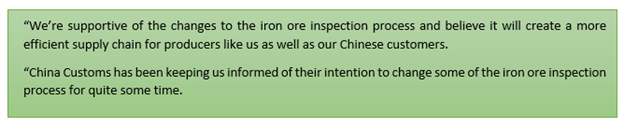
Other miners like Fortescue Metals Group Limited (ASX:FMG) also welcomed the new inspection regime citing that the Company is committed to meet the need of customers and follow the new inspection regime.
Also Read: FMG contours New Record High While ASX-Listed Iron Ore Titans BHP and Rio See Gap Up Session
Amidst of all the noise around the new inspection regime, the market anticipates that it would further fuel the supply concern, which in turn, is now supporting iron ore prices across China with prices of iron ore futures on the Dalian Commodity Exchange (or DCE) rising from RMB 627.50 (intraday low on 12 May 2020) to the present high of RMB 714.00 (as on 21 May 2020), which marks a price gain of ~ 13.78 per cent.
To Know More, Do Read: Iron Ore Futures At 15-Week High, FMG Hits All time High- ASX Iron Ore Stocks on Upswing
While the new inspection regime is anticipated by the mining community and the trade minister to streamline the Australian supply further, tight policies concerning the coal import across China could potentially impact the coal industry.
Suggested Read: Australia Diverting Coal To Emerging Asia While China’s Coal Import Policies Cracking Down on ASX Coal Stocks
China exerts a profound influence on the seaborne market amid its large coal consumption and import. The thermal coal consumption in China since falling between 2014 to 2016, have risen for a third straight year in 2019.
The growing energy demand had prompted China to import 241 million tonnes of thermal coal in 2019, which remained 5 per cent up against the previous year.
However, many independent forecasters anticipate the thermal coal across China to gradually decline to reach at 218 million tonnes in 2025, while coal usage is expected to rise over the next two years amid an increase in coal-fired power generation to meet the growing energy need.
China’s government has actively looking to manage coal import levels over the past few years. This is on back of its efforts to streamline its domestic coal industry led to local miners contending that imports were being encouraged over local production.
The Department of Industry, Innovation and Science (or DIIS) anticipates that China has been reportedly sought to cap the coal imports at around 280 million tonnes in 2019 while extending customs clearance times for vessels across its ports and is also expected to keep the overall import in that range.
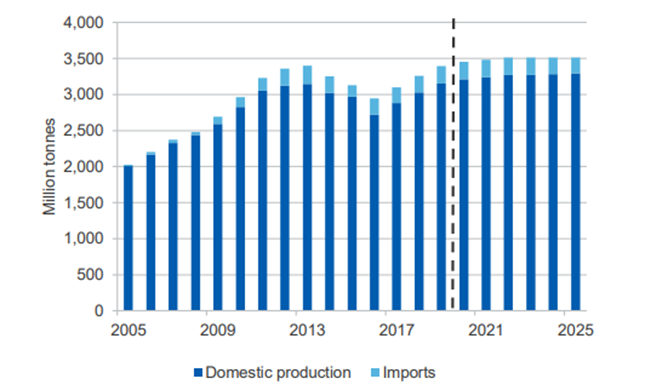
China’s thermal coal production and imports (Source: DIIS)
Many analysts also anticipate that thermal coal consumption in China could reach 1.9 billion tonnes from July 2020 to December 2020.
On the metallurgical coal counter, the coal import surged by 14 per cent to stand at 75 million tonnes in 2019 in the wake of falling seaborne prices; however, imports declined sharply towards the end of the year as policymakers tightened import restrictions to limit total coal imports to the 300 million tonne mark.
Suggested Read: Need Dividend from Mining Stocks? Coal Miners Well Positioned to meet your Dividend needs
In the status quo, the Deputy PM- Michael McCormack has expressed concern over the report that the Chinese government is suggesting the state-owned power generators to use the domestic coal.
