
 AUS
AUS
 NZ
NZ
 UK
UK
 CA
CA
 USA
USA
 IND
IND








Splitit Payments Ltd (ASX:SPT) is a payment solution company and has lately emerged as a competitor to fintechs like Afterpay etc., as it provides credit based banking solutions to businesses and merchants. It has its operations in 27 countries including Australia. The company has recently been listed on the ASX on 29th January 2019 after an oversubscribed Initial Public Offering of A$12 million via the issue of 60M shares at AUD$0.20 each.
Due to the oversubscription many investors were not able to get their hands on the allotment of the shares of the company. This was evidently seen in the first 7-8 trading days of listing. The stock listed at A$0.30 which is already 50% up from the issue price of A$0.20 and started staying at a level close to A$0.38. Clearly huge demand for shares started from the first day of listing which took the prices to an unexpected level of A$0.99 (at the peak) within a few days, and this led to a massive gain of more than 230% from the listing price and an eye-opening return of more than 390% from the issue price.
After this sharp rally in a short span of time, the stock has been consolidating in a range as expected and this generally is considered to be healthy for the existing trend. The reason being when this kind of price movement happens in a very short duration, everybody gets invested in the stock and on the contrary that leaves more potential sellers in the market than buyers, resulting in a temporary decline or consolidation in the trend as seen with SPT. After making a high of A$0.99, the stock fell to A$0.75 â A$0.70 levels. The decline to these levels was not as sharp as the rise, indicating still buying in coming from the lower levels.
Another aspect of this steady decline was the volume generated in this period. As clearly seen on the chart with the decrease in the price, the volume is also declining and that is another positive factor for the stock. The average volume on the first 8 trading days after listing (till the stock made its highest high) was around 24 million. But after that, in the declining stage the volume dropped significantly below 6.5 million. Any trend with declining volume is generally not sustainable because that indicates a lower participation from the investors and has a decent probability of reversing the trend.
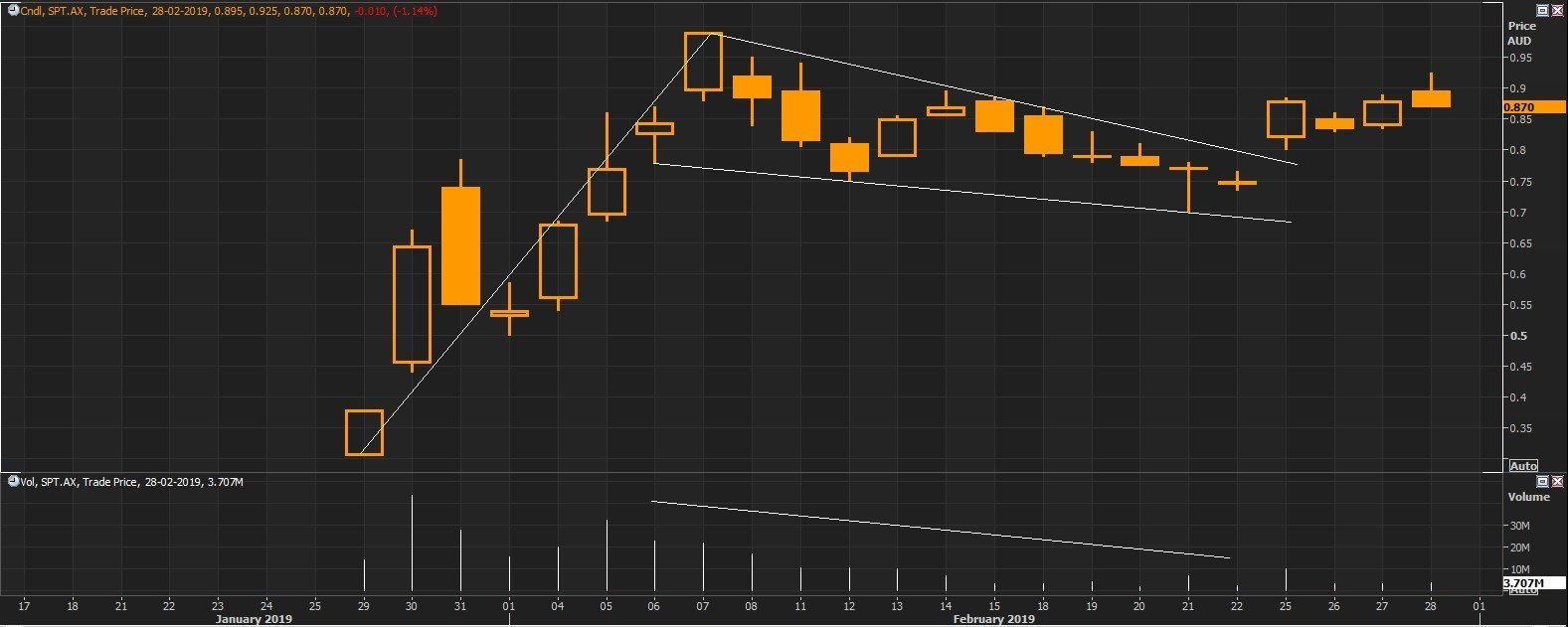 SPT Daily Chart (Source: Thomson Reuters)
A broader view on the stock, indicated for a formation of âBullish Pennantâ price pattern on its daily chart. Bullish pennant is a continuation pattern (as it continues the primary trend), which is formed after a sharp rally which is then followed by a steady decline. This decline is not as sharp as the prior rally and the price bounces off between the two converging trendlines acting as support (lower trendline) and resistance (upper trendline). This decline finally leads to a breakout above the upper trendline which marks the continuation of prior rally. As clearly seen here, on 25th February when the company announced that it has appointed Andrew Pipolo to lead growth strategy in Australian and Asia Pacific regions, the stock surged more than 17% and finally broke the upper resistance which may take the stock to all time levels to an estimated target of A$1.6 â A$1.7 (according to the Bullish Pennant price pattern). This view will be negated if the follow up buying is not generated from existing levels and the stock falls below the nearest support level around A$0.70.
As of 28th February 2019, the stock traded at A$0.87, down by 1.14% from the previous closing of A$0.88.
The trends as of now indicate that SPT is a crucial watch and might be gearing up for a different league altogether.
Disclaimer
This website is a service of Kalkine Media Pty. Ltd. A.C.N. 629 651 672. The website has been prepared for informational purposes only and is not intended to be used as a complete source of information on any particular company. Kalkine Media does not in any way endorse or recommend individuals, products or services that may be discussed on this site. Our publications are NOT a solicitation or recommendation to buy, sell or hold. We are neither licensed nor qualified to provide investment advice.
