
 AUS
AUS
 NZ
NZ
 UK
UK
 CA
CA
 USA
USA
 IND
IND





_07_27_2026_01_21_40_931556.jpg)


Summary
- Global Economies anticipates accelerated transition to cleaner energy sources
- Multi-fold demand increase expected while supply side needs to be strengthened to feed Ethical Cobalt
- Battery manufacturers wary of Cobalt’s supply dependence on DRC, seek other major suppliers
- Corazon’s Mt Gilmore holds the potential for a district scale Cu -Co-Au mineralisation
World Bank Group anticipates a massive global transition to renewable energy sources, the switching to cleaner energy sources requires a supply boost for critical minerals including cobalt, lithium and graphite by as much as 500% to achieve a below 2°C future by 2050.
Cobalt is a critical material essential for the world’s much-anticipated transition to renewable power. Currently, The Democratic Republic of the Congo, a country under widespread civil unrest produces over 60% of the global cobalt supply.
Most of the supply from this African nation is highly non-regulated and occurs through artisanal mining. While artisanal mining promotes the local communities to earn their livelihood by extracting Cobalt from their lands, it does not enforce any health and safety protocols to save the lives of these local inhabitants.
Ethical Cobalt, Call of the Time
While the end users of Cobalt, the Battery industry remains unaware of the exact sources, they have still been held accountable for it. Alphabet, Apple, Tesla, Dell and Microsoft are among a few major technology players who had been sued for the health and safety incidents relating to the unfortunate accidents involving child labourers in some of these cobalt mining operations.
Now, the consumer electronics, smartphones, battery and EV manufacturers are encouraging on sourcing clean cobalt from reliable mining sources, therefore calling out for increased supply for sustainable and ethical cobalt. As per the IEA’s 2DS (2-degree scenario), supply for cobalt is expected to surge by almost 460% against the 2018 levels by the year 2050 to meet the burgeoning demand.
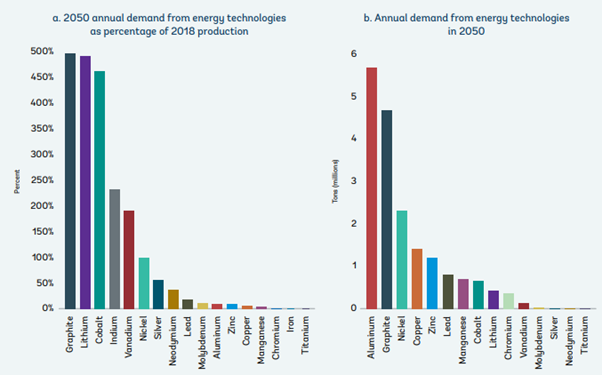
Source: World Bank
Cobalt players that have a sustainable and ethical cobalt development road map and are well positioned to cater to the demand needs are under the spotlight, and one such focused metals explorer is Corazon Mining Limited.
Corazon advancing on the Sustainable and Ethical Cobalt Path
Corazon Mining Ltd (ASX:CZN) is a diversified metals explorer holding key Nickel and Cobalt primary projects in the Tier 1 jurisdictions. The Battery metals projects includes the Lynn lake Nickel-Copper-Cobalt Sulphide project in Manitoba, Canada and Mount Gilmore Cobalt-Copper-Gold project in NSW Australia.
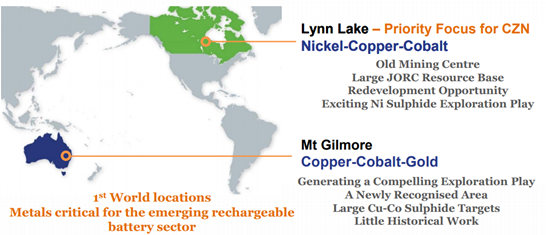
Source: Corazon Mining
Mount Gilmore Cobalt Indicates Signs of Massive Cobalt Mineralisation
The Mount Gilmore Cobalt project targets large Co-Cu sulphide mineralisation in the mining friendly neighbourhood of the New South Wales. Corazon owns an 80% stake in the project with multiple copper-cobalt geological anomalies. Corazon earned the 80% stake by completing an investment of $2 million in the project’s exploration within 3 years of the agreement and has been committed to the exploration activities through sole funding.
The historic exploration at the Mt Gilmore is focused on the exceptionally high-grade Cobalt sulphide deposit, the Cobalt Ridge prospect.
The pressure oxidation method has emerged as the most preferred processing method so far. High quality separate Copper and Cobalt products were produced enabling the products to be used for battery production. The separate products also enable cost efficiency with substantial savings on treatment and refining, therefore optimising the operating expenses.
The exploration program at the project site targets the prospective 22 kilometres long Mount Gilmore trend which revealed a bulk Cu-Co-Ag-Au geochemical trend which holds the potential to hold a district-scale mineralisation zone of Cu-Co-Au intrusions.
Geophysical Targets Identified Below Large Surface Geochemical anomalies
The preliminary results from the Induced Polarisation (IP) survey at the Cu-Co-Ag soil anomalies indicated presence of a bulk underground sulphide mineralisation. IP survey is typically used to identify the sulphide targets by passage of a transient electric current underground and observing the magnetic properties soon after. IP surveying is an advanced exploration technique and has been used for successful identification of sulphide deposits in the New South Wales.
The identified anomalies lie adjacent to Corazon’s previously identified high-grade copper mineralisation structures. The Gordonbrook Hill (GBH) targets encompasses the best IP anomaly indicating moderate changeability anomalism over an area with diameter of a kilometre. Additionally, the rock chip samples from the mapped leakage structures at the GBH resulted in grades of up to 16.3% copper, 1,250 ppm cobalt and 1.29 g/t gold strengthening the prospect of the targeted area.
Corazon would continue to advance on the Mount Gilmore and Lynn Lake projects to ensure stable, reliant, and ethical supply of battery metals in future.
Corazon closed at $0.002 a share on 5 June 2020, with a market capitalisation of $4.82 million.
All financial information in Australian dollars, unless stated otherwise
