
 AUS
AUS
 NZ
NZ
 UK
UK
 CA
CA
 USA
USA
 IND
IND







Summary
- Japan’s Toyota Motor and Nissan Motor have asked the UK government to cover the 10 per cent duty in case Britain fails to reach an FTA with the EU
- This would increase the pressure on PM Boris Johnson prior to the upcoming summit with the EU leaders scheduled for 15 October 2020.
- According to SMMT estimates, the increased tariffs would cost automakers an additional outlay of £4.5 billion per year.
Japanese automobile majors Toyota Motor and Nissan Motor have asked the UK government to cover the extra 10 per cent tariff in case the country fails to secure a free trade agreement (FTA) with the European Union (EU).
According to sources, the automakers are fearing that the EU might impose an extra 10 per cent tax on automobile imports if the UK's transition period of leaving the bloc ends without a trade pact.
This would mean that PM Boris Johnson will be under pressure for the upcoming summit with EU leaders scheduled for 15 October. On 4 October, Johnson had said though he was not keen on the Brexit transition period, which is till December, to run out without a trade deal in place, but if it happens, Britain can live with the outcome.
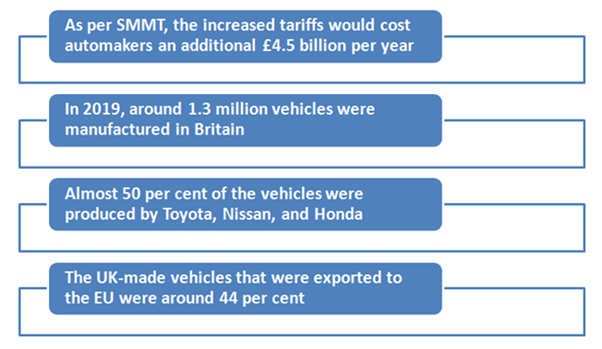
According to the Society of Motor Manufacturers and Traders (SMMT), the increased tariffs would result in additional £4.5 billion cost to the automobile companies every year. It would be tough for these firms to meet the increased tariffs if the UK government does not agree to cover it. If the government’s refusal to cover these tariffs could cause foreign carmakers to quit from Britain as it would erode their profit margins to a greater extent.
While Toyota has a plant in Derbyshire, central England, which builds Corolla and the Suzuki Swace. It also has a factory in Wales, which produces automobile engines. Nissan’s manufacturing unit is in Sunderland, north-eastern England, produces Qashqai, Juke and Leaf and employs around 7,000 workers. It is to be noted that in 2019, around 1.3 million vehicles were manufactured in Britain. Almost 50 per cent of these vehicles were produced by Japanese companies, including Toyota, Nissan, and Honda. The UK-made vehicles that were exported to the EU were around 44 per cent.
Also read: SMMT’s “Safe Harbor Scheme” To Secure Auto Industry Supply Chains Ahead of EU Pullout
Also read: Car Finance Applications Rise During July And August- Stocks of AUTO and LOOK in Focus
Tough situation for auto companies
It would become tough for Toyota and Nissan to accommodate the likely increase in tariffs by cutting costs as their profit limits are expected to be in a tapered range. If the rise in tariffs gets reflected in prices, the two Japanese carmakers would become less competitive in the EU market. Also in such a situation, it would be difficult for them to continue with their production.
During early last year in 2019, Toyota had indicated on withdrawing its business from Britain if it has to face the challenge of paying 10 per cent tariffs. In October 2019, an executive from Nissan said that its business model in Europe would be at risk. Honda Motor also cited similar issues and is likely to end production at its British unit in 2021.
Other major automobile companies, like BMW from Germany and Jaguar Land Rover (subsidiary of Indian automotive company, Tata Motors), have echoed similar concerns.
German automobile major BMW that produces its Mini brand in the UK facility said in 2019 that it would continue to operate in Britain if it reaches an agreement with the EU to keep the tariff rate within five per cent. However, BMW officials denied commenting on any such development.
What does the British government want?
The British government has been saying that it would focus on reaching an FTA during talks with the EU. A government spokesperson has said that it is dedicated towards working with the automobile industry for guaranteeing an outcome that would reflect business interests across the country. The UK has maintained that it aims for a zero tariff and zero quota FTA as avoiding duties would be beneficial for both Britain and the UK.
In case, the UK fails to secure a suitable agreement with the EU, it would not be easy for it to cover the increased tariffs, given the present economic crisis because of the coronavirus pandemic. If the British government initiates a bailout measure for the automobile industry it might invite criticism from pharmaceuticals and airline industries.
It is important to note that these industries had asked for government support when the UK agreed to leave the EU. It is likely that the EU would not compromise on the tariff rules in this regard. If the talks fail to conclude without a favourable outcome, the UK would be compelled to take a decision by end of 2020 if it would take on the extra burden of the increased tariffs.
Conclusion
Depending on the British government’s decision, car manufacturers and allied businesses would be forced to consider either scaling down or closing their operations in the country. Experts described the demand from automobile companies for compensation as strange. Reimbursement would be the same as a subsidy and amount to carmakers doing business in Britain receiving trade preferences, a probable violation of rules made by the World Trade Organisation.
The strong standpoint of the automobile companies in asking for compensation if Britain fails to reach an FTA, could likely transform into aid policies for the manufacturing industry. This could potentially consolidate automobile testing certification for exports to the EU and reduce the taxes for investments made in activities concerned with research and development.
