
 AUS
AUS
 NZ
NZ
 UK
UK
 CA
CA
 USA
USA
 IND
IND







Highlights
- Transport secretary Grant Shapps has stated that flight slots should be used for at least 70 per cent of the time starting from 27 March.
- Prior to the pandemic, the usual level was 80 per cent which airlines had to maintain to retain their slots in the next year.
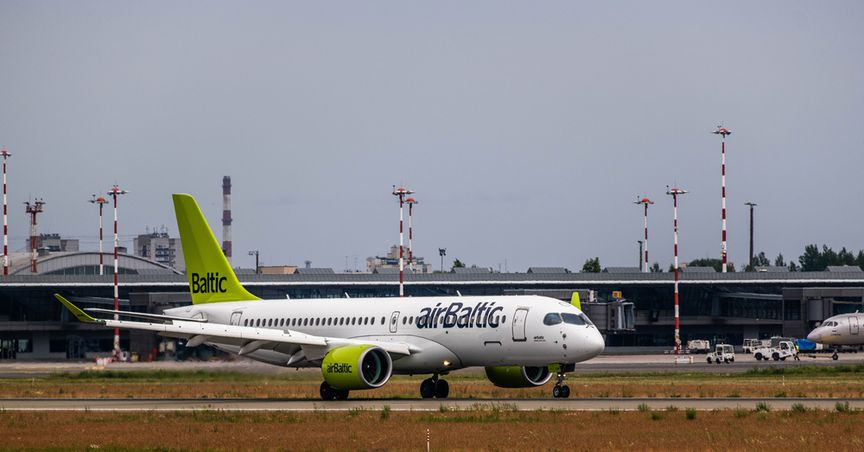
Airlines in the UK must increase the minimum number of flights, for them to keep their flight slots at major UK airports.
UK’s transport secretary, Grant Shapps, stated flight slots should be used at least 70 per cent of the time starting from 27 March. Shapps added that this increase would help balance the needs of different areas of the sector amid its recovery from the pandemic.
This is higher than the current requirement of 50 per cent, which had been put into effect during the covid-19 crisis to avoid airlines from bleeding cash from operating empty flights (also known as ghost flights) to retain flight slots.
Prior to the pandemic, the usual level was 80 per cent which airlines had to maintain to retain their slots in the next year.
Thus, this move of extending slot rules indicates a step towards normal rules, which can aid in the sector’s recovery and growth.
Given this development, let us look at 2 FTSE listed airline stocks and explore their investment prospects:
- International Consolidated Airlines Group S.A. (LON: IAG)
FTSE 100 index listed group, International Consolidated Airlines Group is a multinational airline which owns British Airways and other airlines.
British Airways (BA) was among one of the airlines (along with another airline Virgin Atlantic) which had benefitted from the reduction of slot rules during the pandemic as both BA and Virgin both were able to retain their Gatwick airport rights even though they had reduced flights operating from the airport.
IAG Q3 passenger capacity was at 43.4 per cent of its pre-pandemic levels seen in 2019. Its Q4 goals for passenger capacity plans are about 60 per cent of pre-pandemic levels.
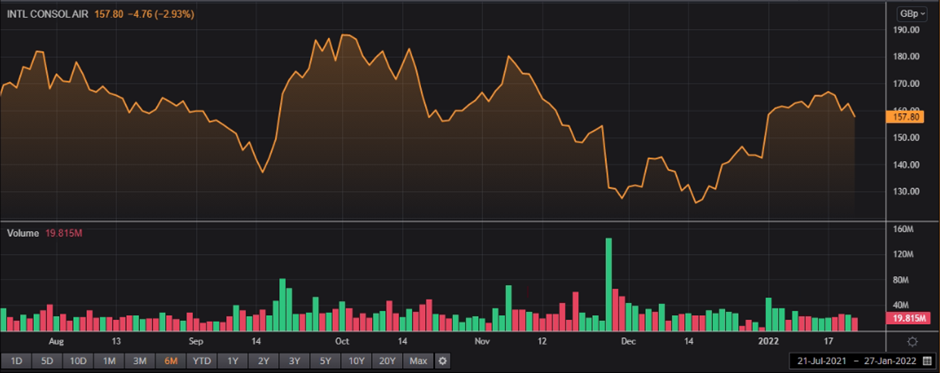
Image source: EODHD/Others
IAG’s shares closed at GBX 157.80, down by 4.76 points or 2.93 per cent on 21 January. The FTSE 100 index ended at 7,494.13, down by 90.88 points or 1.20 per cent.
The group’s market cap was at £7,828.97 million, and it has given shareholders a one-year return of 4.09 per cent as of 21 January.
- Wizz Air Holdings PLC (LON: WIZZ)
Wizz Air is a low-cost airline that is part of the FTSE 250 index.
The reduction of slot rules had left Wizz Air, and other airlines (such as recently LSE delisted group Ryanair) frustrated as it had curbed their expansion goals. This extension will thus help the airlines and airports which had earlier been stifled by the easing of slot rules.
Wizz Air is set to report its Q3 results later this week on 26 January.
It had recently issued a EUR 500 million 1.00 per cent bond due in 2026. The proceeds are intended to be used for general purposes, which includes the repayment of its £300 million CCFF facility in the month of February.
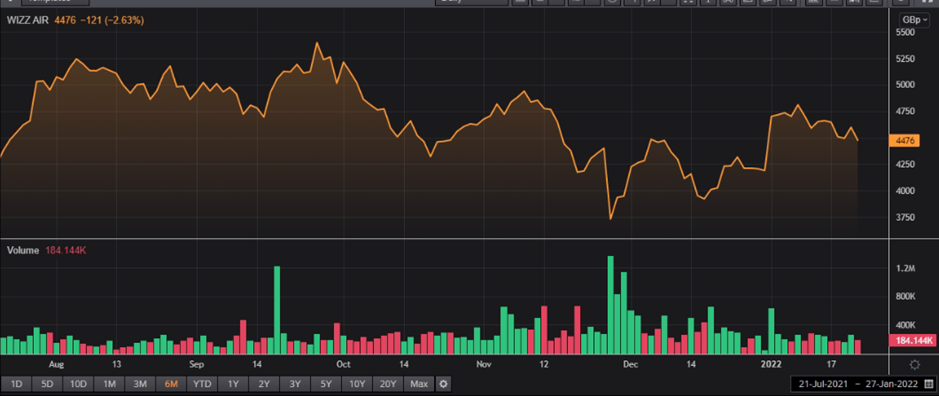
Image source: EODHD/Others
Wizz’s shares closed at GBX 4,476.00, lower by 121.00 points or 2.63 per cent on 21 January. The FTSE 250 index ended at 22,263.24, lower by 451.76 points or 1.99 per cent.
The group’s market cap was at £4,613.50 million, and it has given shareholders a one-year return of 4.63 per cent as of 21 January.
