
 AUS
AUS
 NZ
NZ
 UK
UK
 CA
CA
 USA
USA
 IND
IND






Summary
- Crude oil market has been under immense pressure since the onset of pandemic and global oversupply situations.
- Oil majors like Exxon Mobil have experienced significant reductions in revenue and production amidst the challenging environment.
- BP, another major oil player, has onboarded the journey towards a carbon neutral future, given the growing competition from renewable energy and climate change norms and regulations.
Saudi Arabia, the world’s largest crude oil producer, has been supplying crude oil at a price lower than international prices to China in order to capture higher market share. However, the market situation changed as China ran out of space to store crude oil. Consequently, oil prices fell in the first week of September.
Last month in August, ICE Brent front month rose by 4.2% to $45.02 per barrel and NYMEX WTI registered a rise of 4% to $42.39 per barrel. On a year-to-date basis, ICE Brent traded 34.5% lower and NYMEX WTI went down by 33.4% compared to same period of 2019.
Fund managers including hedge funds remained cautious during the last month and had no clear positional call amid uncertain global outlook during the pandemic. Vaccines are still under trials and cases are increasing. All these factors have put a lot of pressure on new investments in the oil & gas sector. The futures market in August remained flat amid reduced numbers of lots and contracts.
Exxon Mobil Corporation (NYSE: XOM) - Exxon Mobil is one of the largest publicly traded energy providers and chemical manufacturers in the world. The company is engaged in developing and applying next-generation technologies to aid in safely and responsibly meeting the increasing needs for high-quality chemical products and energy on a global level.
In Q2, Exxon Mobil reported a loss of 70 cents per share, owing to global oversupply and pandemic conditions. Revenue reached $32.6 billion (~53% lower on YOY basis) and production fell to 3.6 million barrels of oil equivalent per day, 7% lower when compared with same period a year ago.
Exxon Mobil has slashed its planned investment by $10 billion for the current year. Moreover, the company has planned job cuts and other spending cuts in order to maintain dividends. Recently, it announced a voluntary lay-off program in Australia.
Reportedly, the company plans to conclude a review on workforce reduction this summer and announce the results in the fall.
Exxon Mobil Shale Operations - As the demand for U.S. shale shrinks, many companies have been forced to shut operations and sell their assets to oil majors.
In 2017, Exxon invested nearly $5.6 billion in a deal to double its oil & gas holdings in the Permian Basin. Last year in 2019, the company announced plans to produce more than 1 million barrels of oil equivalent from the Permian Basin by 2024. The figure represented nearly 80% rise in production.
Additionally, in 2019, Exxon unveiled plans to sell assets in Europe, Africa and Asia, which could fetch nearly $25 billion to support the Permian Basin and other major projects. However, rig count is falling in the Permian basin and may fall further by the year end.
BP plc (LON:BP) - Like other oil majors, BP has also been hit hard by the pandemic and price war between Saudi Arabia and Russia.
In the first quarter, the company reported a fall of 67% in profits compared to the same period last year. The profits stood at $800 million compared to $2.4 billion in Q1 of previous year. Operating cash flow for the period reached $1.2 billion.
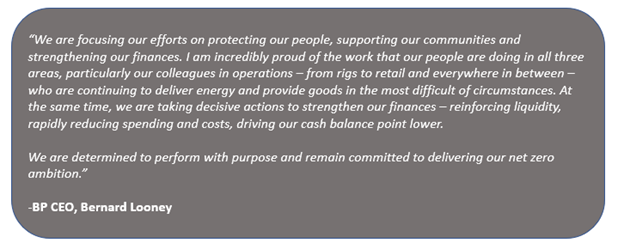
BP Energy Transition - The ongoing oil price crisis has raised many questions on the sustainability of crude oil business models. The sector is already facing competition from renewable energy and climate change norms and regulations.
BP has started working on decreasing carbon footprints and become a carbon neutral company by 2050. The company is planning to invest more in renewable energy than fossil fuels to achieve its target.
Few initiatives for the near term:
- BP is strengthening its balance sheet. The company signed a new $10 billion revolving credit facility in March 2020 and raised around $7 billion of new bonds across the US and European debt markets in April 2020.
- BP is reducing capital expenditure and has slashed group capital expenditure guidance by ~25% to $12 billion for 2020.
- BP is expecting to save cash costs of around $2.5 billion by 2021.
- The company has reconfirmed commitment towards finalising the sale of Alaska business to Hilcorp in 2020. It is in early stage discussions to sell about 10% stake in a key gas field in Oman. This will be in line with the disinvestment plan worth $15 billion by mid of 2021.
Conclusion
Keeping these factors in mind, the supply end of the market seems to be adjusting to the new normal as the world waits for the reviewal of demand. Crude oil prices could be range bound in the near to long term, provided no geopolitical situation arises in the Middle East. The COVID-19 situation is going to change the way industry has been taking bold decisions and risks of developing “difficult oil’. The deeper offshore and intensive costly projects would be delayed or may be ended.
