
 AUS
AUS
 NZ
NZ
 UK
UK
 CA
CA
 USA
USA
 IND
IND







Summary
- Though the S&P/TSX communication index shows a 10.47 per cent year-to-date decline, telecom stocks have been in much demand among investors.
- TELUS Corporation (TSX:T) and Rogers Communications Inc (TSX:RCI) have launched their 5G networks across Canada this year.
- A report by International Data Corporation says the telecom industry is among the ‘resilient’ sectors in the global economy in the face of the pandemic.
The telecommunication industry has been a support system for everyone throughout the pandemic, providing connectivity in times when stepping out and traveling were strictly discouraged. The introduction of fifth generation (5G) networks in Canada has further heightened its demand. As companies invest and launch 5G connectivity across Canada, stocks of TELUS Corporation (TSX:T) and Rogers Communications Inc (TSX:RCI) have been popular among investors.
The TSX Composite Index Communication Services has declined by 10.47 per cent year-to-date but is up marginally quarter-to-date. A recent research by the International Data Corporation (IDC) found that the telecom industry was among the most resilient industries during the coronavirus crisis. However, it predicted a 1.4 per cent year-over-year decrease in the global spending on telecom services in 2020, and an eventually fall in revenues for the sector due to the current economic downturns.
TELUS Corporation (TSX:T)
One of Canada’s top wireless services providers, TELUS Corporation announced the roll-out of its first wave 5G network in June 2020. It started off with Vancouver, Calgary, Montreal, Edmonton and Toronto, with plans of expanding further by the end of the year. Along with the launch announcement in June, the company committed to invest C$ 40 billion in its 5G network rollout over the next three years.
On September 23, TELUS said that it was named the fastest network in the world by UK-based mobile analytics company Opensignal. The company also announced that it will provide TELUS’ 5G connectivity to about 50 communities across Canada by the year-end.
TELUS STOCK PERFORMANCE
TELUS shares saw a decline of nearly seven per cent this year. But since its March lows of C$ 19.93 (March 24), its stock price climbed about 18 per cent in six month’s time. In the last three months, it recorded an increase of nearly three per cent.
The C$ 30-billion market cap company has a 10-day average trading volume of 2.2 million.
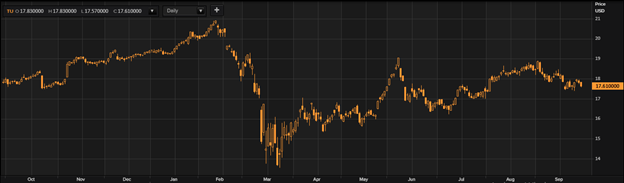
(Telus’ one-year price chart / Source: Thompson Reuters)
TELUS FINANCIAL RESULTS
TELUS posted a 3.6 per cent year-over-year (YoY) increase in its operating revenue, amounting to C$ 3.7 billion, in its second quarter ending 30 June. Its adjusted EBITDA was C$ 1.3 billion in the latest quarter, down 2.9 per cent YoY.
Its net income stood at C$ 315 million in Q2 2020, a 39.4 per cent decrease from C$ 520 million in Q2 2019. The telecommunication company noted that it endured financial impacts amid the pandemic majorly from lower wireless roaming revenue.
Rogers Communications Inc (TSX:RCI)
Rogers Communications Inc introduced its 5G mobile network in Canada in January this year. In September, it announced plans of expanding its 5G connectivity to over 60 new locations across the country by the end of the year.
RCI STOCK PERFORMANCE
Shares of Rogers Communications plummeted to C$ 47.27 (March 24) when the markets tanked amid the coronavirus pandemic. Its scrips rebounded sharply around April but gradually declined, recording a decrease of 18 per cent YTD.
Rogers Communications’ stock price fell 10 per cent in the last six months and over three per cent in three months.
Despite its recent stock movements, the Canadian telecom company has been popular among investors during the COVID-19 times. In the last 10 days, it saw an average share trading volume of over one million.
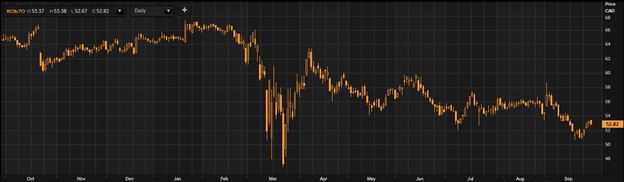
(Roger’s one-year price chart / Source: Thompson Reuters)
RCI FINANCIAL RESULTS
The economic pressures of the pandemic impacted Rogers Communications’ second quarter ending 30 June 2020, which recorded a 17 per cent YoY drop in its total revenue. Its adjusted net income of C$ 310 million in Q2 2020 was down 48 per cent from C$ 597 million in Q2 2019. The adjusted EBITDA in the latest quarter, amounting to C$ 1.2 billion, saw a 21 per cent YoY decline.
The C$ 20.8-billion company posted a liquidity position of C$ 5.4 billion in Q2 2020. Its free cash flow stood at C$ 468 million, which included increased bad debt provision worth C$ 90 million in the latest quarter.
