
 AUS
AUS
 NZ
NZ
 UK
UK
 CA
CA
 USA
USA
 IND
IND


.png)





As expected, the oil crisis continues to play a role in Canada's economy. Despite a good performance in the energy sector and decent performances in the financial and industrial sectors, the TSX Composite Index fell on Wednesday, September 29, mild though it was.
The base metal sector fell nearly 0.3 per cent and the Agnico Eagle Mines and Kirkland Lake Gold merger perhaps had something to do with it. Energy grew over one percent but the continuing fall of the information technology sector does raise questions about a correction but it can’t be said that the writing is on the wall. Speaking of consecutive falls, the healthcare sector dropped 1.56 per cent which led the Composite Index to fall by just 16 points or 0.079 per cent to 20,158.14.
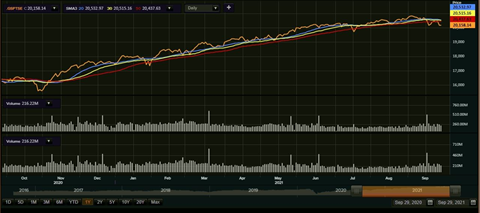
One-year price chart (as on September 29). Analysis by Kalkine Group
Volume active
The Bank of Nova Scotia was the most traded stock where 15.3 million exchanged hands. It was followed by Bombardier Inc where 8.42 million shares exchanged hands and Baytex Energy Corp. where nearly 8.04 million shares were traded.
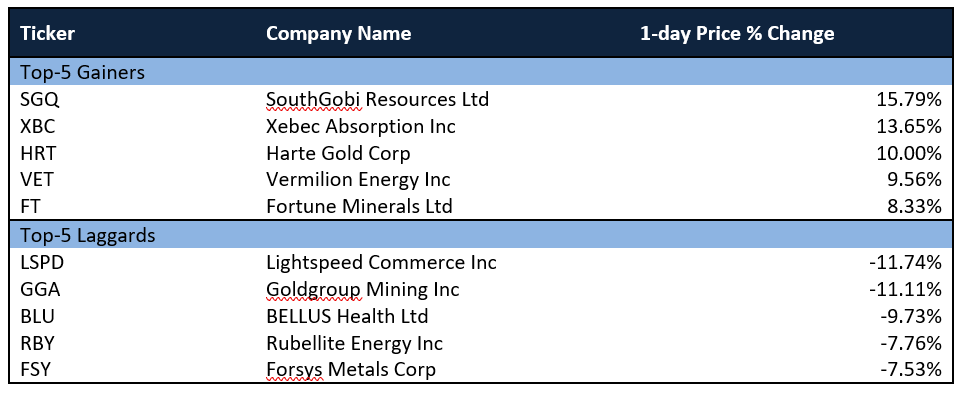
Movers and laggards
Wall Street update
Equities had ups and downs during Wednesday’s trading. The main indices took off in the morning only to plummet by late afternoon before rallying in the evening and then subsiding before the day’s close.
Nonetheless, the Dow Jones Industrial Average rose 90.73 points to 34390.72 or 0.26 per cent, and the S&P 500 gained 6.83 points, or 0.16% per cent to reach 4359.46. The Nasdaq fell 34.24 points to 14512.44, or 0.24 per cent.
Commodity update
Gold traded at US$ $1744.9, up 0.45 per cent. Brent oil fell 0.52% per cent to US$ $78.68/bbl, while crude oil fell 0.53% per cent to US$ $74.88/bbl.
Currency news
The Canadian dollar fell against the U.S. Dollar on Wednesday and USD/CAD closed at 1.2754, in the green 0.54 per cent.
The U.S. Dollar continued to strengthen against the basket of major currencies on September 29, and ended at 94.34, up 0.62 per cent.
Money market:
The U.S. 10-year bond yield traded lower on September 29 and ended in the red at 1.524, falling 1.46 per cent.
After breaking the 1.500 mark yesterday, the Canada 10-year bond yield continued upward on Wednesday’s trade and closed at 1.508, growing 0.53 per cent.
