
 AUS
AUS
 NZ
NZ
 UK
UK
 CA
CA
 USA
USA
 IND
IND







Highlights
- Interim Phase 2b data showed 92% concordance between RAD 101 PET imaging and MRI in brain metastases.
- RAD 101 demonstrated significant and selective tumor uptake in suspected or recurrent brain metastases.
- The Phase 2b trial’s primary endpoint—alignment between RAD 101 PET and MRI—is largely achieved in the first 12 patients.
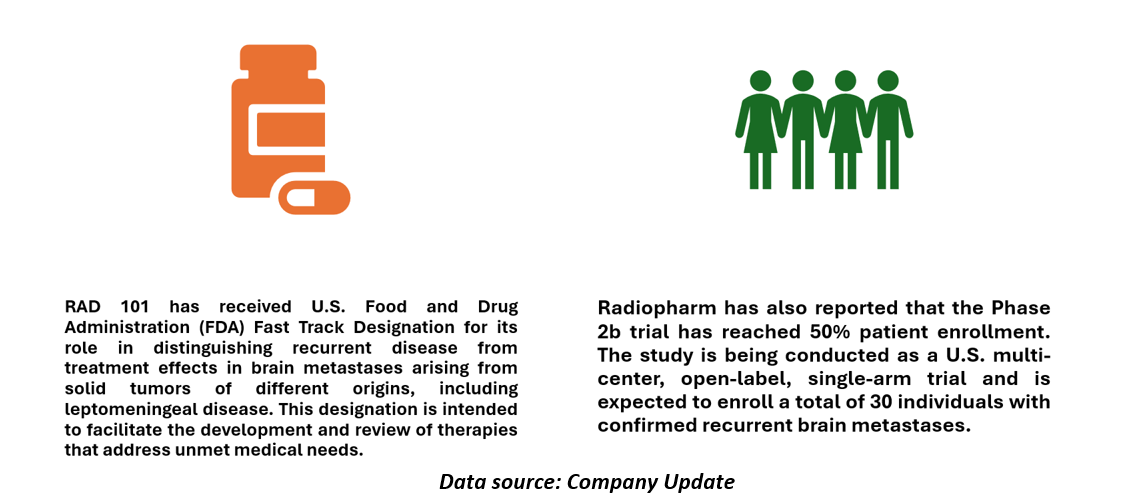
- RAD 101 holds FDA Fast Track Designation for distinguishing recurrent disease from treatment effects.
- Radiopharm will host a webinar to discuss the interim results.
Radiopharm Theranostics (ASX:RAD) has released interim data from its U.S. Phase 2b clinical imaging trial. The trial evaluated RAD 101 in patients with suspected or recurrent brain metastases. The interim analysis covered the first twelve patients enrolled in the study and assessed whether RAD 101 PET imaging aligns with conventional MRI findings, which represents the primary endpoint of the trial.
RAD 101 is a novel, small-molecule imaging agent that targets fatty acid synthase (FASN) and is radiolabelled with Fluorine-18. The compound is based on Radiopharm’s Pivalate technology and is designed for the diagnosis of suspected recurrent brain metastases originating from solid tumors of different origins.
Primary Endpoint Results
According to the interim analysis, 92% of evaluable patients (11 out of 12) treated with RAD 101 achieved concordance with MRI imaging. This concordance, assessed through PET imaging, represents the study’s primary endpoint. The imaging results demonstrated significant and selective tumor uptake in suspected or recurrent brain metastases.
The company stated that PET images confirmed metabolic activity in brain metastases, particularly in cases where MRI findings were equivocal. These observations suggest that RAD 101 may provide complementary diagnostic information alongside standard imaging modalities.
 Clinical Context and Unmet Need
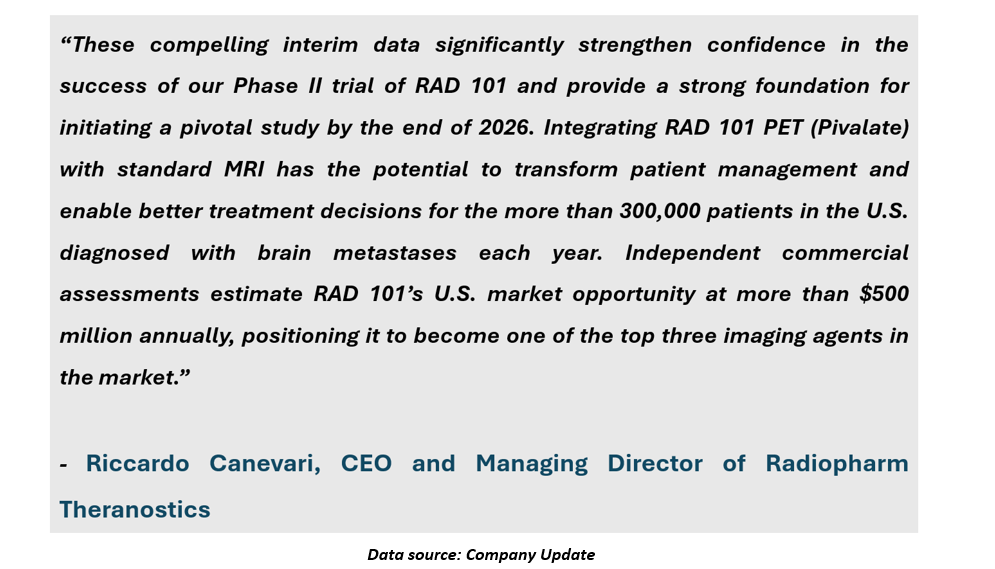
Brain metastases represent a substantial and growing clinical challenge. In the U.S. alone, more than 300,000 patients are diagnosed with cerebral metastases each year. The incidence of Intracranial Metastatic Disease (IMD) has been increasing, partly due to advances in systemic therapies that extend survival and allow more time for metastatic spread to the brain.
Contrast-enhanced Magnetic Resonance Imaging (CE-MRI) is currently the preferred method for imaging IMD. However, CE-MRI has known limitations, particularly during follow-up surveillance, where distinguishing between recurrent disease and treatment-related effects such as radiation necrosis can be difficult. These limitations may affect clinical decision-making and patient management.
Regulatory and Trial Progress
Phase 2b Trial Design
The primary objective of the Phase 2b clinical trial is to evaluate concordance between 18F-RAD101 positive lesions and lesions identified through conventional imaging, specifically MRI with gadolinium. Secondary endpoints include accuracy, sensitivity, and specificity of RAD101 in identifying tumor recurrence versus radiation necrosis in previously stereotactic radiosurgery (SRS)-treated brain metastases.
Upcoming Engagement
Radiopharm Theranostics has announced that it will host a webinar to discuss the interim results on Tuesday, 16 December at 10:00 am AEDT (Australia) / Monday, December 15 at 6:00 pm EST (U.S.).
Shares of RAD were trading at AUD 0.019 at the time of writing on 15 December 2025.
