
 AUS
AUS
 NZ
NZ
 UK
UK
 CA
CA
 USA
USA
 IND
IND







Highlights
- RAD101 achieved 90% concordance with MRI, meeting the primary endpoint in the Phase 2b trial.
- PET imaging showed selective uptake in brain metastases, improving detection over MRI alone.
- Early follow-up data indicates positive trends in sensitivity and specificity for RAD101.
- The study is on track for final data by June 2026, with FDA Fast Track status supporting development.
Radiopharm Theranostics Limited (ASX:RAD) has released new interim findings from its Phase 2b clinical trial assessing RAD101in brain metastases. The results are based on data from 20 patients in the United States imaging trial.
High Concordance with MRI Imaging
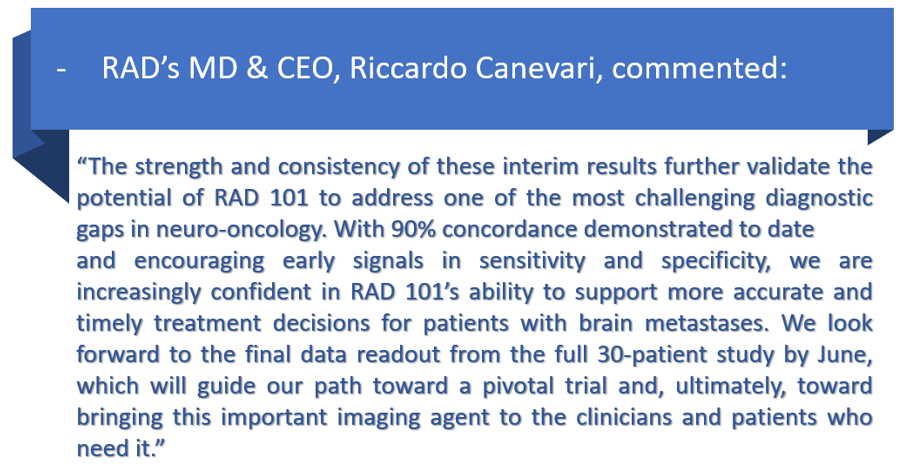
This is the second interim analysis, revealing that 90% of patients (18 out of 20) who received RAD101 showed concordance between PET imaging and MRI results, meeting the trial’s primary endpoint. The imaging agent demonstrated selective and considerable uptake in brain metastases, enabling clearer identification of metabolic activity in brain compared to cases where MRI findings alone were inconclusive.
Early secondary endpoint data show favourable trend
Early secondary endpoint data from a subset of five patients with six-month follow-up or biopsy results indicate a favourable trend for sensitivity and specificity. These measures are central to evaluating how accurately a diagnostic tool identifies both the presence (sensitivity, true positive rate) and absence of disease (specificity, true negative rate)
Potential to address an unmet Clinical Need
Brain metastases affect a significant number of patients each year. In the US alone, over 300,000 patients are diagnosed with cerebral metastases annually. While contrast-enhanced MRI remains the preferred imaging method, it has limitations in follow-up assessments and scans to optimise patient care.
RAD101 is designed to target fatty acid synthase (FASN), a protein commonly overexpressed in solid tumours.
Next Steps and Regulatory Status
RAD101 has received the Fast Track designation from the U.S. Food and Drug Administration for its potential to differentiate recurrent brain metastases from treatment-related changes.
The ongoing Phase 2b trial plans to enrol 30 patients, with final data expected by June 2026. These results are anticipated to help shape the design of a future pivotal trial and support potential regulatory pathways.
The interim results from Radiopharm’s Phase 2b trial provide updated insight into the performance of RAD101 as an imaging tool for brain metastases. While the data remain preliminary, the high concordance rates and early indications of diagnostic accuracy may support further development. Additional data from the complete trial cohort are expected to provide greater clarity on the agent’s clinical utility.
RAD shares were trading at AUD 0.02 per share at the time of writing on 24 March 2026.
