
 AUS
AUS
 NZ
NZ
 UK
UK
 CA
CA
 USA
USA
 IND
IND






Highlights
- Radiopharm Theranostics has dosed the first patient in its Phase 1 RAD 402 trial for advanced prostate cancer.
- The therapy targets KLK3 and uses Terbium-161 to enable targeted radiopharmaceutical treatment.
- The trial will assess safety, tolerability, and early signs of clinical activity through dose escalation.
- Initial clinical data from the first two dose levels are expected in the second half of 2026.
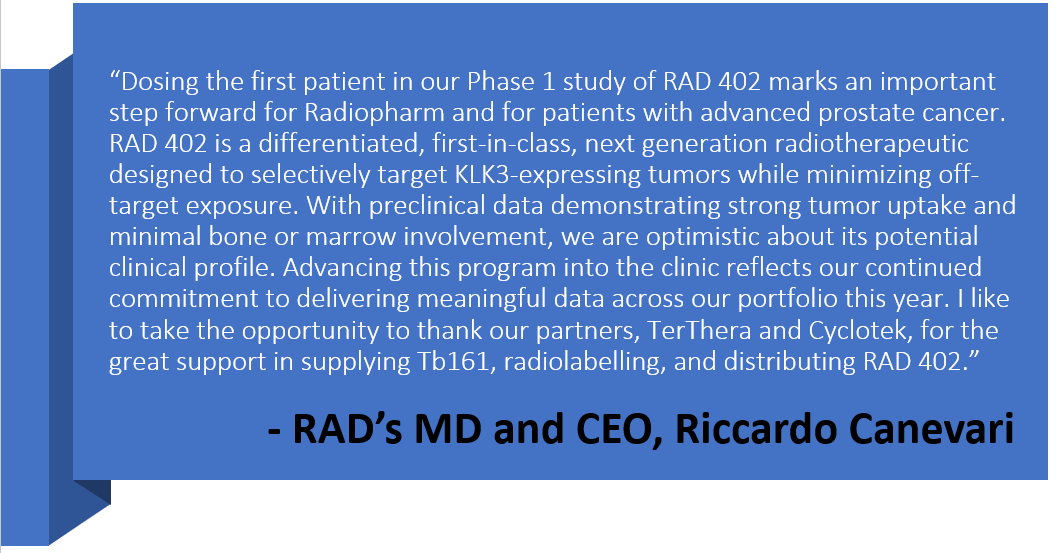
Radiopharm Theranostics (ASX:RAD) has begun clinical evaluation of RAD 402 with the first patient dosed in a first-in-human Phase 1 study targeting advanced prostate cancer. Initial data from the first two dose levels is slated for release in the second half of 2026.
The study is designed to assess safety, tolerability, and how the therapy distributes throughout the body, along with early indications of clinical activity of RAD 402 in patients diagnosed with advanced prostate cancer.
The trial follows a dose-escalation structure, which will help determine the maximum tolerated dose and identify a recommended dose for subsequent study phases.
KLK3 as a Therapeutic Target
RAD 402 is a monoclonal antibody targeting KLK3. Prostate-specific antigen (PSA), encoded by the KLK3 gene, is a widely used biomarker in prostate cancer diagnosis. KLK3 is commonly expressed in prostate cancer cells and metastatic sites, with limited presence in other tissues.
The therapy leverages the dual emission of Terbium-161, an approach designed for radiotherapies in prostate cancer.
Preclinical Findings Support Clinical Advancement
Preclinical proof-of-concept biodistribution studies in mouse xenograft models demonstrated significant tumor targeting, with limited uptake observed in bone and marrow. The distribution profile indicated hepatic excretion, consistent with expectations for monoclonal antibody.
Broader Development Pipeline
Radiopharm Theranostics continues to develop a diversified pipeline of radiopharmaceutical candidates targeting cancers with unmet medical needs. Its pipeline includes therapies based on peptides, small molecules, and monoclonal antibodies.
The company is currently progressing multiple clinical programs, including one Phase 2 and several Phase 1 trials across cancer types.
RAD shares were trading at AUD 0.019 per share at the time of writing on 27 March 2026.
