
 AUS
AUS
 NZ
NZ
 UK
UK
 CA
CA
 USA
USA
 IND
IND







Highlights
- Radiopharm Theranostics has dosed the first patient in its First-In-Human Phase 1/2a clinical trial of 177Lu-Betabart (RV-01).
- The trial will evaluate safety, biodistribution, radiation dosimetry and preliminary anti-tumour activity while identifying a recommended dose for future studies.
- 177Lu-Betabart targets the 4Ig isoform of B7-H3, an immune checkpoint molecule overexpressed in several tumor types.
- Preclinical studies of 177Lu-Betabart demonstrated tumor shrinkage and prolonged survival in animal models.
- The study plans to enrol 61 participants across a broad range of solid tumour indications targeting the B7-H3 immune checkpoint molecule.
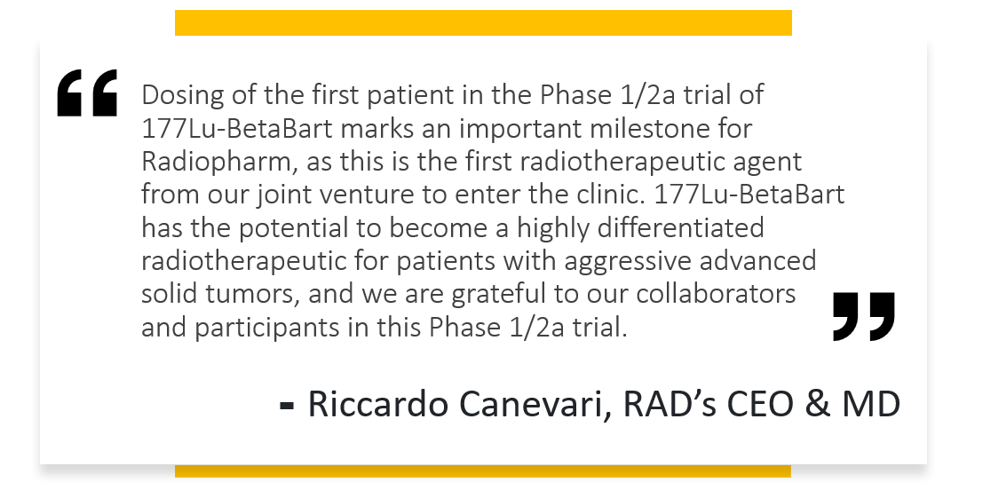
Radiopharm Theranostics (ASX:RAD) has advanced its First-In-Human Phase 1/2a clinical trial of 177Lu-Betabart (RV-01) with the dosing of the first patient. This marks a significant step in the development of its radiopharmaceutical candidate targeting the B7-H3 immune checkpoint molecule.
First Patient Dosed in Phase 1/2a Trial
The Phase 1/2a study is an expansion and dose-escalation trial, which is designed to assess the safety, biodistribution and radiation dosimetry of 177Lu-Betabart, along with its preliminary anti-tumour activity. The trial will also seek to establish the recommended dose of 177Lu-Betabart for subsequent clinical development.
The investigational therapy was developed by Radiopharm Ventures, a joint venture between Radiopharm Theranostics and The University of Texas MD Anderson Cancer Center. In July 2025, the company confirmed that the U.S. Food and Drug Administration had granted Investigational New Drug (IND) clearance for Betabart (RV-01), enabling the commencement of the clinical program.
The trial is expected to enrol 61 eligible participants across multiple cancer indications.
Targeting B7-H3 with 177Lu-Betabart177Lu-Betabart is a Lutetium-177 tagged engineered monoclonal antibody developed to target the 4Ig isoform of B7-H3, an immune checkpoint molecule that is overexpressed in several tumour types. B7-H3 has gained attention as a target for antibody-based cancer immunotherapy.
Preclinical studies of 177Lu-Betabart demonstrated evidence of efficacy and targeting of the specific 4Ig isoform of B7-H3. Furthermore, preclinical animal studies reported prolonged survival and tumour shrinkage.
The dosing of the first patient marks a significant milestone for Radiopharm Theranostics and its joint venture partner. With IND clearance previously secured from the U.S. Food and Drug Administration, the Phase 1/2a trial will provide early-stage clinical data on 177Lu-Betabart across multiple tumour types. The results are expected to guide subsequent stages of development for RV-01.
RAD shares were trading 4.55% higher at AUD 0.023 per share at the time of writing on 24 February 2026.
