
 AUS
AUS
 NZ
NZ
 UK
UK
 CA
CA
 USA
USA
 IND
IND







Highlights
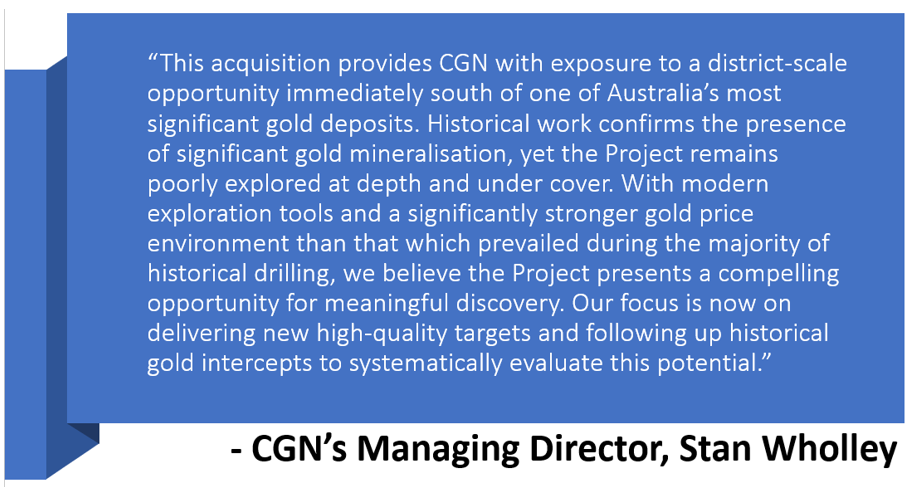
- The Panhandle Project lies directly south of the +8Moz Gwalia Gold Mine and north of the ~2Moz Ulysses Gold Mine within a productive gold corridor.
- The Panhandle Project largely unexplored at depth, with approximately 93% of tenure concealed beneath transported regolith.
- Four prospects have returned several drill intersections exceeding 2 g/t Au, confirming high-grade mineralisation.
- CGR is focused on integrating historical drill data into a 3D geological model to guide upcoming exploration efforts.
CGN Resources Limited (ASX:CGR) has released an update on its recently acquired Leonora Project tenure in Western Australia. The Panhandle Project, formed through the consolidation of the newly acquired and the existing tenure, hosts an underexplored gold corridor immediately south of the +8Moz Gwalia Gold Mine and north of the ~2Moz Ulysses mine. This shows that the project is positioned within a highly endowed geological setting.
Positioned Within a Prolific Gold Corridor
The Panhandle Project occupies a strategic position between the Gwalia Gold Mine and the Ulysses operation. In addition to Gwalia, other significant operations within the district include the ~2Moz Tower Hill Mine and the ~4Moz King of the Hills Mine.
The Christmas Well and Panhandle Projects contain the same stratigraphy and structural framework associated with these deposits.
Historical exploration across the Panhandle tenure has identified at least four gold prospects: Gwalia South, Annapurna, Paradise North and Pelican. Each has returned drill intersections above 2 g/t gold, including:
- 3m @ 17.28 g/t gold from 170m (Annapurna)
- 3m @ 13.27 g/t gold from 42m (Paradise North)
- 12m @ 2.04 g/t gold from 48m (Paradise North)
- 9m @ 20.20 g/t gold from 61m (Pelican)
- 4m @ 6.19 g/t gold from 45m (Pelican)
The company highlighted that these results confirm the presence of high-grade mineralisation and indicate the potential for lode-style gold systems within the project area.
Shallow Drilling and Untested Depth Potential
Approximately 4,000 historical drillholes have been compiled across the project. Of these, around 67% are less than 50 metres deep, while only about 6% extend beyond 100 metres. Most drilling was undertaken prior to the early 2000s during a prolonged low gold price environment and primarily targeted shallow oxide mineralisation.
Exploration efforts during that period focused on the southern extension of the granite greenstone contact that hosts the Gwalia Gold Mine. The project has seen limited testing at depth and as a result, significant portions of the project remain untested at depth.
The project area is also largely covered by transported regolith, which obscures underlying bedrock geology. Approximately 93% of the tenure is interpreted to be concealed beneath cover, providing a possible explanation for the limited historical exploration across large areas.
Data Integration and Modern Reassessment
The recent acquisition provided a vast historical dataset, including pre-2000 drillhole and assay records. The integration of this data into CGR’s database is advancing well. Currently, the company is developing a project-wide 3D geological model by combining old drilling data with available geophysics data. This model will guide upcoming drill targeting for both large-scale and high-grade gold targets.
Heritage Agreement processes are also underway, alongside planning for Heritage Surveys to facilitate drilling within the Pelican area.
The Leonora Project positions CGN Resources within a district that hosts multiple multi-million-ounce gold operations. With four defined high-grade prospects, widespread transported cover, and a predominance of shallow historical drilling, large portions of the Panhandle tenure remain untested at depth.
CGR shares were trading 1.45% higher at AUD 0.07 per share at the time of writing on 3 March 2026.
