
 AUS
AUS
 NZ
NZ
 UK
UK
 CA
CA
 USA
USA
 IND
IND






Highlights
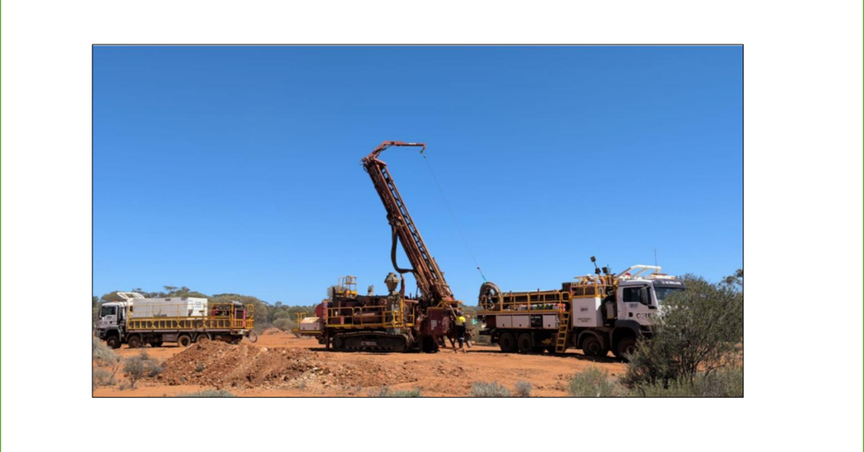
- A 12-hole (~3,160m) RC drilling program has commenced targeting a confirmed copper-rich VMS system at the Breakaway Dam.
- The BDCRC26016 hole is designed to test a multi-plate DHEM conductor for potential sulphide thickening.
- Drilling is evaluating a 700m mineralised corridor within a broader 16km conductive trend.
Catalina Resources Limited (ASX:CTN) has commenced a 12-hole reverse circulation (RC) drilling program at its Breakaway Dam Copper Project, targeting a confirmed copper-rich volcanogenic massive sulphide (VMS) system. This campaign follows recent geological interpretations and downhole electromagnetic (DHEM) surveys that defined priority conductive corridors.
Approximately 3,160 metres of drilling are planned in the initial phase, with the potential for expansion as results are assessed.
Systematic Testing of a Copper-Rich Corridor
The current program is designed to follow up recent drilling that confirmed copper-rich VMS mineralisation along approximately 700 metres of strike. Geophysical and geological interpretation indicates that the mineralised horizon extends beyond this zone. The mineralised corridor is open along strike, and huge part of the trend has seen limited or no effective drilling. The broader conductive trend spans roughly 16 kilometres within CTN’s tenure, indicating additional target positions along the same stratigraphic setting.
The interpretation by CTN suggests that thicker and potentially high-grade sulphide accumulations may occur within core of the conductive system. An updated interpretation now guides the next drilling phase and supports the next phase of systematic testing which aims to confirm the deposit's size and grade potential.
Focus on High-Priority Conductors
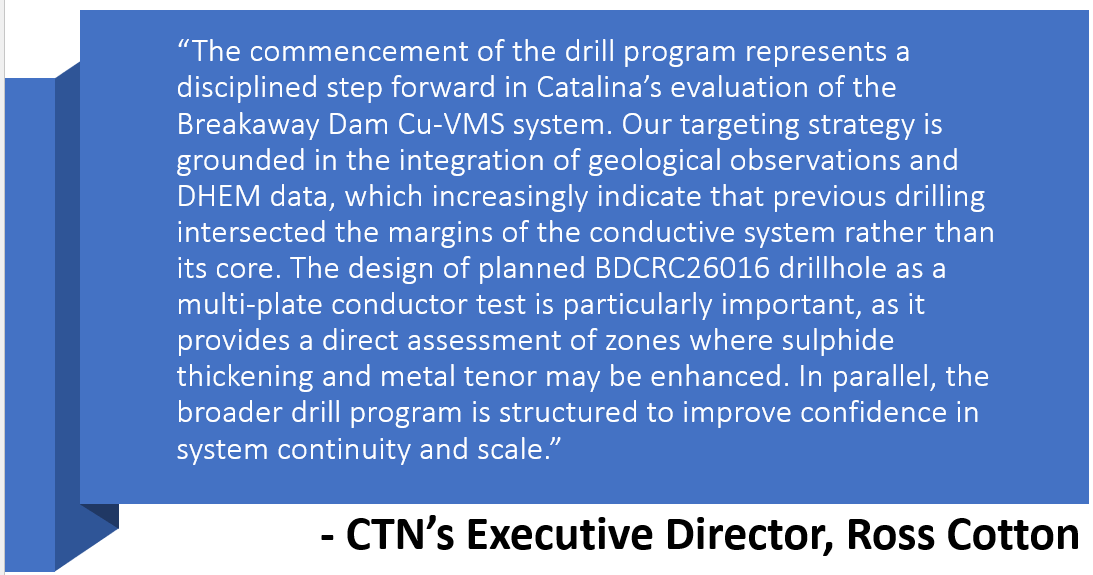
As part of the RC program, the BDCRC26016 hole has been designed as a multi-plate DHEM conductor test, targeting areas with potential sulphide thickening.
Additional holes within the campaign are structured to test along-strike continuity, examine variations in conductor strength and geometry, and assess structural controls that may influence sulphide accumulation. The program also seeks to constrain the vertical and lateral extent of the VMS system and offer geological vectoring data for further targeting.
The drilling strategy shifts from targeting isolated conductors to a broader evaluation of the system’s overall footprint and geological continuity. This approach aims to clarify spatial distribution and identify zones where sulphide mineralisation is more tick or with higher grade.
Integration of DHEM Surveys
DHEM surveys will be conducted as drilling progresses. DHEM will assist in refining conductor plate modelling, detecting off-hole conductive responses, and guiding subsequent drill targeting. This method is designed to sharpen the clarity of conductive structures and provide vital vectoring data, especially when drill holes don't hit the sulphide bodies directly.
Next Steps
RC drilling is now underway, actively testing high-priority conductor plates including the multi-plate BDCRC26016 target. DHEM surveys will continue throughout the program to optimise targeting and refine the geological model as results become available.
The commencement of RC drilling at Breakaway Dam marks the next stage in evaluating a copper-rich VMS system defined by recent exploration. With a 700-metre mineralised corridor identified within a 16-kilometre conductive trend, the program is structured to assess continuity, geometry and potential sulphide accumulation across the broader system. Results from the 12-hole campaign, supported by ongoing DHEM surveys, are expected to guide subsequent phases of exploration at the project.
CTN shares were trading at AUD 0.095 per share at the time of writing on 3 March 2026.
