
 AUS
AUS
 NZ
NZ
 UK
UK
 CA
CA
 USA
USA
 IND
IND







Highlights
- Catalina Resources’ March 2026 RC drilling campaign has expanded the Breakaway Dam mineralised strike from ~700m to ~1.2km.
- Drilling returned copper intercepts including 1.9m @ 2.17% Cu and 2.9m @ 0.57% Cu.
- Mineralisation has been identified across multiple positions and depths, indicating a laterally extensive system.
- DHEM surveys detected conductive plates in all drillholes, supporting targeting for follow-up exploration.
- Priority targets, including larger conductor zones, have been defined for the next phase of drilling.
Catalina Resources Limited (ASX:CTN) has announced updated findings from its March 2026 reverse circulation drilling program at the Breakaway Dam Copper Project in Western Australia, with drilling activities approaching completion. The campaign was designed to evaluate downhole electromagnetic (DHEM) conductor plates identified in earlier programs, alongside a prospective stratigraphic horizon linked to volcanogenic massive sulphide (VMS) copper mineralisation.
Expanded Strike Length Signals Growing Footprint
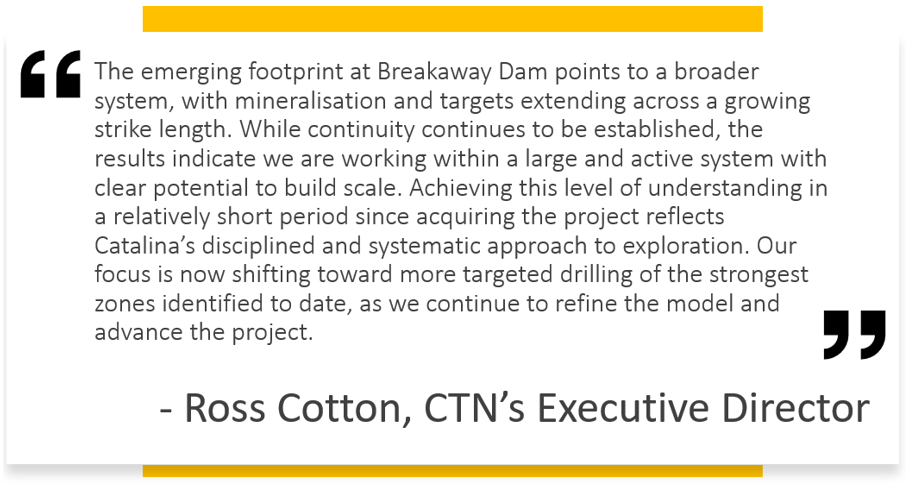
The recent drilling program has extended the strike length of mineralisation from approximately 700 metres to around 1.2 kilometres, marking a notable increase in the known footprint of the system. Copper mineralisation has been intersected at multiple locations along strike and across a range of depths, indicating a laterally extensive system. Historical drilling indicates that mineralisation may extend up to 1.8 kilometres, reinforcing the broader scale of the project area and supporting ongoing exploration aimed at further delineating the system.
Copper Intercepts Confirm Mineralisation Zones
Drilling results returned several copper-bearing intercepts, including
- 9m (ETW) @ 2.17% Cu (BDCRC26016)
- 9m (ETW) @ 0.57% Cu (BDCRC26014)
- 8m (ETW) @ 0.31% Cu (BDCRC26016)
Geophysical Data Guides Exploration
DHEM surveys recorded encouraging responses across all drillholes, identifying both on-hole and off-hole conductive plates. These conductors align with sulphide-rich zones positioned near the basalt unit. The data provides clear vectors for follow-up drilling by using system testing with DHEM surveys along strike to the south and north.
Results from the program continue to support the classification of Breakaway Dam as a copper-rich VMS system, while also providing a clear framework for refining geological interpretations and advancing targeted follow-up exploration.
Program Objectives and Geological Context
The drilling program was designed to test previously modelled conductor plates and improve understanding of system geometry and continuity. The program also aimed at evaluating the potential for more substantial sulphide accumulations within conductor cores, while contributing to ongoing geological and geophysical modelling in preparation for future drilling. Previous drilling intersected sulphide mineralisation within fine-grained metasediments overlying a basalt sequence, a setting associated with VMS deposits. Historical drilling had already identified copper intersections approaching 2% Cu, supporting the current interpretation of the project.
Next Phase Targets Identified
Results from the March 2026 campaign have outlined priority targets for further drilling, including larger, coherent zones. Exploration efforts will also focus on refining geological models and assist in targeting accuracy. Additional assay results from pending drillholes are expected to contribute further insights.
The latest drilling outcomes at Breakaway Dam provide an updated understanding of the project’s scale and mineralisation patterns. Expansion of the strike length, identification of copper intercepts, and confirmation of conductive targets establish a framework for continued exploration.
CTN shares were trading 3.39% higher at AUD 0.061 per share at the time of writing on 6 May 2026.
