
 AUS
AUS
 NZ
NZ
 UK
UK
 CA
CA
 USA
USA
 IND
IND







Highlights
- Altech Batteries has completed a full suite of safety self-destruction validation tests for its SNC technology.
- The SNC batteries demonstrated endurance to extreme conditions such as fire, overcharge, impact, and submersion without failure.
- All SNC cells and modules maintain chemical stability and mechanical integrity throughout the trials.
- The SNC technology surpasses international safety standards, including UL 1973, IEC 62619, and UN 38.3.
Altech Batteries Limited (ASX:ATC) has reported the successful completion of a comprehensive series of safety self-destruction validation tests on its Sodium-Nickel-Chloride (SNC) battery technology. The program was conducted to assess performance under extreme hazard conditions, including direct fire exposure, over-charge, rod penetration, ballistic impact, drop, impact, and submersion scenarios.
Across all tests, the SNC cells and modules displayed outstanding mechanical resilience and chemical stability, highlighted the company update. There were no incidents of explosion, thermal runaway, or uncontrolled reaction observed, confirming the intrinsic safety of the SNC design.
These results reinforce previous field deployment outcomes, demonstrating that SNC batteries remain thermally robust and chemically contained even under severe conditions. Unlike lithium-ion or lead-acid systems that use organic electrolytes and pressure-relief vents, Altech’s SNC modules stay hermetically sealed throughout their operational life, effectively preventing gas venting, electrolyte ejection, or thermal propagation. The company suggests that the technology meets and exceeds global standards such as UL 1973, IEC 62619, and UN 38.3.
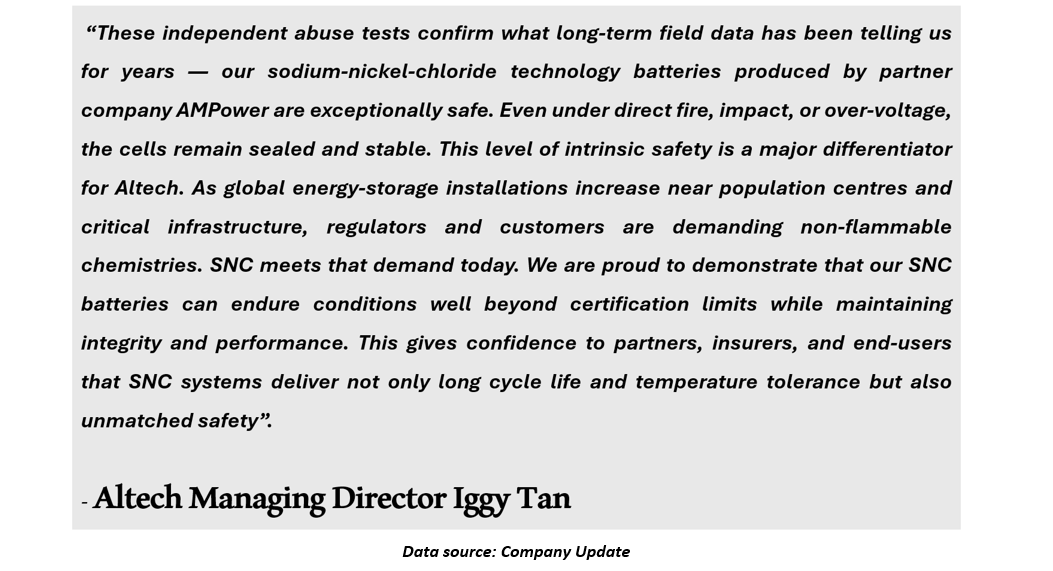
Key Safety Test Outcomes
The comprehensive suite of safety validation tests was conducted to evaluate the performance of Altech’s SNC battery systems under extreme thermal, mechanical, and electrical stress.
- Cell Fire Exposure Test
Three fully charged SNC cells were exposed to a 30-minute gasoline fire reaching 850°C. No explosion, rupture, or material leakage occurred, and all cells remained structurally intact. - Module Fire Exposure Test
A hot, fully charged SNC module was subjected to a 30-minute 850°C gasoline fire. The flames extinguished within one minute, with no explosion and only minor mechanical weakening observed. - Module Rod Penetration Test
A fully charged SNC module was pierced with a 20mm steel rod and submerged in water. A mild external reaction produced steam that dissipated gradually with no explosion or violent activity. - Ten-Metre Drop Test
A fully charged operational SNC module was dropped from 10 metres onto a steel pole, simulating a 30MPH impact. Only minor denting occurred, with no rupture, leakage, or structural compromise. - Module Impact Test
Fully charged SNC battery packs were crash-tested by vehicle impact at 48 km/h against a simulated utility pole. No explosion, fire, or thermal reaction occurred, confirming their mechanical stability. - Module Saltwater Exposure Test
An operational SNC battery module underwent a 2.5-hour submersion in 3.5% saltwater. No ignition, explosion, or external reaction occurred, demonstrating safe operation even in conductive marine environments. - Module Overcharge Test
A fully charged SNC battery was overcharged to 145% of its nominal voltage for one hour — exceeding UL1973 limits. No swelling, venting, or thermal reaction occurred, confirming excellent voltage tolerance. - Module Bullet Impact Test
An operational SNC battery endured shotgun and rifle fire during ballistic testing. Only minor smoke was observed, with no ignition, fire, or explosion, validating exceptional resilience to extreme abuse.
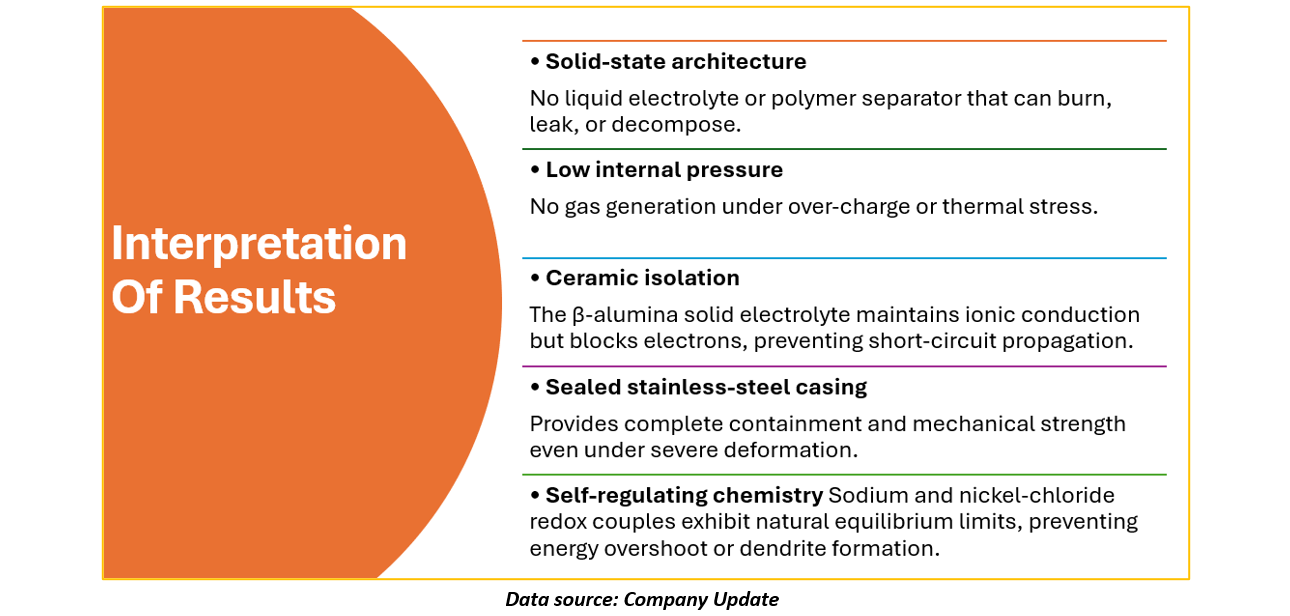
The company suggested that the tests confirm SNC chemistry as one of the safest energy-storage technologies for UPS, stationery and transport applications.
ATC shares were trading at AUD 0.036 at the time of writing on 28 October 2025.
