
 AUS
AUS
 NZ
NZ
 UK
UK
 CA
CA
 USA
USA
 IND
IND


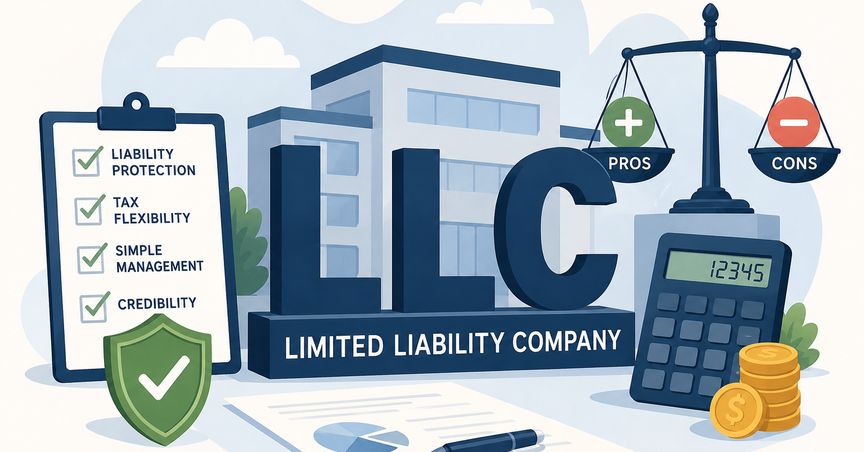





An oil company invented the limited liability company. Wyoming passed the first LLC statute in 1977 at the request of Hamilton Brothers Oil Company, which had been using foreign hybrid structures abroad and wanted an American version. Today the LLC is the default vehicle most new American businesses choose, and an entire industry of formation services has grown up around selling that decision as simpler than it really is.
The pitch is familiar: form an LLC, protect your personal assets, save on taxes, look more legitimate. Some of that holds up. Some of it doesn’t. An honest accounting of LLC pros and cons depends heavily on what kind of business you’re running and which state you form it in - and the brochure version mostly skips that part.
How the LLC became the default
For nearly two decades after Wyoming’s 1977 statute, almost no one used the structure. Then in late 1996, Treasury finalized its check-the-box rules - effective January 1, 1997 - letting eligible entities elect their federal tax classification by simple form rather than the older multi-factor test. That single regulatory shift turned the LLC from a niche curiosity into the dominant entity. As of the most recent IRS Statistics of Income data (tax year 2023), about 3.3 million LLCs filed as partnerships, accounting for 72.7 percent of all partnership returns - the 22nd consecutive year LLCs led every other entity type.
The U.S. Census Bureau recorded approximately 5.5 million new business applications in 2023, which remains the highest yearly total on record as of early 2026. According to LLCBuddy, which tracks LLC formation requirements using primary Secretary of State sources, total annual costs vary enough between jurisdictions that two identical businesses can pay several thousand dollars more or less per decade depending on which state they organized in.
What an LLC actually gives you
The headline benefit is liability protection. An LLC is a separate legal entity that can sign contracts, hold assets, take on debt, and be sued - generally without dragging the owners’ personal assets into the fight. If a customer sues a consulting LLC, they pursue company assets rather than the owner’s personal property. The separation is real, but it isn’t bulletproof: courts can pierce the LLC veil where owners commingle personal and business funds, sign contracts in their own names, or treat the company like an extension of a checking account.
All of that is conditional on actually maintaining the formality.
The second benefit is tax flexibility, and this is where most owners misunderstand what they’re getting. Under current IRS rules, a single-member LLC defaults to disregarded-entity treatment for federal tax purposes and a multi-member LLC defaults to partnership treatment. Neither pays federal income tax at the entity level - profits pass through to the owners’ personal returns. That’s the same treatment a sole proprietor or general partnership would get without forming an LLC. The actual flexibility comes later. An LLC can elect S-corporation status, which may reduce the self-employment tax bill once profits cross a meaningful threshold. It can also elect C-corporation status, useful in a narrow set of situations involving outside investors and retained earnings.
That election is the lever. The LLC is just the entity that can pull it.
Then there’s the paperwork advantage. Most states don’t require LLCs to hold annual meetings, elect a board, or maintain detailed minutes. Compliance is typically limited to an annual or biennial report (where required), a registered agent, and the relevant state filing.
Credibility matters more than founders expect. Banks generally want to see formation documents and an EIN before opening a business account in the company’s name, and larger clients sometimes refuse to contract with sole proprietors. Those three letters at the end of a business name don’t change what the business does, but they change how some counterparties classify it.
Ownership is more flexible than in any other US entity. LLCs can have one member or many. Members can be individuals, other LLCs, corporations, or in most states, foreign nationals. There’s no cap on the number of members and no restriction on share classes the way there is in an S-corporation. Profit distributions don’t have to mirror ownership percentages exactly. For investment vehicles, joint ventures with unequal contributions, and family holding structures, that last point can matter more than the liability shield.
Where the pitch breaks down
Start with the cost the marketing rarely leads with: self-employment tax. Under current federal rules, an LLC owner taxed as a sole proprietorship or partnership pays 12.4 percent toward Social Security on net earnings up to the wage base, plus 2.9 percent toward Medicare on every dollar of net earnings. That’s 15.3 percent on most earnings, before regular income tax even enters the picture. The LLC didn’t create the bill, and forming one doesn’t make it disappear. Some owners go through the formation paperwork expecting a tax cut and find they owe exactly the same self-employment tax they would have owed without one.
Ongoing state fees vary enough between jurisdictions to genuinely affect lifetime cost. As of 2026, California imposes an $800 annual minimum franchise tax on every LLC organized or doing business there, due regardless of revenue; the first-year exemption that briefly applied to LLCs formed between 2021 and 2023 has expired. Delaware: a flat $300 annual tax. A handful of other states layer on similar flat fees, while Wyoming’s minimum annual report license tax is $60. Ohio and New Mexico don’t currently require LLCs to file an annual report at all. Steve Goldstein, founder of LLCBuddy, publishes state-by-state data on LLC fees and compliance requirements.
Raising priced equity is its own headache. LLCs don’t issue stock. They issue membership interests, governed by the operating agreement, which don’t carry the standardized characteristics institutional investors rely on. Most VCs require conversion to a Delaware C-corporation before signing a term sheet, partly because fund agreements often restrict pass-through investments and partly because LLCs can’t cleanly issue the preferred stock and option pools that priced rounds depend on. If the plan is venture funding, the LLC is usually a temporary vehicle. Converting later is doable but not free.
Cross-state operations add a fourth wrinkle. An LLC formed in one state and doing business in another generally has to register as a foreign LLC in the second state, paying filing fees and maintaining a registered agent in both. The popular “form in Wyoming for the tax savings” advice that circulates online frequently overlooks this part - an owner who lives and works in California may still owe the California franchise tax on a Wyoming LLC, plus the cost of foreign registration. In most cases, the simpler state of formation is the state where the business actually operates.
And finally: courts have at times pierced the LLC veil where owners failed to maintain proper separation, and the case law in newer LLC jurisdictions is still evolving. Operating the LLC as a separate entity - separate bank account, separate bookkeeping, contracts in the LLC’s name, formal capital contributions and distributions - keeps the shield credible when it gets tested.
When the math favors an LLC - and when it doesn’t
An LLC may make sense for businesses with genuine third-party liability exposure - anyone with customers on premises, anyone manufacturing or installing physical products, anyone employing others - and for owners with personal assets they want to protect from business risk. It can also work as a vehicle for jointly held investments. Real estate, family pools, multi-owner ventures - anywhere the operating agreement does the work of allocating control and economics.
It may make less sense when the formation and annual costs eat a meaningful share of low revenue. A freelance copywriter earning $30,000 a year in California pays $800 annually in state minimum tax alone, before any registered agent or formation costs. The math gets worse in the high-fee states and better in the cheap ones. At current minimums, a California LLC pays $4,000 across a five-year window in minimum franchise tax alone, a Wyoming LLC at the minimum tier roughly $300, and a New Mexico or Ohio LLC nothing in state annual fees.
The question worth asking isn’t whether to form an LLC. It’s whether the specific LLC, in the specific state, for the specific business, costs less per year than the protection and flexibility it actually delivers. That answer is often yes - just not as often as the formation industry suggests.
The structure is a tool, not a status symbol.
The content has been authored in collaboration with our guest contributor, Deepak Rawat.
“The information contained herein is general in nature and based on publicly available sources believed to be reliable as of the publication date. Laws, tax rules, and filing requirements may change and vary by jurisdiction. Readers should obtain independent legal, tax, and financial advice before making business or structuring decisions.”
