
 AUS
AUS
 NZ
NZ
 UK
UK
 CA
CA
 USA
USA
 IND
IND






Summary
- Homeworking could push up energy bills during October 2020 to March 2021: Energy Helpline estimates
- Ofgem plans to reduce the yearly price limit for electricity bills to £1,042
- It also proposes cutting the returns on investment by half for energy infrastructure
- Energy supplier companies like SSE and British Gas could benefit from rising energy bills
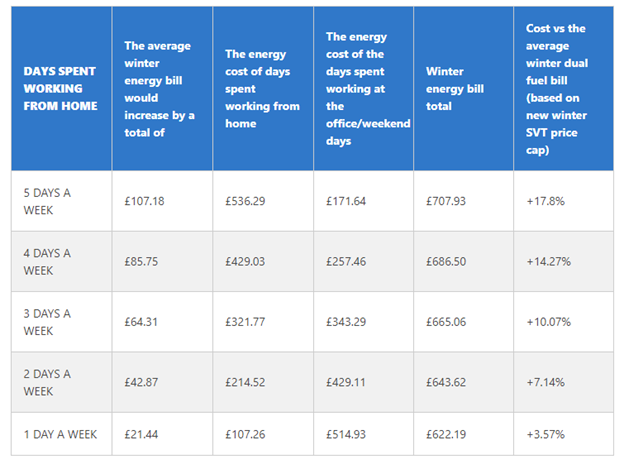
The British home energy bills could rise by around 18 per cent during the coming winter months, says the latest report from Energy Helpline, a company providing price comparison services for energy suppliers across the UK.
The Energy Helpline estimates suggest that if people work from home for up to 5 days a week, the average winter energy bill is forecasted to rise by £107 per household. This could push up the total energy bill cost for the entire nation to £1.9 billion during the period starting October 2020 till the end of March 2021. Utility customers need to be watchful of the same and get prepared accordingly.
Estimates for increase in winter energy bill
(Source: Energy Helpline, UK)
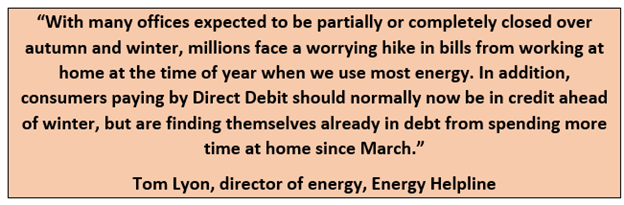
Tom Lyon, director of energy, Energy Helpline suggested that energy companies should be prepared to help those customers who might find it difficult to pay the rising bills. Customers should also keep a tab on the cheapest tariff deals available and should take an informed decision and switch their energy supplier immediately, if required, he added.
Ofgem’s plans to check the household energy bills
The UK government is already aware that a large part of the country’s population would benefit from any type of price cap or support on their household energy bills, given the devastating impact of the coronavirus pandemic on their current sources of income and future financial stability prospects. The country is reeling under the impact of huge job losses since the beginning of the coronavirus outbreak.
Ofgem, the UK energy regulator, has therefore been announcing many moves to control the household utility bills, after the pandemic struck the nation in March 2020.
First, it plans to reduce the yearly price limit for electricity bills to £1,042 for each household beginning 1 October 2020. This move is expected to benefit around 15 million consumers in saving their home energy costs. Ofgem defended its move by saying that the wholesale gas prices are trading at their two-decade low levels, since the overall energy demand has fallen across the world. The price limit shall be raised only in April 2021, according to Ofgem.
Also Read: Coronavirus impact: Ofgem reduces energy price cap limit
Second, in July 2020, Ofgem, the UK energy regulator had proposed cutting the returns on investment by half (from around 8 to 4 per cent) for building the nation’s energy infrastructure. It is also mulling over cutting the total expense on UK energy networks by £8 billion.
This move was undertaken so that the cost of energy bills could go down. The prominent industry players in Britain felt that this could discourage investment into the energy sector and is detrimental to the sector’s growth in the long run. The electricity supplying companies are planning to collectively oppose this move, according to media sources.
Moreover, the National Grid, which operates the country’s electricity network, has warned Ofgem that its price controls could lead to power cuts across the nation, in a worst-case scenario. It is to be noted that the Grid had proposed in its latest business plan for investing close to 10 billion pounds to strengthen the country’s energy network. However, if the watchdog’s proposal is accepted, the Grid could invest only half of that.
Ofgem said that it expected the energy companies to operate more efficiently that before, so that they do not get disturbed by marginal fall in the consumer bills. Affordability is of prime importance, added the electricity watchdog.
Impact on energy suppliers: SSE, British Gas
The energy supplying companies would definitely benefit from a rise in demand for electricity during the winter months and are expected to generate good sales during the period. Of course, the ones giving the best tariff deals would be selling higher volumes for sure. At the same time, the price cap set by Ofgem is expected to dampen the revenues to a certain extent.
The British energy producing industry has been adversely impacted by the coronavirus crisis. On one hand, it witnessed rising operations costs and a disrupted supply chain. On the other hand, it was operating on thin margins, since the government wanted to protect the consumers from paying higher bills.
Lets us now take a closer look at the performance of SSE plc and British Gas, which could benefit from the forecasted rise in energy bills during the winter months.
Scottish and Southern Energy plc (LON:SSE) has been a dividend paying stock for a long period of time and belongs to the prestigious FTSE 100 index. Media reports suggest that it will be declaring dividends for the month of November 2020 as well, despite a revenue hit due to the ongoing coronavirus outbreak.
Recently, SSE was also fined around 2 million pounds by Ofgem. It was charged with hiding information regarding its power generation capacity, which impacted the forward wholesale energy prices.
The company stock (LON:SSE) was trading at GBX 1,214.50 on 8 September 2020 at 3.12 PM, down by 1.38 from its previous day’s closure of GBX 1,231.50. Its 52-week low / high range was recorded to be 1,072.50 / 1,686.50 at that time and it was seen to be providing a negative year to date return of 15.45. The volume of shares traded were 394,558 and the total market capitalisation was £ 12,803.70 million.
Also Read: 3 FTSE 100 Dividend Stocks to watch for- BHP, SSE and BATS
Also Read: Review of Two Defensive Players in Electricity Domain: SSE PLC and ContourGlobal PLC
British Gas, owned by Centrica plc (LON:CNA), is a UK based energy provider firm. Recently, the company acquired Robin Hood Energy, whose official transaction process is scheduled for completion by 16 September 2020. However, the acquisition could also lead to more than 200 job cuts, according to media reports.
Robin Hood Energy owns more than 110,000 household and industrial customers.
Centrica plc is also a part of the FTSE 100 index. Its operating profits fell by 14 per cent for H1 2020. The company did not declare any dividend for the six-monthly period.
The company stock (LON:CNA) was trading at GBX 44.80 on 8 September 2020 at 3.36 PM, down by 2.40 per cent from its previous day’s close of GBX 45.90. At that time, the stock’s market capitalisation totaled £ 2,680.05 million and it displayed a negative earnings per share of 0.18. The volume of shares traded were recorded to be 8,568,080.
Also Read: Future of UK Energy suppliers as the furlough scheme ends, Focus on Centrica
Also Read: Fire and rehire: Employees’ strike likely at Centrica-owned British Gas
Finally, the British energy suppliers are continuing with their fight against the coronavirus pandemic by improving efficiency and incorporating cost cutting measures. While the news of expected higher energy bills during the winter months brings a ray of hope as it could translate into raised revenues for the electricity suppliers, the Ofgem’s proposal to put a price cap on energy bills could put a dampener on company profits.
