
 AUS
AUS
 NZ
NZ
 UK
UK
 CA
CA
 USA
USA
 IND
IND







Summary
- The United Kingdom recorded 22,961 new coronavirus cases on 4 October 2020
- The cases skyrocketed because of a technical glitch admitted by the Public Health England
- The issue was immediately resolved overnight with the combined efforts of the NHS Test and Trace and PHE
There has been an alarming spike in the coronavirus cases in the United Kingdom after more than 16,000 coronavirus cases went unreported over a week due to a technical glitch in the system. On 4 October, the United Kingdom recorded 22,961 new coronavirus cases, which has further sparked fear among the Britons.
In the investigation carried out by the Public Health England, it said that nearly 16,000 cases were missed out due a technical issue with the Government's coronavirus dashboard. The daily reports of 22,961 new cases included 15,841 additional cases which were not included between September 25 and October 2 but were identified later.
The issue was immediately resolved overnight with the combined efforts of the NHS Test and Trace and PHE, after it was brought to light on 2 October 2020. Most of them were recent cases and patients who had been tested positive were advised to quarantine.
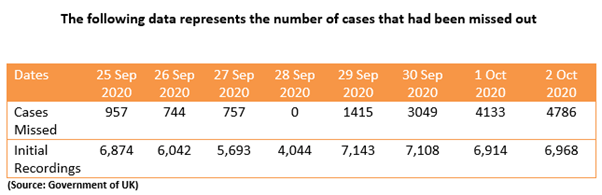
Cases Recorded Till Date
The UK has been seeing a rapidly increase in the number of virus cases in coronavirus infection rate since August. According to the figures disclosed by the government 33 people have lost their lives due to the virus in the last 28 days, with the death toll reaching 42,350. The UK crossed half a million mark with a total of 502,978 people tested positive for the virus since commencement of the pandemic.
Measures Adopted by the Government
Amidst the possibility of the UK facing the second wave of coronavirus infection, British PM Boris Johnson had announced new measures to halt the spread of the virus in September. He had urged the employees to work from home where possible, issued guidelines requiring pubs and restaurants to close down at 10 PM, follow social distancing with the introduction of rule of six, and had also cancelled the planned partial reopening of sports stadiums that was due on 1 October.
Face Coverings- Customers using public transportation, customers visiting hospitality venues (except while eating or drinking), staffs working in hospitality, retail sector and on public transport and taxi drivers are all required to cover their faces by wearing a mask.
Work From Home- Office workers can effectively work from home in consultation with their employer. Employees belonging to the public sector involved in providing essential services can continue to go into work if required.
Hospitality- Businesses selling food and drinks must be closed by 10 PM. However, delivery services can continue to operate as usual.
Economic Impact of coronavirus
Gross Domestic Product: The GDP of the UK for Q2 2020 (Apr to June) contracted by a record 19.8 per cent, following a decline of 2.5 per cent in the previous quarter. The lockdown restrictions that subsequently followed the Covid-19 pandemic led to this decline.
Households Saving Ratio: Due to an increase in voluntary and involuntary savings in Quarter 2 2020, the households saving ratio recorded 29.1 per cent increase.
Cross-Border Financial Flows: In the first half of this year, there has been pronounced cross-border financial flows in response to financial markets. However, there was a reduction in the UK's gross external assets and gross external liabilities in loans and deposits in Q2 2020.
Total hours worked: The total hours worked still remains below the levels as compared to pre-lockdown period. The volume in the three-month period of May to July was 9.8 per cent lower than the three-month period (February to April) for 2020.
Inflation: Due to reduction in VAT in the hospitality sector along with introduction of 'Eat Out to Help Out Scheme', the Consumer Prices Index (annual) that includes housing costs (CPIH) was marginally down by 0.5 per cent in August 2020.
Initiatives Undertaken by the Government
Boosting Employment: The Government is most likely to introduce a new Job Support Scheme effective from next month (November 2020), in order to prevent job redundancies in businesses that are struggling to make ends meet due to the onslaught of the coronavirus pandemic over the approaching winter.
Tax Exemption: The tourism and hospitality sector has been amongst the hard hit sectors by the onslaught of pandemic. The Government strives to provide the support for the businesses by extending the 15 per cent VAT cut scheme until March 2021.
Loan Repayment: The Government has introduced a flexible repayment system “Pay as You Grow” to provide much relief for the already battered businesses, which is similar to the Bounce Back Loan scheme. This new flexible repayment system allows businesses to increase their loan tenures from six years to ten years, thereby reducing repayment instalments substantially. Businesses might be able to enjoy payment holidays along with an option of Interest-only periods of up to six months.
The news of the second wave of the pandemic and accompanying high number of Covid-19 cases has been giving jitters to the already dwindling economy. However, the UK Government has been taking several steps to restore the scenario and push the economy on the recovery path as soon as possible. These measures are expected to protect jobs by hand holding businesses recover from the pandemic.
