
 AUS
AUS
 NZ
NZ
 UK
UK
 CA
CA
 USA
USA
 IND
IND





Summary
- The FM hopeful of an agreement but said Covid-19 would have a larger economic impact on the nation
- Despite some progress from both sides, three main areas of discord still remain between Britain and the EU
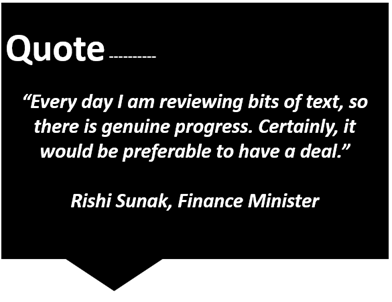
Rishi Sunak, the British Finance Minister admitted that there was genuine progress on Brexit negotiations between the UK and the European Union. At the same time, he said that it was better to walk away from a bad deal in case it was likely to tie the country’s hands for the times to come.
Sunak has been one of the leading voices in the UK cabinet who has vouched for a free trade deal (FTA) with the Union. Nevertheless, he noted that the most important factor impacting the British economy as of now was coronavirus and not the Brexit. There was no question of having a deal at any price, he emphasised.
However, a recent joint analysis conducted by UK in a Changing Europe and the London School of Economics said that the economic impact of a no deal Brexit could be twice or thrice that of the coronavirus pandemic for the country.
Well, views vary a lot on the pandemic’s impact. There is immense uncertainty about the impact of the coronavirus on the British economy, especially short-term, said Paul Johnson, director, Institute for Fiscal Studies.
Sunak would be presenting a spending review on 25 November to lay out the government expenditure plan for the next year, after Covid-19 has blown a big blow to the national finances.
He wished that by the next spring, things would be under control at the pandemic front and he would be able to focus on making the public finances more sustainable.
As part of the plan, Sunak would be sharing an elaborate infrastructure strategy this Wednesday. It would contain massive plans for transportation, flood defence, and fiber broadband, apart from other things, according to media sources.
The bilateral deals
Looking at the life outside of the EU, Britain is in the process of cementing its trade relations with other nations on a bilateral basis.
In that process, it has recently signed two bilateral deals – one with Japan and another with Canada.
An agreement was signed with Japan last month. It ensured that almost all the British exports to Japan were tariff free. The UK tariffs on Japanese vehicles would be removed by 2026 under the deal.
The UK-Japan bilateral deal is likely to boost the trade between the two nations by nearly £15 billion. The deal comes into effect from 1 January next year.
Britain signed an interim tailor-made trade deal with Canada last week. ‘We are working on a comprehensive agreement that will maximise the trade opportunities for both sides over the coming years’, said Justin Trudeau, the Canadian Prime Minister.
Both the nations have common green emissions goals as well and are trying to reach a net-zero level by the year 2050, said Boris Johnson, the British Prime Minister. The bilateral arrangement will eliminate tariffs on 98 per cent of good exported between the UK and Canada.
The Brexit transition period would be ending on 31 December 2020. Without an FTA being worked out between the two sides, the mutual trade will have to follow the WTO (World Trade Organisation) guidelines that will have trade barriers, unlike the preferential treatment going on till now.
The areas of discord
The three main areas of discord between Britain and the EU remain a level playing field, the fishing rights, and the process of enforcing agreements. While both sides have made some concessions, but a final agreement seems far from sight. Talks might continue in December as well, as per media reports.
EU officials said that thankfully, a little progress was made on the issue of state aid. But on the level playing field front, the UK might need to raise its legal standards for environmental and social protection in case the Union’s legislation is modified in the future.
“We want an agreement that fully respects the UK sovereignty”, said a British official without wanting to be named.
Ursula von der Leyen, President, European commission said on Friday that progress was definitely there but there remained significant gaps on issues like the fishing rights and competition regulations.
Sunak told the British media that the UK had been reasonable, consistent, and transparent with its side of requests throughout the negotiation process. However, the nation would thrive and prosper in any eventuality, he insisted.
The cost of a no deal Brexit
A report by the New Economics Foundation and European Institute, University College London revelated that Britain would have to bear a cost worth £1.6 billion if it does not comply with the EU data management standards after Brexit.
The UK would need to set up new compliance procedures after 1 January next year in case it wished to exchange data with the EU.
While the micro businesses will have to bear a compliance cost of £3,000, the comparable value would be £10,000 for small firms, £20,000 for mid-sized companies, and £163,000 for large sized businesses.
Smaller sized firm would face a bigger challenge to survive, especially given the challenging times posed by the pandemic.
