
 AUS
AUS
 NZ
NZ
 UK
UK
 CA
CA
 USA
USA
 IND
IND





Summary
- Federal Reserve allowed a major strategy to shift in the way it sets interest rates by doing away with its conventional practice of raising them to head off high inflation.
- Fed left interest rates near 0 and signalled to hold on to that at least through 2023 to support the economic recovery of the US.
- As per Fed's latest statement, FOMC anticipates keeping an accommodative stance of monetary policy until it achieves inflation averages 2% over time and remains on track to moderately exceed 2% for some time.
- Uncertainty is expected to prevail in the economy until election results are out on 3 November.
The US Federal Reserve Board announced a major policy change on 27 August to keep low-interest rates and allowed inflation to run above 2% to support the labour market and broader economy.
The new strategy that was detailed in a speech by Federal Chief Jerome Powell during the yearly Jackson Hole economic symposium, indicated that the central bank would look to achieve inflation that averages 2% over the time and after periods when inflation has continued to run below 2%, the monetary policy will aim to target inflation moderately above 2% for some time.
To Know More, Do Read: Fed’s new strategy for inflation and labour market
Fed had undertaken a public review in early 2019 to evaluate monetary policy strategy, tools and communications that would best promote the achievement of goals of maximum employment and price stability over the years ahead.
Post undergoing an 18-month review, Fed announced modifications to its long-term plan created to assist the central bank in meeting inflation goals.
In January 2012, the Federal Open Market Committee issued its first statement on “Longer-run goals and monetary policy strategy” in which the longer-run inflation goal of 2% was the central part of the statement. The statement largely influenced the Fed's approach to interest rates and general economic growth.
Also Read: US Economy Charter and Dow Jones: Economy shrivels while stocks are under spotlight
Powell asserted that a solid job market could be upheld sans triggering an outbreak of inflation. Conventionally, there has been a belief that low unemployment results during quite high inflation and central bank officials have proactively gone ahead to prevent it.
However, the policy shift will now imply that when the unemployment rate drops, Fed will lean less towards raising interest rates until inflation does not rise as well.
Low-interest rates for 3 years and accommodative policy
The Federal Reserve released new estimates on 16 September after a 2-day policy meeting, in which all 17 officials who attended the meet stated that they were planning to keep rates close to zero at least through 2021 and 13 expected rates will remain there across 2023.
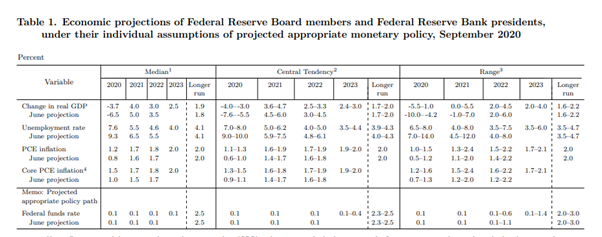
Source: Federal Reserve, dated: 16 September 2020
The Federal Open Market Committee (FOMC) stated in a statement post-meeting that it looks to attain maximum employment and an inflation rate of 2% in the long run.
ALSO READ: A glimmer of hope in US economic recovery? Stock Markets indicate towards it
The Committee has also planned to aim for reaching at the inflation figure just moderately above 2% for some time so that inflation averages 2% over time and inflation expectations for the long-term stay well balanced at 2%.
The Committee expects to keep an accommodative stance of monetary policy until the above outcomes are attained.
FOMC also decided to maintain federal funds rate at 0 to ¼ % and expected to keep this until labour market conditions have reached levels coherent, with the FOMC's evaluation of maximum employment and inflation increasing to 2% along with being on the path to reasonably go above 2% for some time.
The new guidance is the Fed's first move in an emerging communication plan, following last month's announcement of a new long-term policy structure to enable inflation, after cycles of underperformance, to exceed its 2% goal.
Yield curves steepened after the decision
After the decision, the US Treasury Yield Curve steepened marginally on 16 September as investors sank in the US Fed's statement.
A steepened yield curve shows, investors are expecting stronger growth and higher inflation. Such a curve shows that the spread between long and short-term interest rate is widening.
GOOD READ: US 10-year Treasury yields at an all-time low amidst coronavirus fears
10-Year Bond Yield and 30-Year Bond Yield rose for a short time during the trading session, noting a day’s high of 0.70% and 1.46%, respectively on 16 September, causing 10-2 Year Treasury Yield Spread Bond Yield, as well as 5-Year Bond Yield to increase by 3.72% and 4.11%, respectively.
On the same day, the Federal Reserve also promised to utilise its full range of instruments to help achieve economic stability and to buy Treasuries, as well as mortgage-backed securities at the present speed to continue easy functioning of the market.
The amounts have been set at an $80 billion of Treasuries per month and $40 billion of mortgage-backed securities as per another statement, released on 16 September.
Economic and fiscal support ahead
As per the median projection of the quarterly forecasts made by officials, rates are expected to be ultra-low through 2023, but 4 officials have planned for at least one hike in 2023.
Fed policymakers are expecting a shallower economic slump in 2020 in other updates to quarterly projections, but are also, anticipating a sluggish rebound in the years ahead.
Jerome Powell stated that the economic recovery had gained momentum much earlier than expected, though warning about slower economic activity and uncertainty ahead.
Do Read: Federal Reserve Turns Cautious Signals ‘Long Road’ to Recovery, Markets Jittery
Federal Reserve has injected trillions of dollars into the financial sector through its bond-buying program and introduced a number of emergency lending facilities to hold companies buoyant, apart from slashing borrowing costs in the month of March.
Also Read: Stocking up the Stocks: Federal Reserve expanded corporate bond-buying plans
The economy has partly recouped from the coronavirus induced slump, but still, several Americans are losing lives due to coronavirus; unemployment stays at a high level, and industries like travel and hospitality remain weak.
Interesting Read: How is the US Election Race Faring? Does it impact your portfolio?
The extended temporary unemployment payments are running out, and the political standoff over fresh stimulus round is failing to bring the economy back on track. Uncertainty is expected to prevail until the outcome of election comes out due on 3 November.
Also, Republicans, including Donald Trump have offered a smaller package than Democrats.
