
 AUS
AUS
 NZ
NZ
 UK
UK
 CA
CA
 USA
USA
 IND
IND







Summary
- Around 0.16 million people got redundant during the period between May to July 2020 in the UK
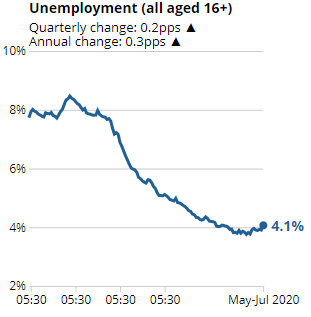
- UK’s unemployment rate stood at 4.1 per cent for the same period, up from 3.9 per cent earlier (April to June 2020)
- Trade associations seek a targeted extension of the coronavirus job retention scheme to avoid mass unemployment
The recently released statistics from the Office for National Statistics (ONS) have revealed that close to 0.7 million job losses have taken place across Britain since the start of the coronavirus pandemic. Economists are warning that the unemployment rate in the nation will continue to rise if the furlough scheme ends on 31 October 2020 and is not extended any further.
The number of redundancies rose by 0.10 million for the May to July 2020 quarter across the UK. This was higher by 58,000 over the same period a year back (May-July 2019). It was also higher by 48,000 over the previous quarter of February to April 2020. In fact, these numbers were the highest annual and quarterly jumps observed in redundancy rates since the year 2009, the year of the financial crisis.
(Source: Office for National Statistics, UK)
As can be observed from the chart displayed above, the unemployment rate moved up to 4.1 per cent for May-July 2020 period. It was recorded as a 0.3 per cent annual and a 0.2 per cent quarterly jump. For the earlier quarter of April to June 2020, the unemployment rate in Britain stood at a level of 3.9 per cent.
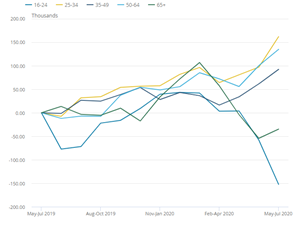
A particularly worrying estimates is that the number of young people (aged between 16 to 24 years) in jobs has gone down for the May to July 2020 quarter, as compared to the same period in 2019. The UK government is aware of this fact and is already running special schemes for training and skilling youngsters so that they can be made employable soon.
Also Read: Has The Dismal UK Employment Data Impacted Stock Markets?
UK change in employment level by age
(between May - Jul 2020)
(Source: Office for National Statistics, UK)
The worse affected sectors as a result of the coronavirus-led crisis have been airlines, retail, entertainment & leisure, automobiles, hospitality, oil & gas, and accommodation. Not surprisingly, these are also the sectors that have been forced to layoff a large chuck of their staff.
People under furlough
According to the latest government statistics, more than 5 million people are still under the coronavirus job retention scheme (popularly known as the furlough scheme), down from 9.4 million people using it in the month of April 2020.
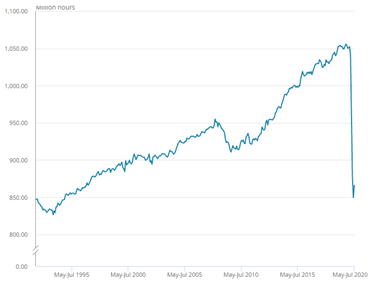
Half of the people under furlough did not have work for the entire 8 working hours of the day in July 2020 and their employers needed government support to pay for their salaries, mentions the ONS data. In fact, the total number of hours worked for the day was substantially lower than the pre-pandemic levels across the nation (please refer chart below).
UK Total Actual Weekly Hours Worked
(Source: Office for National Statistics, UK)
The total number of actual weekly hours worked was 1.05 billion for the quarter of December 2019 to February 2020. It dropped drastically to 0.85 billion for the May to July 2020 quarter, due to the harmful effects of the pandemic on the British economy.
Furlough scheme may not be extended
The furlough is an expensive scheme and has costed more than £27 billion to the British exchequer, as per government estimates. This is probably the reason that Rishi Sunak, Chancellor, UK Treasury has clearly stated that most probably, the scheme would not be extended. At the same time, trade unions and economic institutions are making repeated requests for at least a target, if not complete extension of the same.
For instance, Len McCluskey, general secretary, Unite has requested the government for a temporary furlough support extension to the sectors of aviation, hospitality, and manufacturing. Unite is a British and Irish trade union with 1.4 million members, headquartered at London.
The British industry association CBI (Confederation of British Industries) has on the other hand, another solution to offer. It said that the government could instead subsidise salaries of those employees who are still working for half of their usual working hours or less.
Pawel Adrjan, economist, Indeed said that the government’s job retention scheme has cushioned the full impact of the coronavirus crisis on the total number of job losses across the nation. Indeed is a recruitment portal in the UK. With a spike in the quarterly redundancy numbers, it is clear that more trouble is on its way, added Adrjan.
Two companies that recently announced job cuts were Lloyds and Marks and Spencer. Let us take a closer look at their stock performance.
The shares of the Lloyds Banking Group (LON: LLOY) were trading at the value of GBX 26.30 on 16 September 2020 at 3.15 PM, up by 0.55 per cent from the previous close of GBX 26.16. The total volume of shares traded at the time of recording was 71,637,317 while the company’s market capitalisation totaled up at £18,514.59 million. The year to date return was negative with a value of 58.95. The 52-week low / high range was recorded to be 25.88 / 67.25. The group had recently announced that it was laying off more than 800 employees as a part of its restructuring plans.
Also Read: What’s Causing the Fall in the Share Price of Lloyd Banking Group?
The shares of Marks and Spencer Group plc (LON: MKS) were trading at a value of GBX 111.25 on 16 September 2020 at 3.19 PM, up by 1.83 per cent from the previous close of GBX 109.25. The stock’s market capitalisation was £2,134.08 million at the time of recording. The company displayed a negative year to date return of 49.4 and the total volume of shares traded were 4,680,564. The company had recently announced that it would be laying off close to 7000 of its employees in a phased manner, spread over a period of three months.
To sum up, the latest ONS data revealing a sharp rise in the job redundancies and a slight jump in the unemployment rate across the UK has not come as a surprise to the market experts. With an economy that is still undergoing a severe downturn, and is smaller in size than its pre-corona economic output levels, a rise in job losses is naturally expected. In case the government decides to further cushion the damaging effects of the coronavirus crisis on the worst impacted sectors by a targeted extension, the chosen employees will definitely be comforted. However, it will only come at a huge price of a fiscal deficit that is already blown out of proportion and has long-term economic costs to be borne.
