
 AUS
AUS
 NZ
NZ
 UK
UK
 CA
CA
 USA
USA
 IND
IND





_07_03_2026_03_50_21_133108.jpg)

Highlights
- A call option generates wealth in the event of the price of the underlying asset rising
- According to reports, retails investors are using options trading to speculate on value of a stock
Investors in the stock market have multiple ways to park money. The simplest of all is to transfer some money to the trading account and commence buying of stocks.
But have you heard about speculators in the stock market? Speculators read the fundamentals of any stock to understand how they may impact the price in the future. For example, if any positive development is underway and can lift the price of a security in future, the speculator will pre-book purchase at the current lower price.
In the opposite trade, the speculator will sell a security that is likely to fall in the future at the current high price. The right to buy or sell on the later date is purchased by paying a ‘premium’.
Understanding options trading
Options trading is easy. It is a contract that allows one party to buy or sell the underlying security at a pre-determined price. The right to buy or sell has to be invoked before or on the due date mentioned in the contract.
Options are predominantly used to speculate on underlying assets. A call (buy) option generates wealth in the event of the price of the underlying asset rising, and the put (sell) option is rewarding if the price falls.
Also read: 7 cheap TSX stocks to buy in 2021
Risks of options trading
What is important to note is that retail investors are increasingly using call options. A report by the Bank for International Settlements (BIS) points to the fact that options trading for small traders “tends to be unprofitable in the aggregate.”
What retail investors need to know at a time when trading has become so easy and cheap -- thanks to zero commission online brokerages -- is that the concept is easy to understand, but can be tricky to execute. Moreover, seasoned investors rely on fundamentals when undertaking options trading, while sentiments of some amateur retail investors can be shaped by conversations over social media platforms.
A few sectors and related stocks can be promising for options trading, for example, cannabis-related and small-cap stocks when economic conditions can change their values in the near-term.
In this light let’s find out the returns of two related TSX indices.
Also read: Got $500? 5 best TSX stocks to buy in 2021
S&P/TSX Cannabis Index
The Index has TSX or TSX-V listed companies engaged in the cannabis market. A few high market cap companies are Canopy Growth, Tilray Inc., and Aurora Cannabis.
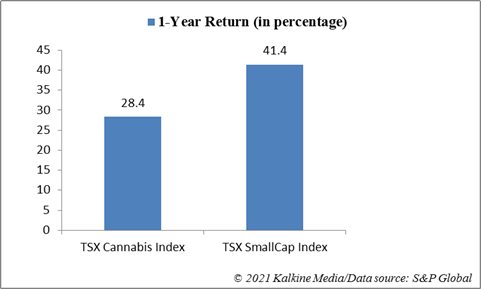
The return of the S&P/TSX Cannabis Index over one-year is 28.4 per cent. On year-to-date (YTD) basis, the index has given double digit negative returns. Options trading by speculating the move of the stocks can generate returns for the investor.
Also read: 5 Canadian cannabis stocks to buy this fall
S&P/TSX SmallCap Index
The index comprises of stocks of companies that provide investment opportunity to small-cap investors. A few names include Trillium Therapeutics Inc. and Vermilion Energy Inc.
The one-year return of the S&P/TSX SmallCap Index is a whopping 41.4 per cent. The YTD return is 15.1 percent.
Bottom line
Options trading can be rewarding when the investor has an idea of what might happen in the near-term to the stock. Retail investors are increasingly using this trading strategy. It is time we know what options trading is before placing a speculative bet.
