
 AUS
AUS
 NZ
NZ
 UK
UK
 CA
CA
 USA
USA
 IND
IND







Summary
- UK Treasury extended coronavirus support to businesses, jobs, and low-income families; but many self-employed not covered
- Manufacturers ask for a clear long-term strategy instead of a piecemeal support
Around 3 million self-employed people would be left out without any government support, despite the recent revision of the UK government self-employment income support scheme (SEISS). It would be paying for up to £7,500 for the three-monthly period of November 2020 to January 2021.
Rishi Sunak, Chancellor, UK Treasury had recently announced extending furlough scheme and raising aid for the self-employed people to protect millions of jobs across the nation and people a sense of certainty over a tough winter coming ahead.
However, not everyone impacted by the coronavirus pandemic had been covered. For instance, ExcludedUK said that millions of self-employed people such as freelancers and contractors were left out and would not be gaining from the latest SEISS scheme.
ExcludedUK is a group that represents interests of those who were unable to access any Covid-19 support from the government. It was formed in March 2020 when the pandemic broke out in the nation, after the first set of support schemes were rolled out by Sunak.
Aron Padley from Excluded UK said that the eligibility criteria are same as seven months back when the scheme was introduced. Many hard-working self-employed people who have lost everything were still not a part of the beneficiaries, he stressed.
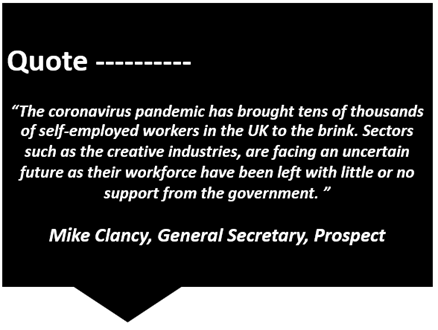
Prospect and Community, two national trade unions also had a similar opinion on the issue.
Aid for the needy
On the other hand, the UK work and pensions department had recently announced extending a new winter grant scheme worth £170 million. It will be provided to the local councils whereby at lease 80 per cent would be earmarked for food and bills for the needy. The scheme would last till the end of March 2021.
This move is expected to help people on low income to feed close to 2 million children, especially after more people had lost their jobs as a result of the coronavirus pandemic.
Thérèse Coffey, Secretary, Department for Works and Pensions (DWP) said that the government wanted to care for the vulnerable people during these difficult times. No one should sleep hungry or not be able to pay their winter bills, added Coffey. DWP handles policies for child maintenance, pensions, and welfare in the UK.
SEISS scheme
Under the scheme, the UK government would pay 80 per cent of the average trading profits for people who were self-employed. Trading profits disclosed to the HMRC in the last three years ending April 2019 were taken for calculating the average.
The period of the scheme was November 2020 to January 2021. Grants can be claimed starting from 30 November 2020.
To claim the grant, an individual must have been eligible for the previous two grants of the SEISS scheme. Individuals who have become self-employed only recently had been left out the scheme’s purview.
The first SEISS grant was meant for the period of May to July 2020 and paid for up to 80 per cent of average profits while the second one was applicable from August to October 2020 and paid for up to 70 per cent of the total earnings.
The third one had been announced as an extension of the scheme from November 2020 to April 2021. It is slated to be paid in two instalments covering a period of three-months for each.
Manufacturers urge for a strategy
Stephen Phipson, chief executive, Make UK said that while the government had extended huge support to British businesses, manufacturing as well the overall industry needed a clear strategy for its long-term sustenance and growth.
The industry was undergoing challenging times and such a plan would add stability, said Phipson.
Piecemeal and changing aid plans did not allow firms proper time to plan out for future, insisted industry experts.
Make UK asked the government to double its R&D tax credit provision and raise its accessibility to small sized firms, thereby promoting research.
The industry association also urged for securing a favourable deal with the EU and keeping the national borders open for goods, services, and key trade routes well-protected.
UK deficit
In the meantime, the budget deficit for the nation hit a value of £208.5 billion for H1 2020, which is an unprecedented value. It highlighted the government’s rising support the national economy to fight the crisis led by the coronavirus pandemic.
According to the latest data from the Office for National Statistics, government debt soared to a value of £36.1 billion for the month of September 2020.
The latest figures revealed that the public debt had climbed up to cross 103 per cent of the UK’s GDP (gross domestic product).
The fresh support for jobs and businesses is going to further burden the government exchequer and raise public debt in case tax collections also go down. Sunak had extended the furlough scheme till the end of March 2021 to contain the rising unemployment in the country and support workers effectively sail through the second wave of rising corona cases.
The furlough scheme extension could cost the government a whooping value of more than 6 billion pounds every month, as per expert estimates.
