
 AUS
AUS
 NZ
NZ
 UK
UK
 CA
CA
 USA
USA
 IND
IND


_07_03_2026_03_50_21_133108.jpg)



Investors’ confidence which was showing some signs of recovery has taken a big hit with Chancellor Rishi Sunak’s remarks that it is very likely that the UK economy is in a significant recessionary phase. Whether or not this turns true in future largely depends on the time coronavirus finally gets contained. Though some experts also hint at a bigger market fall in the current quarter if there is news of a relapse.
However, what investors can look for is the trend in the market, equity space, and tips to manoeuver through these challenging times.
The trend
The FTSE 100 index – which ascertains the performance of the largest companies in the UK – stood almost 20 percent lower at 5983 points on May 18, 2020 as compared to three months ago at 7437 points on Feb 20. Almost 80 percent of the complete market capitalization of the London Stock Exchange is constituted by the stocks listed under this index.
Even though the market seems to be moving up since its lowest recent levels seen on the UK lockdown day of March 23, this crash is likely to have caused substantial losses to many investors. And as most of the times, we do not really know if another fall is awaiting us in the recent future.
Movement in the FTSE 100 index during the past 3 months
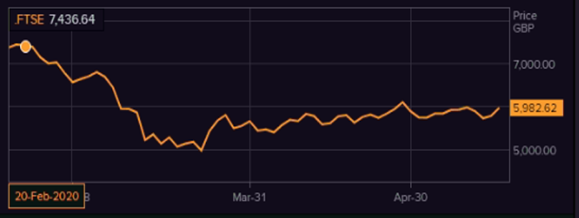
(Source: Source: Thomson Reuters, May 18, 2020)
The equity market reaction to the corona outbreak is seen since late February 2020. Sudden loss of revenue is seen in sectors of travel & tourism, airlines, automobiles, retail and oil. All these sectors are bearing the brunt of coronavirus crisis, more than most other sectors. For instance, the travel & tourism business especially is a loss with international borders closed and only emergency domestic travel operational. Ships, trains, buses nothing is plying. Hotels are shut. Similarly, consumer spending is at its lowest and coupled with the lockdown closures; the retail sales have crashed.
Movement in the FTSE Mid 250 index during the past 3 months
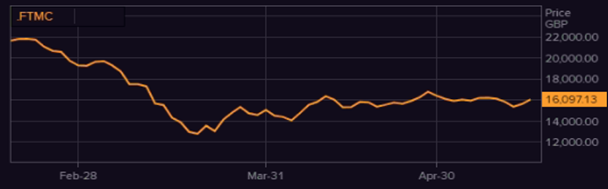
(Source: Source: Thomson Reuters, May 18, 2020)
A similar trend has been seen across the FTSE Mid 250 index, which fell by around 27 percent during the past three months (21,850.86 of Feb 20 to 16,097.13 of May 18), as can be observed from the above chart.
In fact, very few companies have escaped the stock market bear run. Many companies have even announced that the dividends could be scrapped or delayed.
The UK Chancellor, Rishi Sunak announced state loan guarantees worth £330 billion and £20 billion financial handouts to help businesses cope coronavirus led economic distress on March 18, 2020. Bank of England also lowered interest rates to a historic low level of 0.1 percent to give an investment boost. Though recovery may seem to be visible, even in the FTSE mid 250 index, moving up since March 23 again, the market continues to remain volatile as the ground-level impact of Government stimulus will only be visible in times to come.
So what next? You don’t really have to jump through the hoops to deal with a contracting market. It’s simpler than that! First and foremost, stay put whether your goal is income, growth or regular pension. Keep in mind that the equity markets will be either bullish or bearish but will never lack opportunities. What you may need to ensure as a wise investor now is that the lessons from blunders done during the earlier bull run should be avoided, to earn more and lose less from the present turbulent period.
So have a look at these 5 tips to deal with a market meltdown.
Don’t put all your eggs in a single basket
If you are an investor, your basic mantra has to be diversification. This simply means that the first step is to have a healthy mix of stocks in your bunch. Within the stock-based assets, a move towards good-quality higher-yielding holdings makes sense. A bonus tip is to invest no more than 10 percent of your portfolio in individual stocks.
The next step would be to manage the risk by mixing investments from equities, real estate and gold in your portfolio. Diversification will lower your portfolio risk by raising exposure to other asset classes that tend not to move in the same direction as equities over the same period. Like when markets crash, investors are anxious and put more money in gold, considering it safe, so its price may shoot up, and it gives a better return. Government bonds or gilts and absolute return funds are in the same category as gold. They may or may not give you high returns in the long run but do promise greater stability and capital preservation.
The bottom line is that your risk of loss is minimized with lesser exposure in any one area, so the total impact of a downturn goes down.
Make a balanced portfolio choosing industries and asset classes carefully. Keep your goals clearly in front of you while making these choices.
Have a long-term horizon
Select few FTSE shares (which have nosedived low in recent weeks) with strong credentials like a decent price to earnings (P/E) ratio that indicates the significant value, needs to be looked at. This is the ratio of a company's share price to its earnings per share and is used to find if it’s over or undervalued. Buy without forgetting that you are a part-owner of the company now. Take time to understand how it operates, its competitors and rank in the industry, its long-term strategy and if how adds to your existing equity portfolio.
Pick up these stocks and stay invested in them for a long period (maybe 5 to 10 years to reap the benefits, as appropriate). Yes, be patient. No need to keep a constant eye on the scoreboard and to overreact, you can plan to focus on the company value and not on the share price.
Do not attempt to time the market and make a quick sale. It will then be a matter of trivia to you if the market rebounds or crashes in the next few quarters. Markets are expected to rebound. If you are willing to take the plunge, the market is sure to reward you in times to come.
Get away from high debt companies
As an informed investor, try to understand the business model and fundamentals of a company before you invest in its stocks. Whenever market correction takes place, high debt companies suffer the most. As far as possible, avoid such companies. Experts have warned that companies that have been dependent on high levels of borrowings for the past decade face the fear of going out of business
Go in for companies paying dividends
Many of the top UK Companies have stopped paying out dividends or cut them, to mitigate the impact of the uncertainty caused due to the coronavirus crisis. You will be facing hardships, particularly if you are an income investor. Change your portfolio to move to a range of dividend-paying stocks while they trade at bargain prices. Many of the FTSE 100 companies will fit the bill. This will prove to be a profitable move in the long run for you.
Companies from utilities, healthcare or consumer goods space, for instance, seem to be on a stronger footing than others and could be performing well. They appear to have healthy sales with steady demand. As such, they might be maintaining their dividend plans for this year at least.
More so, select some relatively high yielding FTSE 100 dividend stocks which also offer the chances of dividend growth over a 3 to 5-year horizon, like say utility companies. Therefore, dividend shares not only will give you a high yield but will also deliver an increasing passive income.
Also, companies that may have slashed dividends for the time being but can yield results later should still be looked at.
Staggered buying and selling
With a staggered buying, you will not fall into the classic trap of buying high and selling low. Keenly observe the market moves and gradually keep buying inherently strong companies in a staggered way.
Since it’s tough to catch the market at its trough, the best way is to buy slowly and not at one go. Plan as per your level of wealth, income requirements, age, and volatility tolerance.
For some systematic investors, staggering also means buying over years or even decades. It is certain to lower your exposure to price volatility. There is no single fool proof strategy, but you can choose from options such as buying once a month/week, buying in three parts, or buy a select basket instead of one company if you are confused what to do.
Finally, be aware of scammers who are on the lookout to make a quick buck. Go in for a reputable investment firm only.
