
 AUS
AUS
 NZ
NZ
 UK
UK
 CA
CA
 USA
USA
 IND
IND







Highlights
- Air Canada (TSX:AC) stock has been rebounding from its pandemic miseries amid relaxing COVID-19 measures.
- Since its record dip in March 2020, Air Canada stock has jumped by over 79 per cent.
- The ongoing surge in oil prices has triggered some concerns regarding airline stocks.
Air Canada (TSX:AC) stock has been rebounding from its pandemic miseries amid relaxing COVID-19 measures. Its latest financials have also been reflecting recovery. Now that travel seasons are back on, Canadian investors are wondering if they can go back to this top airline’s stock. Here are a few things to take note of before doing so.
Air Canada (TSX:AC) stock’s fall and recovery
Before the COVID-19 outbreak, stocks of Air Canada were flying at a value of around C$ 50 apiece in January 2020. But as the pandemic hit in March 2020, AC stock fell drastically to C$ 12 per share amid rapid lockdown and border restriction implementations worldwide.
Since its record dip to a price of C$ 12.15 on March 19, 2020, Air Canada stock has jumped back to C$ 21.77 (as on Thursday, June 2). This is a notable expansion of over 79 per cent.
Air Canada has expanded its international schedule for this summer and relaunched 34 routes to expedite its recovery process in 2022. The flier inaugurated a cold chain handling facility at the Toronto Pearson Cargo Hub in March. The mid-cap company also increased its South Pacific footprints and acquired 26 Airbus A321neo aircraft in March and so on.
Also read: ATD, L, MRU, NWC, EMP.A: 5 TSX retail stocks to buy in June
The company also increased its cargo flights and capacity, especially to maintain Vancouver’s supply chain network during floods in November 2021.
The ongoing surge in oil prices has triggered some concern among people interested in the stocks of airline companies. Air Canada, for one, dedicates a significant portion of its operational expenses to jet fuel.
However, the airline company says that it has been exploring sustainable aviation fuel, carbon removal and decarbonatization technology.
Let us take a peek at its financials next.
Air Canada (TSX: AC) Q1 2022 financial results
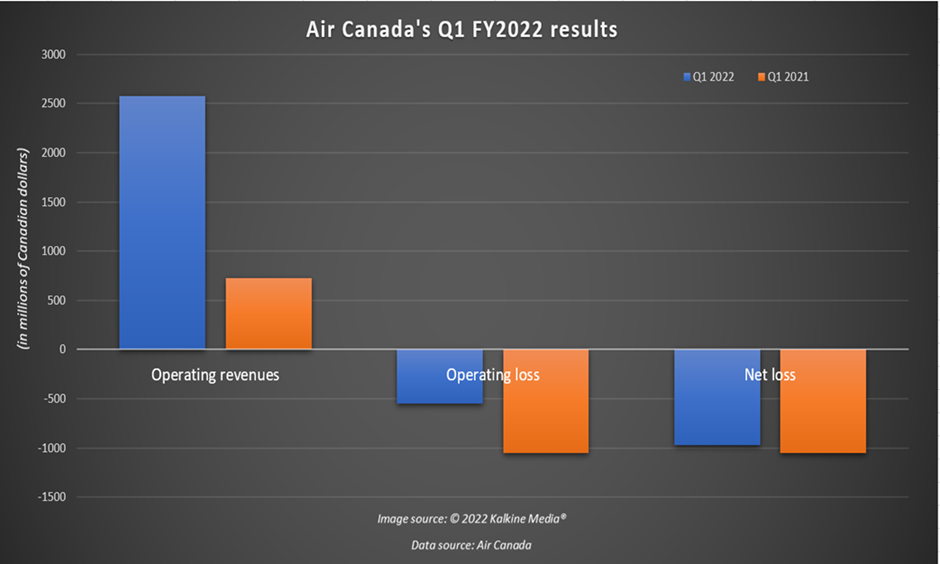
Air Canada improved its operating capacity by approximately 3.4 times in the first quarter of FY2022 compared to Q1 2021. The airline reported that its passenger revenue grew five times to C$ 1.91 billion in Q1 2022 compared to the previous year’s quarter.
Air Canada also recorded operating revenues of C$ 2.57 billion in the latest quarter, 3.5 times higher than Q1 2021. However, its operating expenses surged by 76 per cent year-over-year (YoY), leading to a net loss of C$ 974 million in Q1 2022, less than C$ 1.3 billion a year ago.
Air Canada stock performance
Having closed at C$ 21.77 on June 2, Air Canada stock posts a year-to-date (YTD) gain of about three per cent. AC stock has, however, declined by over 19 per cent in the past one year.
According to EODHD/Others, AC’s Relative Strength Index (RSI) value was 53.59 on May 30, marking a balanced position between an oversold and overbought market situation.
Also read: 5 Canadian vegan stocks for June as Kim Kardashian joins Beyond Meat
Bottomline
The increasing prices of jet fuels could take out a chunk of its revenues, affecting its profitability. Also, recession fear may impact Air Canada’s recovery by influencing consumers’ behaviour and market sentiments. But it is worth noting that Air Canada stock, while recovering, is still significantly discounted as compared to its pre-pandemic days.
Hence, Air Canada could be an explorable option for long-term growth, especially as a low-priced stock, but it also comes with its own bag of risks.
Please note, the above content constitutes a very preliminary observation based on the industry, and is of limited scope without any in-depth fundamental valuation or technical analysis. Any interest in stocks or sectors should be thoroughly evaluated taking into consideration the associated risks.
