
 AUS
AUS
 NZ
NZ
 UK
UK
 CA
CA
 USA
USA
 IND
IND







Highlights
- It is important to keep in mind it that the green energy industry is likely to be a gamechanger in the future.
- As the awareness around clean energy rises over the years, companies involved in this space are likely to see a rise in demand too.
- The S&P/TSX Renewable Energy and Clean Technology Index, however, has not been performing extraordinarily this year.
The S&P/TSX Renewable Energy and Clean Technology Index may not have been performing extraordinarily this year, but it is important to keep in mind it that the green energy industry is likely to be a gamechanger in the future.
The challenge to combat the ill-effects of climate change is one that the world will be facing for decades to come. As the awareness around clean energy rises over the years, companies involved in this space are likely to see a rise in demand too.
So, let’s look at some green energy stock listed on the Toronto Stock Exchange (TSX) that investors can keep in their portfolio for the long run.
Also read: Which TSX energy stocks to buy as oil hits highest price since 2014?
1. Northland Power Inc (TSX: NPI)
The Toronto-based renewable energy player had a notable price-to-earnings (P/E) ratio of 47.4 and a return on equity (ROE) of 9.92 per cent, as of Monday, October 18.
Northland Power owns and runs infrastructure for green energy production, with a major focus on offshore wind production
The clean power stock was down by about 10.34 per cent year-to-date (YTD) and lost roughly 4.5 per cent year-over-year (YoY).
The Canadian player also pays a dividend of C$ 0.1 per piece to its shareholders on a monthly basis, which held a dividend yield of 2.946 per cent as on October 18.
Northland Power’s dividend, which grew by nearly 2.94 per cent in the last five years, is due next on October 15 this year.
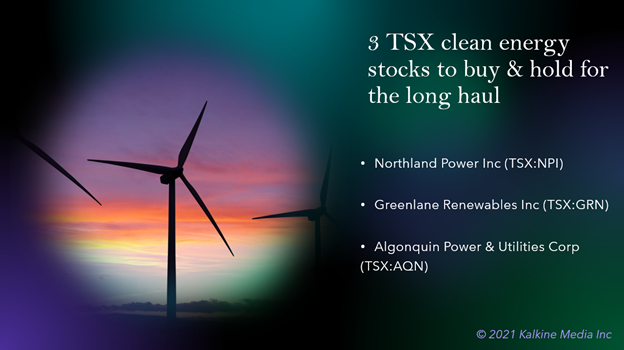
2. Greenlane Renewables Inc (TSX: GRN)
Engaged in the manufacture and distribution of biogas upgrading systems, Greenlane Renewables’ products create renewable natural gas from organic waste sources like landfills, dairy farms, waste water, etc.
While it garners most of its revenue from its businesses in the North America regions, it also has a presence in Europe.
As of October 18, the clean energy player held a market cap of about C$ 228 million and a price-to-book (P/B) ratio of 4.
The Burnaby, Canada-based energy producer’s stocks posted a one-year return of 129 per cent and rose 10 per cent on a month-to-date (MTD) basis.
Also read: Fobi (TSXV:FOBI) surged 650% in a year! A Canadian AI stock to buy?
3. Algonquin Power & Utilities Corp (TSX: AQN)
Algonquin Power & Utilities Corp, which provides green utility and power solutions, pays a significant dividend of US$ 0.171 per piece to its shareholders on a quarterly basis. Due to be paid on October 15, Algonquin noted a dividend yield of 4.591 per cent as on October 18.
Algonquin’s utilities operations spans across regulated water, natural gas and electricity distribution. Earlier in October, the green energy company reported that in its 33 years of operations, it has come to own, manage or have interests in more than 4,000 MW of clean energy capacity.
The Oakville, Canada-based company also said that its green power generation capacity consists of more than 60 per cent of its total capacity, which places it on track to hit its goal of being 75 per cent dependent on clean courses by 2023-end.
As for its stock performance, Algonquin Power & Utilities Corp saw its share prices drop almost nine per cent in the past year and by 4.66 per cent in the last month.
Also read: Is Enbridge (TSX:ENB) a great dividend buy after Line 3 permit?
Bottom line
The rising anxiety around the oil supply crunch all around the world has been keeping investors on their toes. And as more countries and agencies look to quench this crude shortage, the debate around transitioning to clean energy has cropped to the surface again.
While clean energy production is likely to feel the heat of oil shortage as well, some market experts note that this turbulence should also serve as a reminder of the need to transition to more renewable power sources.
While the actual transition is a long and painful process, it aims at reducing the stress on the environment. And this increasing dependence on clean power is what could make the industry one watch out for in the long run.
