
 AUS
AUS
 NZ
NZ
 UK
UK
 CA
CA
 USA
USA
 IND
IND

.jpg)

_06_19_2026_10_41_46_758506.jpg)



Summary
- FTSE 100 plunged sharply after UK inflation rate soared to highest in pandemic era
- The annual inflation rate in the UK surged to 1.5 per cent in April 2021
- Rise in motor fuels prices contributed majorly towards the sharp uptick in inflation
- Dow Futures falling over 0.90 per cent also battered the sentiments
- Inflationary fears resurfaced with Canada’s inflation hitting a decade high
The benchmark FTSE 100 plunged sharply, extending the morning losses, on Wednesday, 19 May, after the UK CPI inflation rate in April 2021 more than doubled. The rising fears of sudden spike in the inflation rate of the United Kingdom has once again unnerved the sentiments of investors.
According to the data released by the Office for National Statistics (ONS), the annual inflation rate in the UK surged to 1.5 per cent in April 2021 as compared to a sub-1 per cent, rate of 0.7 per cent in March.
Also Read | Lloyds Recovery Tracker Records Output Growth Across Sectors
The inflation rate of 1.5 per cent has been the highest reading since March 2020, as most of the sector in the UK reopened according to the planned easements, steering a gradual jump in the prices of several goods and commodities.
The resumption of most of the halted indoor, as well as outdoor activities and the forthcoming plans of the government to restart a large section of businesses that have to shut their operation have escalated the prices.
Also Read | What do Rising Bond Yields Indicate About the Economy?
The removal of the fixed cap on the energy bills after the relaxation from lockdown restrictions has had a major impact on the motor fuel prices. The motor fuel prices in April rose 13.6 per cent as compared to an increase of 3.5 per cent in March, after the price cap returned to pre-pandemic levels to £1,138 from £96. The massive change in the upper cap for motor fuels resulted in a substantial spike in the wholesale energy prices.
The rising bills of household utility and subsequent surge in the clothing prices, effectively contributed to the jump in inflation rate. However, the downward contribution on the back of drop in prices of recreation and culture partly offset the upward contributions, the ONS data indicated.
Also Read | APAC markets a sea of red; ASX200 bleeds AU$40 billion
The futures linked to Dow Jones Industrial Average (DJIA) falling over 0.90 per cent, cumulatively battered the sentiments of the market participants. As per the latest data, the Dow futures were trading at 33,687, down 0.91 per cent, indicating a negative start to Wall Street.
According to the data available with London Stock Exchange, the headline FTSE 100 dropped as much as 1.55 per cent, to an intraday bottom of 6,925.10 in the afternoon session from the previous close of 7,034.24.
FTSE 100 chart (19 May)
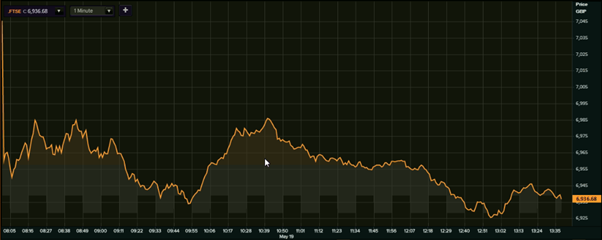
(Source: EODHD/Others, Thomson Reuters)
The losses of mid-cap barometer FTSE 250 remained under 1 per cent. The market index was trading at 22,169.42, down 0.73 per cent, while the wider share indicators FTSE 350 and FTSE All-Share dipped more than 1 per cent, in line with the fall in FTSE 100.
The inflationary pressure has again hurted the equities with the annual inflation rate in Canada rising to its highest level since May 2011. According to the date released by Statistics Canada, the annual inflation rate in the country soared to 3.4 per cent in April with almost every component witnessing an increase in the prices. Institutional investors remained skeptical ahead of the release of FOMC minutes, slated to be unveiled in the later part of the day.
