
 AUS
AUS
 NZ
NZ
 UK
UK
 CA
CA
 USA
USA
 IND
IND




_06_16_2026_06_12_08_773360.jpg)


What is Novel Coronavirus?
Background â Since December 08, 2019, a few instances of pneumonia of obscure aetiology were cited in Wuhan, Hubei territory in China. Most of the patients were those who worked at or lived around the Huanan seafood market, where some live animals had also been reported to be on sale. In the early stages of this pneumonia, severe acute respiratory disease signs appeared, with certain patients immediately establishing Acute Respiratory Distress Syndrome (ARDS), intense respiratory failure, and various other complexities. On January 07, 2020, a novel coronavirus was recognised by the Chinese Center for Disease Control and Prevention (CDC) from the throat swab test of a patient and was confirmed the 2019 n-CoV (2019 â Novel Coronavirus) by the WHO.
As per the World Health Organisation (WHO), Coronaviruses (CoV) are a huge group of viral infections causing sickness ranging from the normal virus to extreme illnesses. This can include Severe Acute Respiratory Syndrome (SARS-CoV) and the Middle East Respiratory Syndrome (MERS-CoV). A novel coronavirus (nCoV) is another strain that has not been previously observed in homo sapiens. Coronaviruses are zoonotic, which means they are transmitted among animals as well as humans.
What is the UK doing to stop this outbreak?
In a global epidemic, this novel Coronavirus has impacted around 9800 people across the world, most of them, Chinese, with 362 individuals confirmed dead from this outbreak. On January 31, 2020, Coronavirus reached the United Kingdom as well, when two individuals from the same family tested positive for the infection. As proof of human transmission outside of China mounts, cases in Germany, Taiwan, Vietnam and Japan included patients who had not been to China, the difficulty of stemming the progression of the infection is looking harder than expected. The United Kingdom has finally announced the Coronavirus epidemic as severe and impending risk to public health. Through this declaration, now the government is legally armed to force people to quarantine, sending them into isolation.
In earlier measures to put a stop to this in the United Kingdom and contain the spread of Coronavirus, lots of actions were being taken. In terms of the precautionary measures, medical staff, equipped to handle this disease, have been stationed on the airports, especially at the Heathrow. This strategy has been termed as advanced monitoring. Other than this, the British Administration issued travel advisory to all travellers, especially to the passengers travelling to and from China, regarding the prevention and potential cures of the virus.
The British administration has also pledged an amount of £20 million to finance the development of a vaccine that could potentially cure the Coronavirus. As per the announcement, the finances will be for the Coalition for Epidemic Preparedness Innovations (CEPI), an institution founded specially to fight against such epidemics.
The drugmakers and biotechnology company have warned that it may take a while to develop such a medicine, and it could take up to an year after all clinical trials and tests for it, is available for the public use. A large number of biotech companies in the UK and across the world have started research and development of such vaccines, and this has seen the shooting up of biotech stocks in the last few days.
The following is the list of UK based Pharmaceuticals and biotechnology companies whose shares are likely to remain in action in the coming days, as they race-up to develop the first vaccine/medicine that can work against the novel Coronavirus.
AstraZeneca Plc (LON:AZN) Share Price Performance
As on 10th February 2020, at 11:00 A.M (Greenwich Mean Time), by the time of writing this report, the AstraZeneca Plc share has been reported to be trading at a value of GBX 7631.00 per share on the London Share Exchange Market, a fall in the price of 0.70 per cent or GBX 54.00 per share, as opposed to the price of the share on the previous trading day, which had been reported to be at GBX 7685.00 per share. The market capitalisation (M-Cap) of the share stood at a value of GBP 100.84 billion, with respect to the current market price of the share of the company at the time of writing this report.
AstraZeneca Plc share had gained around 34.32 per cent in value, in the last twelve months, since February 11, 2019, when the stock was trading at a price of GBX 5681.00 per stock at the time of the close of the market. It has also been reported that the companyâs stock has gained approximately 3.81 per cent, in the last six months, in comparison with the stock price of GBX 7351 per share at the time of the close of the market as on August 09, 2019. AstraZeneca Plcâs stock has been reported to have lost 0.18 per cent, in last 30 daysâ time from the stock price of GBX 7645.00 per stock that the stock set as on January 10, 2020.
AstraZeneca Plcâs beta was reported to be at 0.84, indicating the fact that the share price movement of the AstraZeneca Plc share, is less volatile, as against the movement of the comparative benchmark index.
Â
GlaxoSmithKline Plc (LON:GSK) Share Price Performance
As on 10th February 2020, at 11:05 A.M (Greenwich Mean Time), by the time of writing this report, the GlaxoSmithKline Plc share has been reported to be trading at a value of GBX 1696.80 per share on the London Share Exchange Market, a fall in the price of 0.20 per cent or GBX 3.40 per share, as opposed to the price of the share on the previous trading day, which had been reported to be at GBX 1700.20 per share. The market capitalisation (M-Cap) of the share stood at a value of GBP 84.84 billion, with respect to the current market price of the share of the company at the time of writing this report.
GlaxoSmithKline Plc share had gained around 9.47 per cent in value, in the last twelve months, since February 11, 2019, when the stock was trading at a price of GBX 1550.00 per stock at the time of the close of the market. It has also been reported that the companyâs stock has gained approximately 16.20 per cent, in the last six months, in comparison with the stock price of GBX 1669.80 at the time of the close of the market as on August 09, 2019. GlaxoSmithKline Plcâs stock has been reported to have lost 5.60 per cent, in last 30 daysâ time from the stock price of GBX 1797.40 per stock that the stock set as on January 10, 2020.
GlaxoSmithKline Plcâs beta was reported to be at 0.80, indicating the fact that the share price movement of the GlaxoSmithKline Plc share, is less volatile, as against the movement of the comparative benchmark index.
Â
PureTech Health Plc (LON:PRTC) Share Price Performance
As on 10th February 2020, at 11:10 A.M (Greenwich Mean Time), by the time of writing this report, the PureTech Health Plc share has been reported to be trading at a value of GBX 305.00 per share on the London Share Exchange Market, a surge in the price of 0.33 per cent or GBX 1.00 per share, as opposed to the price of the share on the previous trading day, which had been reported to be at GBX 304.00 per share. The market capitalisation (M-Cap) of the share stood at a value of GBP 867.82 million, with respect to the current market price of the share of the company at the time of writing this report.
PureTech Health Plc share had gained around 75.96 per cent in value, in the last twelve months, since February 11, 2019, when the stock was trading at a price of GBX 173.33 per stock at the time of the close of the market. It has also been reported that the companyâs stock has gained approximately 6.27 per cent, in the last six months, in comparison with the stock price of GBX 287.00 at the time of the close of the market as on August 09, 2019. PureTech Health Plcâs stock has been reported to have gained 9.32 per cent, in last 30 daysâ time from the stock price of GBX 279.00 per stock that the stock set as on January 10, 2020.
PureTech Health Plcâs beta was reported to be at 0.89, indicating the fact that the share price movement of the PureTech Health Plc share, is less volatile, as against the movement of the comparative benchmark index.
Â
Genus Plc (LON:GNS) Share Price Performance
As on 10th February 2020, at 11:15 A.M (Greenwich Mean Time), by the time of writing this report, the Genus Plc share has been reported to be trading at a value of GBX 3174.00 per share on the London Share Exchange Market, a surge in the price of 0.44 per cent or GBX 14.00 per share, as opposed to the price of the share on the previous trading day, which had been reported to be at GBX 3160.00 per share. The market capitalisation (M-Cap) of the share stood at a value of GBP 2.056 billion, with respect to the current market price of the share of the company at the time of writing this report.
It has been reported that the Genus Plc share had gained around 40.94 per cent in value, in the last twelve months, since February 11, 2019, when the stock was trading at a price of GBX 2252.00 per stock at the time of the close of the market. It has also been reported that the companyâs stock has gained approximately 21.05 per cent, in the last six months, in comparison with the stock price of GBX 2622.00 at the time of the close of the market as on August 09, 2019. Genus Plcâs stock has been reported to have gained 1.93 per cent, in last 30 daysâ time from the stock price of GBX 3114.00 per stock that the stock set as on January 10, 2020.
Genus Plcâs beta was reported to be at 0.90, indicating the fact that the share price movement of the Genus Plc share, is slightly less volatile, as against the movement of the comparative benchmark index.Â
Comparative share price chart of AZN, GSK, PRTC and GNS
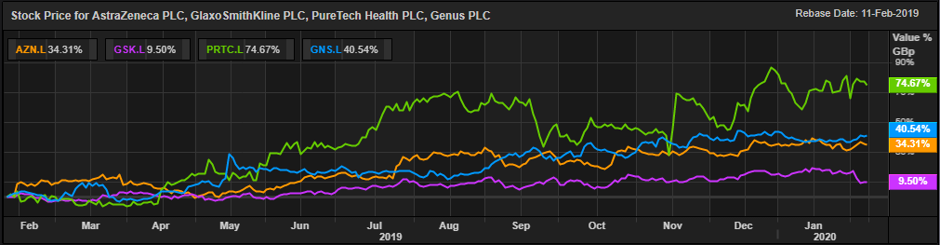
(Source: Thomson Reuters) Daily Chart as on 10-February-20, before the closing of the LSE Market
