
 AUS
AUS
 NZ
NZ
 UK
UK
 CA
CA
 USA
USA
 IND
IND






Summary
- Due to the coronavirus pandemic, both the companies and employees are taking a calculated approach for restarting offices as pre-pandemic times, escalating the debate on WFH.
- The issues of productivity, public transport, social distancing, office space utilisation, and reopening of schools are the key elements being considered.
- The CBI has urged the corporations and the government to achieve a balance ensuring shops in city centres, that depend mostly on the office goers for their business, do not suffer losses.
The debate on work from home (WFH) has escalated after the lockdown restrictions were eased and the government encouraged people to start re-engaging in business activities. Though mostly for the white-collar workers, technology came as a saving grace as they could adapt to WFH systems. Given the fear of contagion and recent spike in infection cases, possibly leading to a second wave of coronavirus, both the companies and employees are taking a calculated approach to restarting office as pre-pandemic times. In the midst of all this, what about the businesses that depend mostly on the daily commuters to work? The Confederation of British Industry (CBI) that speaks on behalf of 190,000 businesses that together employ a workforce of around 7 million people or almost one-third of the private sector-employed staff, has urged the corporations and the government to achieve a balance ensuring shops in city centres do not face oblivion.
Some reasons for the cautious approch taken by the employers
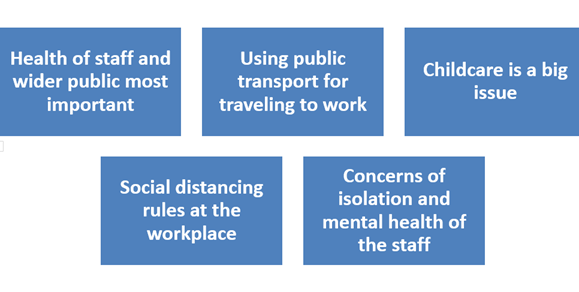
Observing that WFH has been a success for several corporations and workers alike and the benefits need to be preserved, the CBI raised its worries regarding the business loss and adverse effect that it could have on the businesses that operate in the town and city centres and rely mostly on the trade generated by the office goers. In this context, it is the responsibility of both the government and companies to support more people rejoin their offices safely and securely, clarified the trade body. The CBI felt that things would not return to pre-pandemic times and nor should they be hurried, but a mid-way is required as the economy has reopened.
Some solutions being considered
Public transport gears up to increase capacity
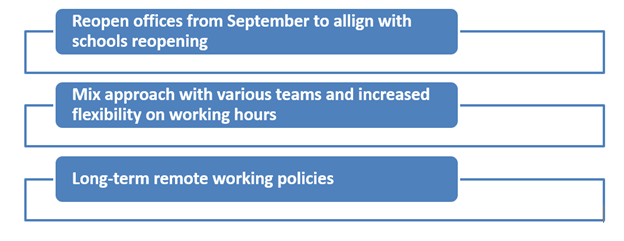
Public transport including the trains said on 26 August 2020 that they are increasing their services to normal levels with capacities to reach above 90 per cent during the second week of September 2020. The train operators would do this to accommodate the increase in number of commuters because of schools reopening and parents rejoining offices. To help the commuters follow social distancing norms, the national rail’s Alert Me app would offer up-to-the-minute details about which trains are busy. However, it is unlikely that the reopening of schools would bring the peak of commuters back as several companies are yet to have a concrete plan in place to make their employees rejoin offices.
What companies say about reopening of offices?
According to the CBI, many companies are yet to alter their approach to returning to the office, with many offices are filling less than 20 per cent capacity and others still discussing with their staff. Though WFH is not a new thing as several IT and ITES companies providing this option to many of their workers even in pre-pandemic era, it has just entered swiftly in various other sectors with the pandemic-induced lockdown and continued even after the lockdown restrictions were lifted-thanks to the health advisory on social distancing and increased fear of catching an infection in close door environments. Several businesses are finding that WFH has been a success for them with no negative impact on the overall staff productivity.
Some companies including the KPMG, a multinational professional services firm have implemented a three-phase plan for returning to office. At KPMG, beginning from July 2020, the business-critical employees were asked to rejoin office that filled up to 5 per cent capacity. The second phase started a month later, allowing up to 20 per cent of the staff to work from office on a voluntary basis. The company is waiting for the government’s advice and how the rate of Covid-19 infection unfolds itself in coming times to begin phase three. The third phase would allow up to 50 per cent of the team to commence work from office. The staff at PricewaterhouseCoopers (PwC) another professional services company has been encouraged to return to work on a voluntary basis and hopes to have around 50 per cent of the company’s workforce back at office by September 2020. PwC would look to cut office attendance from five days a week to three or four days a week due to the pandemic. PwC mentioned that its employees were willing to return to work after months of lockdown to venture out the house and assist local businesses.
Also read: Work from Home Becoming the New Norm for More Than Half of Britons
Also read: Work from Home and Changing dynamics of the Banking landscape
Also read: Suburbs Lead Recovery in The UK As More And More People Work from Home
Does WFH impact productivity?
The July 2020 growth indicator by CBI found out that the period of coronavirus pandemic is too short to conclude concretely that productivity has suffered. Given the better work life balance, it is likely that there would be long-term benefits with the shift towards a WFH scenario. Several studies conducted within the business fraternity have shown a considerable increase in productivity among remote workers. However, due to schools being closed and childcare providers not operating their services, there have been noteworthy differences among male and female employees. According to expert estimates, with schools reopening in September, there is a great probability that this gap would decrease and results would be much better.
The impact of social distancing
The health advisory on social distancing in the ongoing fight against the coronavirus pandemic is very crucial when it comes to the offices operating at full capacity. Companies need to judge what effects social distancing would have on their operations. The concerns on plans of the companies regarding their office space and future working environment amid social distancing norms showed that on an average, a distance of two metres would decrease the operating capacity of businesses by over 25 per cent, while one metre would make it fall by 15 per cent.
What impact WFH would bring to office space?
The outcome of the study conducted by the CBI presented that 37 per cent of the firms have already started speaking or planning to hold discussions with landlords and managing agents to review their office space requirements for future. While banks have topped the chart with 88 per cent reporting a review of office space, the manufacturing sector occupied the bottom space with only 18 per cent going for reviews. Given both social distancing and WFH, 47 per cent of the firms believed that they required only 70 per cent of their current office space.
Will reopening of schools lead more employees to rejoin office?
Believing that there was no assurance regarding things returning back to normal with reopening of schools, the Institute of Directors, a business organisation for company directors, senior business leaders and entrepreneurs stressed that WFH suits several companies and their employees alike as travel costs reduce to a minimum. The advantages of office cannot be denied as it offers more relaxed and a professional working environment. But the pandemic is expected to witness a lasting trend of WFH for some office jobs. Sharing a similar sentiment, the Trades Union Congress (TUC) that supports trade unions and stand up for people who work for a living suggested the companies should not think that reopening of schools could result in people rejoining offices. It is important to note that majority of childcare facilities are yet to start their operations. The TUC added that the employers need to be flexible where parents would need childcare, besides ensuring that the staff could travel safely to work. It is the task of the employers to conduct risk assessments to guarantee employees could return safely and share the findings with the workforce.
Conclusion
The coronavirus pandemic has changed the way people look at many things. First the outbreak of the pandemic enforced stay at home orders, then the lockdown easing measures encouraged people to come out and engage in business activities. Many companies put the health of their employees on top before asking them to rejoin office. Few have reopened office for staff but are working with much lower capacities than pre-pandemic times. While some companies have already indicated on permanent WFH for their team at least till mid-2021, others are encouraging their staff to either volunteer to rejoin office or making arrangements for employees who want to rejoin office due to several reasons. On the other hand, there are businesses that are facilitating employees with systems and infrastructure like laptops to facilitate employee engagement and increase productivity. Given the world sees a safe and effective vaccine in coming times and the pandemic decimates, the debate on WFH is going to stay for future as well because it is not only the pandemic that that brought the shift, it is the technology that has facilitated the shift. Several experts agree that both the companies and the employees need to make better use of newer technologies to increase productivity and better employee engagement, ultimately leading to a smooth work-life balance.
