
 AUS
AUS
 NZ
NZ
 UK
UK
 CA
CA
 USA
USA
 IND
IND






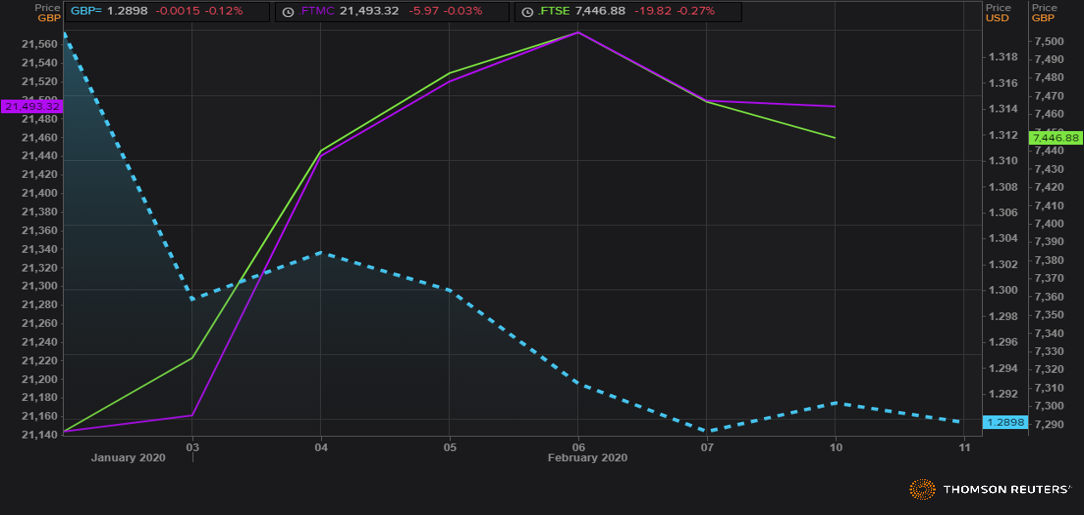
GBP, FTSE 100 and FTSE 250 daily price chart from Brexit day (January 31st, 2020 to February 10th 2020. (Source: Thomson Reuters)
The first stage of Brexit is concluded; It ended 47-year long UK-EU relationship!
Britain has formally left its 47-years old EU membership on January 31st, 2020 and entered into a 11-month long transition period. During this period, the UK will continue to adhere to the EU rules and regulations. Some of things will continue to be the same while there will be changes in others.
This include that there will be no representative member from the UK in European Union Parliament, there will be no more EU summits, which implies that PM Johnson will have to be specifically invited if he wants to be a part of other leaders at EU council summits in the future.
Blue passport is going to return after almost 30-years as the British passport will change colour. In 2017, the then Immigration Minister of the UKÂ announced the return of the "British Iconic blue-and-gold design" passport, which was first used in 1921.
Another important point is, Germany is not going to extradite its citizens to the UK. It means it would not be possible for some suspected criminals to be brought back to London if they flee to Germany. This is because Germany vows not to extradite its citizens to any other country unless it is another EU member country.
How did the British currency (GBP) react since the Brexit day?
Since Brexit delivered on January 31st, 2020, British Pound has plummeted sharply against the US greenback from 1.318 to as low as 1.2873. Since Brexit day, the British currency has given up more than 1.36%, so far (till February 10th, 2020). The renewed fears of a no-deal exit of the UK from the bloc at the end of 2020 has further jolted traderâs sentiments and led them to go short on the GBP.
Also, at the February 10th, 2020 closing, the GBP/USD traded below its crucial long-term support level of the 200-day simple moving average- 1.3007, which reflects that long-term trend in unfavourable and 20-day SMA could act a crucial resistance in this case.
However, it managed to trade above its 5-day, 10-day, 20-day, 30-day and 50-day moving averages, which are near-term and short-term support levels for the pair.
There could be bigger volatilities in the upcoming months of 2020, as trade negotiations start between both sides.
FTSE 100 Index surged over 2% since Brexit day
The broader equity benchmark of the UK surged approximately 2.21% since Brexit day to February 10th 2020. A lot of gains in the FTSE 100 constituents are because of a fall in the British Pound. A vast majority of the FTSE 100 constituents are more of global companies and derive a majority of their earnings from the abroad markets. Therefore, a fall in GBP against the USD increases repatriation gains arising from currency translation, for these companies. This gives rise to an inverse correlation between FTSE 100 index and the GBP.
There were total 78 stocks out of FTSE 100 constituent, which managed to trade in either green or flat, since the Brexit day. Here, we are sharing a list of FTSE 100 stocks which performed extremely well since Brexit day.
| Ticker | Company Name | Total Return (2020-01-31:2020-02-10) | Closing Price (GBX) (As on February 10th, 2020) |
| SKG.L | Smurfit Kappa Group PLC | 12.6% | 2962 |
| EVRE.L | EVRAZ plc | 10.4% | 389.2 |
| TUIT.L | Tui AG | 10.0% | 856 |
| FERG.L | Ferguson PLC | 9.5% | 7448 |
| PRU.L | Prudential PLC | 8.2% | 1463.5 |
| AHT.L | Ashtead Group PLC | 8.0% | 2652 |
| SMT.L | Scottish Mortgage Investment Trust PLC | 7.7% | 626 |
| MNDI.L | Mondi PLC | 7.6% | 1663.5 |
| SMDS.L | DS Smith PLC | 7.5% | 366.1 |
| JETJ.L | Just Eat Takeaway.com NV | 7.3% | 7605 |
*Source: Thomson Reuters.
Mid-cap Index FTSE 250 increased ~1.65% since Brexit day, despite a fall in GBP
The mid-cap gauge of the UK stock market or domestically exposed stocks, the FTSE 250 added ~ 1.65% since Brexit day. However, this is a bit strange as fundamentally there is a direct relationship between the British Pound and FTSE 250 index, as a plunge in pounds against the basket of majors could weigh on the FTSE 250 constituents too. However, a sharp plunge in the oil prices over the past couple of weeks also have strengthened equities, as a fall in oil prices could have direct positive impacts on the economy and businesses as well.
There were total 184 stocks out of FTSE 250 companies which traded either higher or flat since the Brexit day. Here, we are sharing a list of FTSE 250 stocks which accumulated the highest gains since the Brexit day.
| Ticker | Company Name | Total Return (2020-01-31:2020-02-10) | Price Close (GBX) (As on February 10th, 2020) |
| BEZG.L | Beazley PLC | 12.0% | 606.5 |
| APAX.L | Apax Global Alpha Ltd | 11.1% | 182.75 |
| SYNCS.L | Syncona Ltd | 11.0% | 237.5 |
| PETSP.L | Pets at Home Group PLC | 10.3% | 311 |
| KNOS.L | Kainos Group PLC | 9.9% | 868 |
| GFRD.L | Galliford Try Holdings PLC | 9.8% | 163.86 |
| AVST.L | Avast PLC | 8.8% | 462.2 |
| VMUK.L | Virgin Money UK PLC | 8.2% | 177.7 |
| FCSS.L | Fidelity China Special Situations PLC | 7.9% | 238 |
| GAW.L | Games Workshop Group PLC | 7.2% | 7110 |
*Source: Thomson Reuters.
However, a renewed fear of a no-deal Brexit could weigh significantly on the domestically exposed assets of the UK, i.e., Pound Sterling and FTSE 250 index in the future. Though oil has provided some support to the domestically exposed companies, any trend reversal in oil prices could also bring large volatility in the UK equity market, especially in mid-caps and small-caps arena.
A smooth and market-friendly negotiated trade agreement between UK and EU during the transition period would bring substantial upsides to the London Stock Exchange-traded equities, primarily in domestic asset classes like Pound and domestically exposed equities, as well.
