
 AUS
AUS
 NZ
NZ
 UK
UK
 CA
CA
 USA
USA
 IND
IND






Summary
- There has been a conspiracy theory doing the rounds that 5G is causing Coronavirus
- 5G towers are being sabotaged and vandalised even though the theory has no scientific evidence
- Ofcom test reports have nullified the possibility of a link between Coronavirus and 5G
- 5G network could help the telecom sector grow by leaps and bounds
There has been a conspiracy theory doing the rounds across the globe that the novel Coronavirus is caused by 5G technology. This theory is making headlines in the mainstream media and has been trending on social media platforms since January this year. This theory was backed by the argument that, the Spanish Flu (1918) was caused by the invention of Radio. In addition, the 5G network is also blamed for causing Infertility, and many other disorders with baseless theories.
According to this theory, the 5G technology damages the human immune system. The claim has spread across the internet as fast as the novel coronavirus itself. If we talk about the UK in particular, 5G was introduced in 2019. This theory gains gravity from the fact that the inception of this technology took place in Wuhan (China), which is the same place where the novel Coronavirus originated. This is purely a coincidence. Some theories even claim that 5G technology absorbs oxygen. According to this theory, 5G technology is causing this pandemic, which is the largest global coverup in history.
People seem to have started believing in this theory in recent times. In the UK, 5G towers are being sabotaged and vandalised by people. Telecom workers are facing abuses from the activists across the UK. This is how fake news could lead to criminal activities and vandalism, which consequently can take down the essential network infrastructure during the darkest hours of an unprecedented crisis caused by Covid-19.
What does science say?
Experts believe that this theory is utter nonsense during these critical times. A virus has a physical existence which could be seen through microscopes. It is hard to believe that a 5G network could transmit a physical thing like a virus. The deadly pandemic has engulfed more than 210 nations till date. Most of these nations do not even use the 5G technology.
5G network is made up of higher frequencies, which are likely to carry significantly higher radiation. However, there is a huge difference between safe and unsafe frequencies. The unsafe frequencies include ultraviolet (UV), X-rays, and Gamma rays’ radiations. These kinds of ionising radiations could damage the DNA and cause Cancer in humans.
5G network uses higher frequency waves which cannot pass through physical objects and could only travel to shorter distances. This is the reason why a lot of smaller versions of base stations often referred to as small cells are being installed in densely populated areas. This implies that the humans would be exposed to more radio frequency (RF) waves overall due to the addition of the higher wavelengths from 5G networks. However, as RF waves are less likely to penetrate the human body, the theories of 5G networks damaging the human body should be deemed baseless.
However, the 5G network comprises of non-ionising radiations and meets all the mandatory safety standards. The telecom authority in the UK, Ofcom has carried out EMF (Electromagnetic Field) measurements at more than 20 locations near 5G network across the UK, and the results were in accordance with the international standards issued by the ICNIRP (International Commission on Non-Ionizing Radiation Protection) Guidelines.
The 5G network uses SUB-6 GHz airwaves that are between the most common 4G and Wi-Fi frequencies. This bandwidth has been in use by existing systems for more than a decade.
Prominence and need of 5G
The fifth generation of wireless data networks is popularly known as 5G. This is looked upon as a successor to fourth-generation (4G) and is an improvement over the existing wireless network technologies as the need for the faster network has gone up drastically.
Nowadays, people need fast internet on their phones, homes, offices and cars as well. People expect downloads and streaming to happen without any delay. Driverless cars are now a reality along with real-time navigation systems. An untethered augmented and virtual reality could be achieved with real-time response. Industrial uses like remote surgery or drone control are now possible with 5G networks.
5G network has certain technological advancements over its predecessor technology. Firstly, the network has a higher bandwidth compared to its predecessor technology. 4G network could only muster up to 200 megabytes per second (MBPS) of data throughput whereas a 5G network is capable of handling 1,000 megabytes per second or more.
Secondly, the 4G network usually takes a response time of 100 milliseconds, whereas the 5G network takes only a single millisecond, which makes everything happen instantly. Thirdly, a 4G network can cater to a much lesser number of connections in comparison to a 5G network.
A 5G network uses higher radio frequencies and ‘small cells’ to transmit data and which can carry a large amount of data. Small cells are like small versions of the big cellular tower. Many of these small cells are installed to facilitate the 5G network. In the long terms, entire cities could be made smarter by deploying 5G technology.
Developments in the UK telecom industry
The telecom industry in the UK is going through certain headwinds. Huawei, the cheapest provider of 5G technology, is not being considered by the US and its allies due to trade tensions between China and the US. During the unprecedented crisis, the reliance on the highspeed internet has increased drastically, to cater to this surge in demand, the UK telecom industry witnessed a merger of Virgin Media and O2. In addition, BT Group Plc slashed its dividend to fibre up the rural households of the UK through 5G technology. Meanwhile, Ericsson, Nokia, and Qualcomm have also joined forces in the development of 5G network infrastructure before 2021. UK is likely to reap benefit through an FTA with the US. The research firm, IHS Markit, predicts growth of the telecom industry by 946,000 per cent through 5G technology.
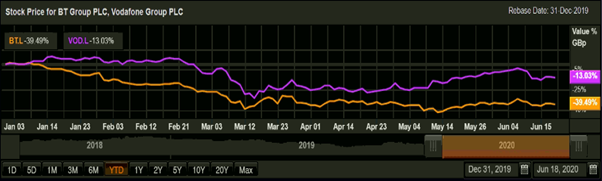
Let us discuss the stock performances of two telecom giants which could provide 5G services in the UK.
- BT Group Plc (LON: BT.A) has already rolled out 5G services in the UK in February 2020. Its shares last traded at GBX 118.15 at the market close on 18th June 2020, marginally down by 0.04 per cent versus the previous day closing price. Stock's 52-weeks High is GBX 209.20, and 52-weeks Low is GBX 101.40. BT Group Plc’s market capitalisation stood at 11,680.77 million.
- Vodafone Group Plc (LON:VOD) is another telecom major in the UK which has rolled out its 5G services. The company’s shares last traded at GBX 127.02 at the market close on 18th June 2020, down by 1.61 per cent versus the previous day closing price. Stock's 52-weeks High is GBX 165.24, and 52-weeks Low is GBX 98.02. Vodafone Group Plc’s market capitalisation stood at £34,565.09 million.
Stock price comparative chart: BT.A, and VOD
(Source: Thomson Reuters)
