
 AUS
AUS
 NZ
NZ
 UK
UK
 CA
CA
 USA
USA
 IND
IND






Summary
- Aramco committed to diversify its product portfolio and strengthen its business strategy
- Royal Dutch Shell and BP to reduce carbon footprint and invest in renewable energy sources
- Oil producers trying to maintain a delicate balance between its demand and supply
- Fall in the value of world oil reserves continues to remain worrisome for the equity markets
Despite the carnage caused by the coronavirus pandemic, one of the biggest energy companies in the world, Saudi Aramco has managed to stand tall due to its financial and operational resilience.
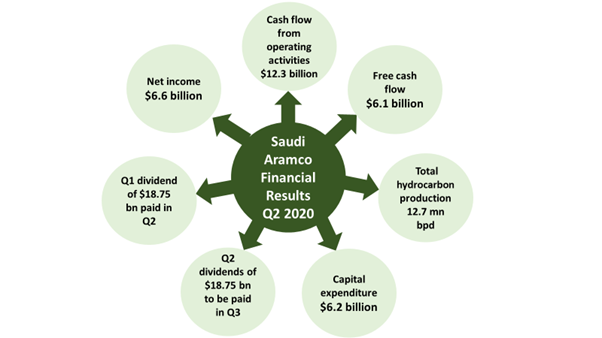
Notwithstanding the challenges and consistent global economic disruption faced, the company declared dividends of nearly £19 billion in the second quarter of 2020. Aramco’s net income for the second quarter of 2020 stood at $6.6 billion amid the challenging market conditions, which almost plummeted by 75 per cent in contrast to the same period previous year in 2019.
The company managed to deliver solid results in the second quarter of 2020 due to lesser production costs, large-scale, and robust business models despite strong headwinds from reduced demand and lower oil prices. This helped the company in announcing dividends even in these pressing times. The company expects a partial recovery in the battered sector as countries around the world take steps to reboot their economies and ease restrictions.
(Source: company report)
Aramco’s diversification and long-term growth strategy
Once it passes through the refinery, the crude oil becomes more valuable. Apart from fuel used in aviation and transportation, there are several other by-products derived out of crude. Oil is used in a variety of applications from cleansing agents to vitamin capsules. This implies that the core oil business indirectly fosters ecosystem for other sectors worth billions of dollars.
Aramco recently acquired a 20 per cent stake in Reliance Industries, an Indian oil refining & petrochemical company for US$ 75 billion through foreign direct investment (FDI), as a part of its diversification strategy. This strategy would enable Aramco to bolster its footprint in the crude by-products industry and get revenue through its doors in pressing times like these. Moreover, as the world is thinking over to reboot and trying to reduce the carbon footprint, the diversification strategy by Aramco would help the company in making a swift transition as the company could enjoy revenue streams diversified verticals. The company would like to achieve long-term growth by capturing unrealized and additional value from the by-products of crude it produces.
The oil prices have been highly volatile in the recent times. The novel coronavirus outbreak has devastated economies around the world. The damage caused by the pandemic is not just limited to the economy but also has costed several human lives. The pandemic has claimed nearly 50 thousand lives in the United Kingdom, according to World Health Organisation’s (WHO’s) website.
As the coronavirus pandemic washed up the shores of the UK, the British government imposed travel restrictions and lockdown to contain the spread of the deadly virus. Most of the economic activities came to a screeching halt suddenly. The scene was common in most of the countries around the globe. Most countries closed their borders. Only the supply of essential goods & services was up and running.
These circumstances drove the demand for the oil consumption to decline drastically as all the economic activities came to sudden halt. In addition, the oil producing nations kept on producing oil which led to flooding of oil in the global markets along with dampened demand. This imbalance drove the price of oil below zero (negative) in mid of April 2020 in the US markets. This meant that oil producers would pay the oil buyers for buying crude.
Oil demand is likely to return once the lockdown is lifted in the major economies. However, if supply is controlled, the crude price is likely to go back to pre-pandemic levels. Therefore, world’s major oil producers have decided to find a delicate balance between the demand and supply of oil in the global markets. Oil producing nations are heavily reliant on oil for survival of their economy. Their strategy is to stabilise volatility in the oil prices by balancing the factors of production and consumption.
Also Read:
U.S. Crude Oil Inventory Declines and Refining Rates Improve
Crude Oil Continues on the recovery path, Libya blaming UAE on support to Hifter
Crude Oil Futures Soar As Trump Fuels Hope Of Saudi-Russia Production Cuts
Oil prices decline for the third straight day; Brent crude down 0.4%
According to the International Energy Agency (IEA), this is the second severe drop in oil demand post the second world war. The economic fallout caused by the novel coronavirus could create further lows in demand for oil in the years to come. However, businesses in renewable energy generation have the potential to grow.
According to sector experts, the value of oil reserves is expected to plunge by 66 per cent in the forthcoming years. This could trigger a massive collapse for the businesses in this sector. These businesses owe trillions of dollars to banks around the world and are major constituents of global equity markets. This collapse could further mount pressure on the global banking industry. The world is looking forward to moving away from the conventional energy sources.
On the same time, the British-Dutch oil and gas company, Royal Dutch Shell Plc (LON: RDSA) has embarked upon a journey to turn itself into a net-zero carbon company by the year 2050. For this, the company is preparing to sell more green energy to support the reduction of carbon emission. The company wishes to eliminate carbon discharge & industrial effluents by creating carbon capturing and storing facilities.
Earlier in February 2020, BP Plc (LON: BP.) had set a target to reduce its carbon footprints to net-zero by 2050. This is likely to be done by reducing the emissions of greenhouse gases produced in the UK every year. Environmentally friendly measures such as tree-plantation and carbon capture technologies could help in offsetting 360 million tons of greenhouse gases. The aim to achieve the net-zero target is the next major move towards a greener future.
The entire world is looking forward towards a cleaner future. The battered oil industry would take some time to recover in the near term. However, diversifying into new verticals could be a boon for most of the oil producers around the world and meanwhile they can plan a gradual shift towards other renewable sources of energy from the core business.
