
 AUS
AUS
 NZ
NZ
 UK
UK
 CA
CA
 USA
USA
 IND
IND






Summary
- The plunge in crude prices has been severely impacting the oil companies
- The oil-producing nations are on the verge of slipping into recession
- The lessened demand for oil might stay longer than expected
- Stock performance of BP and RDSB
The novel coronavirus outbreak has devastated economies around the world. The damage caused by the pandemic is not just limited to the economy but has also costed several human lives. The pandemic has claimed more than 41 thousand lives in the United Kingdom, according to the World Health Organisation’s (WHO’s) website.
As the pandemic washed up the shores of the UK, the nation imposed travel restrictions and lockdown. The demand for oil consumption plunged drastically as all the economic activities came to a sudden halt. In addition, the oil-producing nations kept on producing oil which led to the flooding of oil in the global markets along with dampened demand. This imbalance drove the price of oil below zero (negative) in mid of April in the US markets. This meant that oil producers would be paying the oil buyers for buying crude.
With China easing lockdowns in the first week of May, the oil prices rallied, as on 1st May, the Brent crude traded at $26.44 per barrel, and on the 1st June, the Brent crude was trading at $38.32 per barrel, up by nearly 45 per cent. The oil prices would gain stability once the demand for transport fuel is up.
The Plight of major oil producing countries
Oil demand is likely to return once the lockdown is lifted in the major economies, also if the supply is controlled, the crude price is likely to go north. Therefore, the world’s major oil producers have decided to reduce the supply of oil in the global markets. Oil producers are heavily reliant on oil for the survival of their economy, and their strategy has been to stabilise prices by limiting oil production.
Saudi Arabia, one of the major oil producers, will have to dishonour its defence contracts if oil prices continue to plunge. As the nation is on the verge of recession, it has started eating into its reserves, and might fell into a severe financial strain. This would also impact the UK’s economy to some extent. UK based BAE Systems (LON:BAE) reportedly generate around 13 per cent of their total revenue from the defence contracts of Saudi Arabia.
According to sector experts, the value of oil reserves is expected to plunge by 66 per cent in the coming years. This could trigger a massive collapse for the businesses in this sector. These businesses owe trillions of dollars to banks around the world and are major constituents of global equity markets. This collapse could further mount pressure on the global banking industry.
According to the International Energy Agency (IEA), this is the second severe drop in oil demand post the second world war. The economic fallout caused by the novel coronavirus could create further lows in demand for oil in the years to come. On the other hand, businesses in renewable energy generation have the potential to grow. Let us discuss a few fossil fuel businesses, which have a strong presence across the UK.
It is like a double whammy for the oil businesses, making a transition to green technologies on the one hand and coping with the economic impact of Covid-19 on the other.
- BP Plc (LON: BP.)
The FTSE 100 energy company blamed the collapse in oil demand which was triggered due to the economic fallout caused by the novel coronavirus, which resulted in £505 million loss for the company in the first quarter of 2020. However, the company announced that it would still be paying a dividend to its shareholders owing to its rich dividend history. The quarterly dividend pay-out was up by 2.4 per cent from the previous year same period and stood at 10.5 cents per share. The company witnessed a significant rise in debt levels in the first quarter of 2020. The company is seeking new financing facilities to ensure liquidity.
BP Plc (LON: BP.) is likely to axe 15 per cent of its workforce around the world. The FTSE 100 listed Group is likely to cut nearly 2 thousand jobs in the United Kingdom. The company aims to make a transition to become a lower carbon emission company in the long term, however, to cope with abrupt fall in oil demand, the company is likely to reduce its representative base.
According to some reports, BP Plc is ready to buck the trend and make a swift transition towards zero carbon emissions following the collapse of global oil markets. Industry experts believe that the oil companies would be under immense pressure from campaigners, environmentalists, and renewable energy companies.
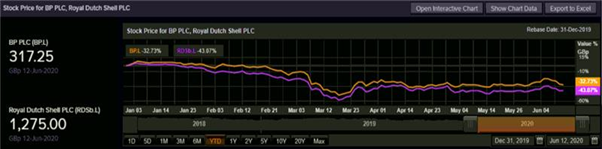
BP Plc has delivered nearly 33.26 per cent negative price return on the Year to Date basis. The Group has an annual dividend yield of 9.48 per cent. As on 12th June 2020, while writing before the market close, shares of the company were quoting at GBX 317.25. BP Plc’s market capitalisation stood at £ 65,015.02 million while writing.
- Royal Dutch Shell Plc (LON:RDSB)
Royal Dutch Shell Plc’s profits plunged by 46 per cent to £2.3 billion in the first quarter of 2020 in comparison to the previous year. In addition, this was the first time that the FTSE 100 oil giant slashed its dividend pay-out in nearly eight decades. The quarterly dividend was down by 66 per cent to 16 cents per share in the first quarter of 2020. The pandemic has caused a catastrophic impact on the oil sector, and the oil companies are likely to preserve cash and ensure liquidity in these unprecedented times.
Royal Dutch Shell Plc has delivered nearly 43.33 per cent negative price return on the Year to Date basis. The Group has an annual dividend yield of 9.05 per cent. As on 12th June 2020, while writing before the market close, shares of the company were quoting at GBX 1,275. Royal Dutch Shell Plc’s market capitalisation stood at £ 47,431.74 million while writing.
Comparative chart: BP Plc vs Royal Dutch Shell Plc
(Source: Thomson Reuters)
