
 AUS
AUS
 NZ
NZ
 UK
UK
 CA
CA
 USA
USA
 IND
IND








Summary
- People across the world are keenly awaiting the arrival of an effective COVID- 19 vaccine for mass vaccination
- Industries like Pharmaceuticals, Aviation and Tourism & Hospitality will be the ones deriving immediate gains from this event.
- Top vaccine manufacturing companies are already close to completing their trial processes, with multiple candidates entering the market within short intervals of each other.
The arrival of the COVID- 19 vaccines is a bit overdue now. With the speculations of AstraZeneca’s AZD1222 vaccine candidate making a debut in September not coming true, the waiting game has extended indefinitely as no one else is willing to give a specific date anymore. The delay could e called a reason for the relapse of the coronavirus pandemic in the winter months; a very well anticipated event which everyone was hoping will not happen if the vaccine is on time. This pandemic has now proven itself to be a greater economic hazard for the economy than it has been to the healthcare.
Since the outbreak, the country has seen hundreds and thousands of businesses being shut down and millions of people becoming unemployed. The country has been pulled down to its worst economic crisis encountered in a hundred years. The scope of policy and monetary tools, the government and the Bank of England have deployed after this outbreak has never been seen by the country in peacetime. The government’s public borrowings have also reached record levels, and the tax collections have plummeted sharply after the massive drop in economic activity levels in the country following the outbreak.
While the entire British economy will be benefited with the early introduction of the COVID-19 vaccine, there are few industries like Pharmaceuticals, Aviation and Tourism & Hospitality, which will be particularly benefited. Let us discuss these sectors one by one and try to illustrate what could be the impact of the vaccine on them.
The Impact on the Pharmaceutical Industry
The British Pharmaceutical industry has been at the forefront of the global vaccine development effort. AstraZeneca plc and GlaxoSmithKline plc have their vaccine candidates that are at advanced stages of their third phase trials process. Both these companies have made international tie-ups to manufacture and supply the vaccines at short notice. Once these vaccines start to go out in the market, the companies and their stocks are likely to see improvement.
There are also several other smaller pharmaceutical and biotechnology companies who have been providing diagnostic kits to the NHS since the outbreak. These companies have seen an increased growth rate in their financial performance over the past couple of months and would continue to see a favourable market despite the introduction of the vaccine.
The share price movement of AstraZeneca plc (LON:AZN)
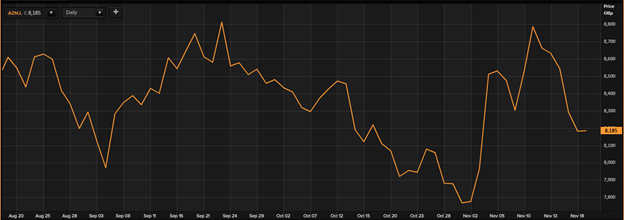
Three months share price movement- (Source- Thomson Reuters)
The shares of AstraZeneca plc were trading at GBX 8,162.60 per share on 19 November 2020 (10.38 AM GMT+1), losing 0.21 per cent over yesterday’s close.
The Impact on the Aviation Industry
The aviation industry is one of the most battered industries because of coronavirus pandemic. The initial ban on air travel in the March and the subsequent heavy safety regulations have made life difficult for the sector. The early introduction of the vaccine will lead to early relaxation of the stringent safety regulations, which will prompt people to start flying again.
Several other related industries like Airports and travel agencies have also been deeply impacted by the pandemic and the subsequent government safety regulations. These businesses would also witness an increase in their business activity levels once the mass inoculation process starts.
The improving safety situation after the introduction of the vaccine will also lead people to feel safer and prompt them to come out in large numbers to take public transportation systems. Since the opening of first the lockdown, very few people have come out to fly fearing the pandemic infection.
The share price movement of EasyJet plc (LON:EZJ)
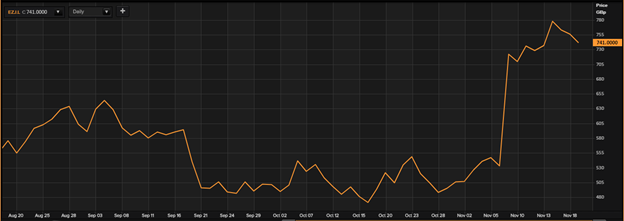
Three months share price movement- (Source- Thomson Reuters)
The shares of EasyJet plc was trading at GBX 738.91 per share on 19 November 2020 (11.03 AM GMT+1), losing 2.29 per cent over yesterday’s close.
The impact on the tourism & hospitality industry
The British tourism and hospitality industry which comprises of the hotels, restaurants, resorts, and other recreation businesses have been having a very difficult period since the outbreak of the coronavirus pandemic. The government-imposed lockdown in March saw the revenues of most of these businesses plummeting to nil. Even after the reopening of the first lockdown, stringent safety protocols were put in place by the government, which made the uptake in the business activity levels in these industries very slow.
The early roll-out of the vaccine will see the government safety protocols to be withdrawn and people feeling safer to visit these establishments. The United Kingdom receives a large number of foreign tourists every year, which brings in a significant amount of revenues to the tourism and hospitality industry as well as the aviation industry. Since the outbreak of the pandemic tourist arrival in the UK has almost dried up. The roll out of the vaccine in the country would help turn this tide.
The share price movement of Whitbread plc (LON:WTB)
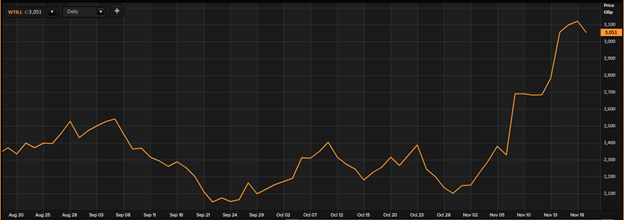
Three months share price movement- (Source- Thomson Reuters)
The shares of Whitbread plc were trading at GBX 3,034.00 per share on 19 November 2020 (11.06 AM GMT+1), losing 2.76 per cent over yesterday’s close.
To conclude, it can be said that the imposition of the second lockdown has created a difficult situation for most of the industries in the country. Though the lockdown is scheduled to end by the first week of December, its economic impact will linger in for a few more months. If there is an early roll out of the vaccine by the first half of January 2021 then further damages can be avoided.
