
 AUS
AUS
 NZ
NZ
 UK
UK
 CA
CA
 USA
USA
 IND
IND







In 2026, ransomware activity increased substantially over last year's monthly average. Meanwhile, the hybrid workforces took the hardest hits. Traditional perimeter security simply wasn’t designed for the way we work today.
The uncomfortable reality is this: if you’re still relying on a firewall at the office and a VPN for remote access, you’re not really secure. You’re just hoping no one takes advantage of the holes in your setup.
Zero Trust takes a completely different approach. Instead of assuming anything inside your network is safe, it treats every request with caution. Every user, every device, and every attempt to reach data is checked, every time. In other words, no free passes for anyone already “inside” the network.
But Zero Trust isn’t a product you buy. It’s an architecture you build. And building it on top of fragmented, siloed tools is where most organizations fail.
That’s where Sangfor Athena SASE (Secure Access Service Edge) has a major and decisive role to play. SASE converges networking and security into a unified, cloud-native platform. When it’s built right, like Sangfor’s Athena stack, which combines Sangfor SASE, Zero Trust Guard (ZTG), and Zero Trust Data Protection (ZTDP), it transforms Zero Trust from a buzzword into a working reality.
Zero Trust Is Compelling. Implementing It Is Hard.
The pillars of Zero Trust read like common sense: verify identity continuously, grant least-privilege access, micro-segment your network, and monitor everything. In theory, it sounds concrete. But what about in practice? A logistical nightmare for most IT teams.
The threat landscape driving Zero Trust adoption isn’t slowing down. Remote work exploded post-pandemic and never fully reversed. Remember that cloud sprawl means applications live everywhere, including AWS, Azure, on-prem, and third-party SaaS.
IoT devices, from IP cameras to industrial sensors, are multiplying the attack surface daily. On top of that, the advanced persistent threats (APTs) now probe networks for months before making a move.
The real implementation killers, though, are self-inflicted:
- Fragmented tools: Separate firewalls, legacy VPNs, and standalone endpoint solutions, none of them talking to each other. Every gap between tools is a blind spot that attackers exploit.
- Scalability pain: Hybrid and multi-cloud environments don’t play nicely with on-prem security architectures designed for a single corporate headquarters.
- Management overhead: Running six different security consoles means six different alert queues, six different policy engines, and six times the burnout for your security team.
Picture a regional bank rolling out remote work access via legacy VPN. Authentication is weak. Meanwhile, traffic inspection is minimal.
Then, a phishing email lands in a remote employee’s inbox, and within 48 hours, attackers have moved laterally into customer records. It’s not hypothetical. It’s the pattern playing out across APAC enterprises right now.
What “Unified SASE” Actually Means?
SASE at its core merges two things organizations have historically bought separately: networking (SD-WAN, traffic optimization) and security {firewalls, Zero Trust Network Access (ZTNA), Cloud Access Security Brokers, Data Loss Prevention}, delivered as a cloud-native service.
But “SASE” has become a marketing umbrella. Plenty of vendors slap the label on a bundle of loosely integrated products. That’s not unified. That’s just repackaged silos.
A genuinely unified SASE stack means a single policy engine, a single management console, and security components that share threat intelligence in real time. Sangfor’s Athena platform is built on exactly that premise:
- Sangfor SASE: The secure connectivity foundation. SD-WAN plus cloud-delivered firewall-as-a-service, routing traffic through the nearest point-of-presence (PoP) for low latency and rated 4 out of 5 on G2.
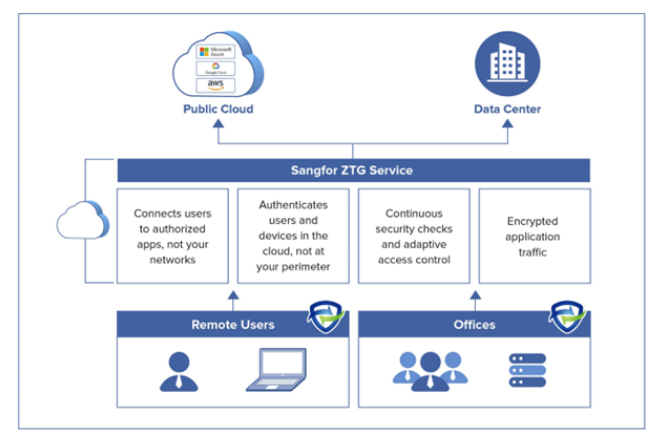
- Zero Trust Guard (ZTG): Identity and access management with teeth. Risk-based multi-factor authentication, continuous device posture checks, and adaptive cloud security access control policies.
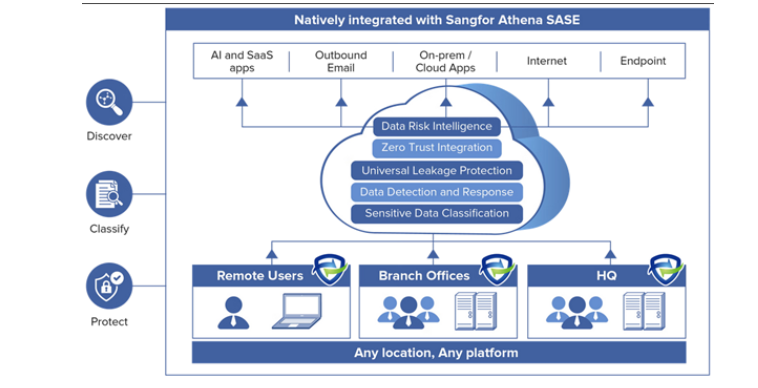
- Zero Trust Data Protection (ZTDP): Data-centric security. Inline DLP, encryption at rest and in transit, protecting sensitive data before it can leave your environment.
Integration solves half the battle. Data protection seals it.
Four Reasons Unification Is Non-Negotiable
- Silos Kill Security
Disjointed security tools inevitably create policy blind spots. When your ZTNA solution operates separately from your DLP platform, a user flagged as high‑risk can still move sensitive data out of the organization, simply because neither system has full visibility.
Sangfor’s unified architecture eliminates this gap. ZTG and ZTDP continuously correlate signals, ensuring that as soon as ZTG identifies anomalous user behavior, ZTDP automatically enforces tighter data‑movement controls. This isn’t a manual process; it’s real‑time, automated enforcement of a Zero Trust Security framework.
- Scale Without Compromise
Cloud-native SASE handles what on-prem architectures simply can’t: global scale, elastic capacity, 5G, and IoT support. Sangfor’s APAC-optimized PoP network means a remote employee in Cebu gets the same low-latency, security-enforced access as one in Manila, without backhauling traffic through a congested data center. Performance doesn’t get sacrificed at the altar of security.
- Simplicity That Slashes Alert Fatigue
A unified security stack reduces operational noise. Research reveals that consolidating tools can cut alert fatigue by as much as 70%. With one console and one policy engine, Athena’s AI‑driven analytics highlight genuine threats instead of overwhelming analysts with false positives. In today’s threat landscape, distraction is costly. So, teams need to stay focused on what actually matters.
- Compliance Visibility That Actually Works
End-to-end logging across the network, identity, and data layers means you can demonstrate compliance with the local Data Privacy Act (PDPA), industry regulations, and internal audit requirements.
However, without stitching together logs from six different systems. Real-time analytics also catch lateral movement before it becomes a breach notification.
How Sangfor’s Stack Delivers Zero Trust Security End-to-End
The real value of Athena isn’t any single component. It’s the association between them. Here’s how each layer maps to Zero Trust outcomes:
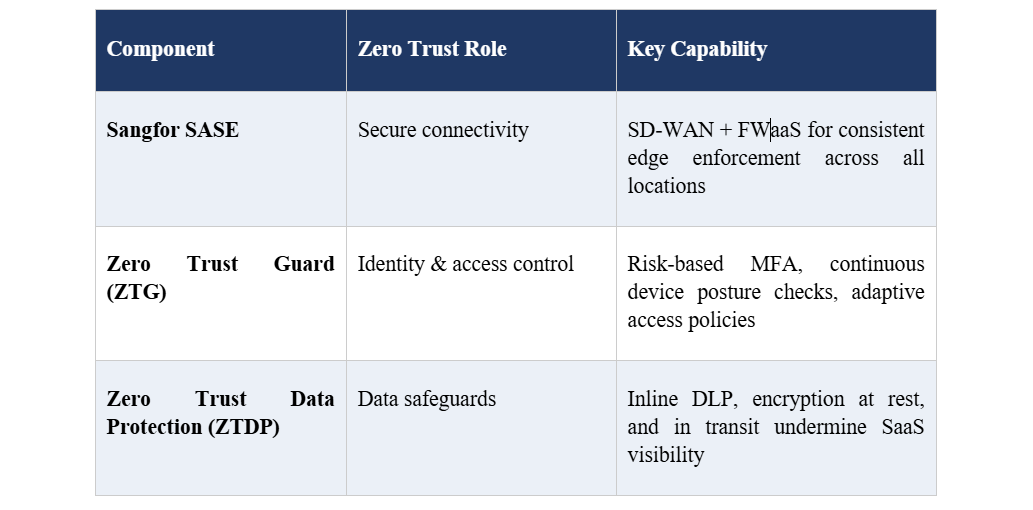
If your CASB misses a shadow SaaS app, a disconnected security stack won’t catch it until a breach happens. However, with Athena, it works differently: ZTG detects unusual access, ZTDP blocks data movement, and your team receives a single combined alert rather than several separate ones.
Zero Trust Isn’t a Destination. But Unification Gets You There.
The Zero Trust Security model isn’t a product you buy and a problem you solve. It’s an ongoing architecture decision. One that gets harder every time you bolt on another point solution and easier every time you consolidate.
The organizations getting Zero Trust right aren’t necessarily the ones with the biggest budgets. They’re the ones with-
- The most integrated stacks.
- Unified policy enforcement.
- Shared threat intelligence.
- One console to rule the entire security surface.
Here, Sangfor’s unified security stack, combining Sangfor Athena SASE, Zero Trust Guard, and Zero Trust Data Protection, is built for exactly this. As threats evolve and hybrid environments become more complex and fragmented, fragmented security isn’t just inefficient; it's also ineffective. It’s a liability.
Explore Sangfor today and start your Zero Trust journey the right way.
Check the SASE ROI Calculator: Assess Sangfor SASE’s Total Economic Impact!
The content has been authored in collaboration with our guest contributor, Mashum Mollah.
