
 AUS
AUS
 NZ
NZ
 UK
UK
 CA
CA
 USA
USA
 IND
IND







Highlights
- Air Canada has been one of the most active stocks trading on the Toronto Stock Exchange in past 10 days.
- In third quarter of fiscal 2021, the carrier intends to increase its available seat miles (ASM) capacity by 85 per cent year-over-year (YoY).
- It reported a net loss of C$ 1.165 billion in Q2 2021, as compared with C$ 1.752 billion loss YoY.
Air Canada (TSX:AC) is the largest carrier in the country. Its regular scheduled passenger services span across the stretches of North America, the Pacific and overseas market.
But when these services came to a halt last year amid the pandemic, Air Canada quickly became one of the major companies in Canada to incur substantial losses.
As the economy slowly recovered and vaccine campaigns kicked in, Air Canada saw a ray of hope. Its operations began to open up in phases and its stock price also noted recovery from its pandemic lows earlier this year.
However, this rebound appears to have hit the brakes as well amid the surge of Delta variant cases.
Air Canada stock declined by around one per cent in the last one week to close at a price of C$ 23.02 on Friday, September 17. Its market capitalization stood at C$ 8.2 billion.
Let’s take a closer look at Air Canada’s stock market and financial performance.
Also Read: Is Air Transat (TSX:TRZ) a good travel stock to buy on the dip?
Air Canada (TSX:AC) stock performance
Air Canada has been one of the most active stocks trading on the Toronto Stock Exchange in past 10 days, with an average trading volume of 2.92 million shares.
The stocks, however, are trading 4.5 per cent below the 30-day simple moving average, reflecting a downward trend.
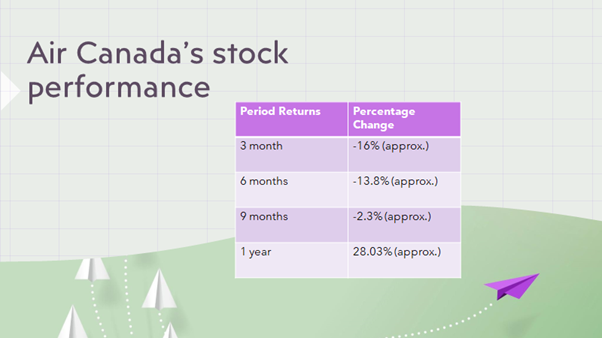
The Canadian airline stock posted a decline of about 14 per cent in the past six months and is presently trading nearly 26 per cent below its 52-week high (March 15, 2021).
While the S&P/TSX Equal Weight Industrials Index grew by nearly seven per cent quarter-to-date (QTD), Air Canada stocks note a dip of nearly 10 per cent.
However, the airline stock currently holds a one-year and year-to-date (YTD) stock price growth of 28 per cent and one per cent, respectively.
Also Read: Is UEC stock a buy as uranium spot prices hit 9-year high?
Air Canada’s recent financial position and Q3 2021 outlook
The global airline industry suffered a significant decline in their revenues, cash flows, and traffic due to travel restrictions imposed by several countries across the globe, particularly Canada, in fiscal 2020 and 2021.
Air Canada reported a net loss of C$ 1.16 billion in Q2 2021, which was comparatively lesser than that of C$ 1.75 billion in Q2 2021.
Also Read: Decoding inflation: What is it and how does it impact economy of a country?
The company claims to have increased its cash position since fiscal 2020 through a series of equity and debt transactions, particularly C$ 5.9 billion support package from the Canadian government in April 2021.
The federal government holds shares worth C$ 500 million in Air Canada (as of April 2021).
Air Canada said it has drawn C$ 858 million for ticket refund facility out of the finance package as of June 30, 2021.
In Q3 2021, Air Canada plans to increase its available seat miles (ASM) capacity by 85 per cent year-over-year (YoY).
Bottom line
With things getting back to ‘normal’ amid an increasing vaccination coverage, Canadian air carriers could expect progressive improvement in their cash flows and liquidity position.
Air Canada also believes that ease of travel restriction would drive additional demand for travel and provide an impetus to the overall economic activity, including financial improvements.
It projects a net cash burn of C$ 3 to 5 million per day in Q3 2021.
However, investors should bear in mind that the COVID-19 outbreak remains as unpredictable as before. Hence, amid such an uncertain situation, there is yet to be a definite answer as to when the travel restrictions will be fully removed.
