
 AUS
AUS
 NZ
NZ
 UK
UK
 CA
CA
 USA
USA
 IND
IND






Highlights
- Canadian National Railway moved above its long-term moving average during early-week trading
- The move arrived alongside steady trading activity and continued attention from multiple research firms
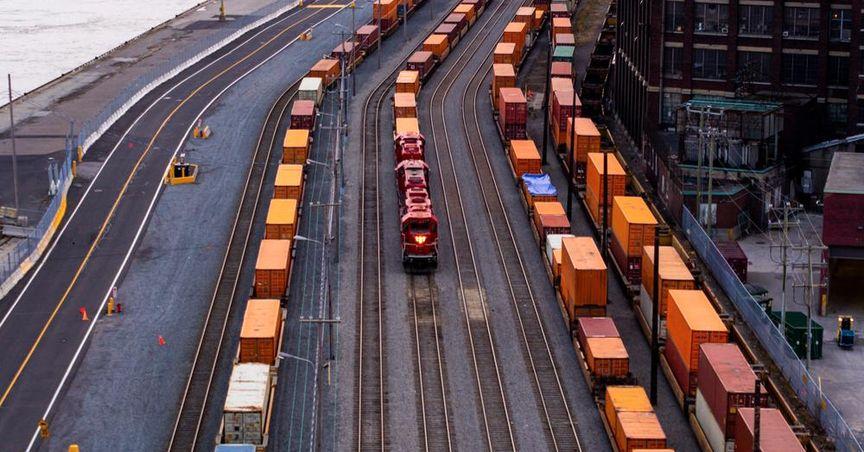
- The business remains a key rail operator moving diverse freight across a wide North American network
The transportation sector plays a central role in Canada’s economic activity by enabling the movement of raw materials and finished goods across long distances. Within this sector, rail operators are often tracked for service reliability.
Canadian National Railway (TSX:CNR) operates in Canada’s transportation sector as a major rail operator known for broad network reach and corridor efficiency, linking Canada’s eastern and western coasts while extending into important United States regions to support cross-border freight across multiple industries, and it is often referenced alongside large Canadian benchmarks such as the TSX 60.
What does the sector cover?
Rail-based transportation supports supply chains by moving large volumes of commodities and manufactured goods, often over long routes that link ports, industrial areas, and distribution hubs. This activity can include shipments tied to natural resources, agricultural products, energy-related materials, automotive components, and consumer goods. In Canada, rail lines also form an important connection between export gateways and inland regions, helping producers reach global and cross-border markets.
Canadian National Railway operates in this setting with a network spanning Canada and extending into the United States. The company’s operations combine rail transport with related logistics services, aiming to provide end-to-end freight movement across regions and customer categories. This broad reach often places the company among the more closely watched transportation names on the Toronto Stock Exchange.
Why moving averages matter?
Moving averages are widely used technical reference points that smooth trading fluctuations and help show longer-term trend direction. A longer-term moving average is commonly treated as a dividing line between extended periods of weaker momentum and extended periods of stronger momentum. When a share value moves above a longer-term moving average, it can signal that the recent trend has strengthened relative to the longer baseline.
In early-week trading, Canadian National Railway (TSX:CNR) moved above its longer-term moving average during the session. This move drew attention because longer-term moving averages are often used as a reference point in chart-based review. Trading activity was steady during the session, showing broad participation rather than an isolated move. Market context is often compared with the TSX Composite Index.
What happened during trading?
During Monday trading, Canadian National Railway crossed above its longer-term moving average and later traded near session highs. The session included active turnover in the shares, reflecting ongoing market participation. Moves like this can draw attention because they may indicate a shift in recent momentum relative to the longer baseline that many market participants track.
Even when a move above a long moving average occurs, it does not automatically describe what follows next. It is simply a factual signal that the recent trading path has climbed above a longer-term reference line. Market participants often pair that signal with other context such as business performance, sector conditions, service metrics, and broader index direction.
For broader Canadian market context, the TSX Composite Index is commonly referenced as a benchmark for large and mid-sized listed companies, including transportation names.
Which firms updated coverage?
Multiple research firms issued reports on Canadian National Railway (TSX:CNR) across recent months, reflecting continued attention on the name. Those notes included changes in stated valuation expectations and shifts in stated stance from certain firms. One report referenced a small reduction in an objective level, while others maintained performance-oriented stances. Another report described an upgrade in stance to a more optimistic category.
Across the broader set of published views referenced in the source material, the mix included several top-tier positive ratings, a larger set of positive ratings, a sizable portion of neutral ratings, and a single negative rating. Taken together, the overall consensus described there aligned with a moderately positive stance, alongside an average objective level referenced in the same material.
This range of published viewpoints highlights that coverage is not uniform and can vary by methodology, assumptions, and what each firm emphasizes, such as operating execution, volume trends, cost discipline, and network performance.
For a large-cap lens that sometimes includes major transportation constituents, the TSX 60 is also commonly followed as a Canadian large-company reference set.
How did valuation look?
The provided material referenced commonly tracked valuation and trading descriptors, including a multiple-based measure and a growth-adjusted metric. It also cited a beta value that suggested lower volatility than the broader market, along with a market capitalization that placed the company among larger listings. These descriptors are often used to compare a business to sector peers, though they do not define operational quality on their own.
The same material also referenced short-term and long-term moving averages, describing a shorter moving average above the longer average at the time of reporting. In general market language, that configuration is sometimes described as showing stronger near-term trend strength relative to the longer baseline, though it remains purely a snapshot based on the observed trading period.
Broader benchmark mentions often vary by wording, and common phrasing includes the s&p tsx composite index and the S and P tsx index, both used in market commentary around Canadian equities.
What did balance metrics show?
The source material described liquidity ratios and a leverage measure. Liquidity ratios provide a general snapshot of how short-term resources compare with short-term obligations, while leverage measures compare financing structure elements. These figures are frequently included in profile summaries for large companies because they provide a standardized way to compare balance-sheet structure across peers.
For rail businesses, capital intensity can be a key factor because rail networks require ongoing maintenance and upgrades. Track work, rolling stock management, signalling systems, yard capacity, and safety-related spending are recurring operational requirements. Because of that, balance-sheet structure and funding approach often receive attention in company discussions, even when the operating model is stable.
Within index commentary, variations in naming sometimes appear, including s&p 500 tsx composite index, even though market participants typically use the linked Canadian benchmark page for TSX Composite Index references.
What did earnings include?
Canadian National Railway (TSX:CNR) last reported quarterly earnings in the period cited in the provided text. The material noted earnings per share for the quarter, along with reported revenue. It also referenced profitability-related measures such as net margin and return on equity, which are commonly cited to describe operating efficiency and how effectively equity capital is used within the business model.
For rail operators, earnings performance is often discussed alongside shipment mix, service reliability, network fluidity, operating ratio style metrics, labour and fuel dynamics, and customer demand trends across key commodity groups. While the provided material offered a high-level earnings snapshot, deeper earnings discussions typically examine how volumes and pricing interact with cost management across operating segments.
The same summary section also mentioned a full-year earnings-per-share estimate for the fiscal year, presented as part of a standard snapshot alongside other commonly used company profile metrics and broader market context linked to the s&p tsx composite index.
What does the business do?
Canadian National Railway (TSX:CNR) describes itself as powering the economy through safe transport of a wide range of goods across North America. Its rail network spans a large distance and connects major Canadian regions with important U.S. destinations. The company’s network reach includes links between Canadian coasts and key American corridors, including the Midwest and the Gulf Coast.
This geographic coverage can support multiple freight categories, such as natural resources, manufactured goods, and finished products, helping customers move shipments between production zones and end markets. Rail networks also tend to benefit from network effects: the value of the system can increase as routes connect more origins and destinations and as terminal infrastructure supports interchanges and transfers.
Operationally, rail service can be shaped by weather, port activity, supply chain cycles, and macroeconomic demand for industrial and consumer goods. Safety performance and infrastructure reliability are also central themes in how rail operators are evaluated in public reporting and industry discussion.
How do indexes shape sentiment?
Many market participants track large Canadian benchmarks to contextualize sector movement. When broad indexes show strength or weakness, sector constituents often move in the same direction, though company-specific news can still matter. For Canadian market context, benchmark references may include the s&p composite index, while large-company references may include the TSX 60. Alternate naming also appears in some commentary, such as the s&p 60 wording used for the same large-company benchmark link.
For transportation names, sector sentiment can also be influenced by broader themes such as industrial demand, trade flows, and cross-border logistics activity. Rail operators are often viewed as economic enablers because they move bulk freight and support supply chains that touch multiple industries.
