
 AUS
AUS
 NZ
NZ
 UK
UK
 CA
CA
 USA
USA
 IND
IND






Summary
- Eli Lilly’s Covid-19 antibody experimental drug ‘Bamlanivimab’ received US federal approval for use in adults with mild-to-moderate Covid-19 symptoms.
- GlaxoSmithKline’s vaccine booster and Medicago’s experimental Covid-19 vaccine together produces virus-neutralizing antibodies to fight the deadly virus.
- Earlier this week, Pfizer announced rollout of Covid-19 vaccine developed along with German partner BioNTech, which claims to be 90 per cent effective.
Almost a year of combating coronavirus with still no “go-to” absolute cure or treatment in sight, the second week of November finally brought some good news with Pfizer and BioNTech announcing vaccine with 90 per cent effectiveness. As a result, healthcare and pharma stocks started soaring worldwide. Two US healthcare stocks Eli Lilly and Company (NYSE: LLY, LLY:US) and GlaxoSmithKline (NYSE: GSK, GSK:US) are trending now.
Eli Lilly has been making headlines since its Covid-19 antibody experimental drug called ‘Bamlanivimab’ got emergency USFDA clearance to be used in adults with mild-to-moderate Covid-19 symptoms. This includes the elderly population of 65 years or older and paediatric patients as well.
Data suggests that this drug will help keep patients infected with coronavirus out of immediate hospital admission and avoid disease progression. According to a statement from the company, the drug should be administered immediately after the patient is tested Covid-19 positive and within 10 days of symptoms occurring.
Eli Lilly will supply the antibody therapy to drug distributor AmerisourceBergen Corp., who will then distribute the drug as per the U.S government instructions to states and territories based on the number of Covid-19 cases and hospitalised patients. Americans covered by the Medicare program do not have to bear out-of-pocket costs to access the drug, however healthcare facilities might charge a fee for intravenous administration of the drug.
Meanwhile, a report touted that a combination of GlaxoSmithKline’s GSK.L vaccine booster and Canadian drug producer, Medicago’s experimental Covid-19 vaccine together produces virus-neutralizing antibodies to fight the deadly virus, says an early-stage study conducted on all healthy volunteers.
Earlier this week, Pfizer announced rollout of Covid-19 vaccine developed along with German partner BioNTech, which claims to be 90 per cent effective. Global stock markets soared riding on the news of successful Covid-19 vaccine trials, and stocks of Pfizer shot up 7 per cent, while BioNTech rose 13 per cent.
Let us study the stock performance and financials of these two healthcare stocks.
Eli Lilly and Company (NYSE:LLY)
Indianapolis-based Eli Lilly is a drug developer with particular focus on neuroscience, oncology, endocrinology, and immunology. The company projects its COVID-19 research and development expense for FY2020 to be approximately US$400 million.
Current market capitalisation of the company is C$140.19 billion and earnings per share is US$6.13. The stock gained 11.52 per cent this year.
The stock holds P/E ratio of 23.20, P/B ratio of 29.022, P/CF ratio of 19.50 and D/E ratio of 3.51. Return on equity (RoE) and Return on Assets (RoA) is 131.25 per cent and 13.11 per cent, respectively. Quarterly dividend payout of US$0.74 was declared by the company.
The stock has positive dividend growth in the three-year period of 10.32 and five-year period of 6.91.
In the third quarter of 2020, (period ended September 30), the company’s revenues increased by 5 per cent to US$5.741 billion, as compared to US$5.477 billion in Q3 2019.
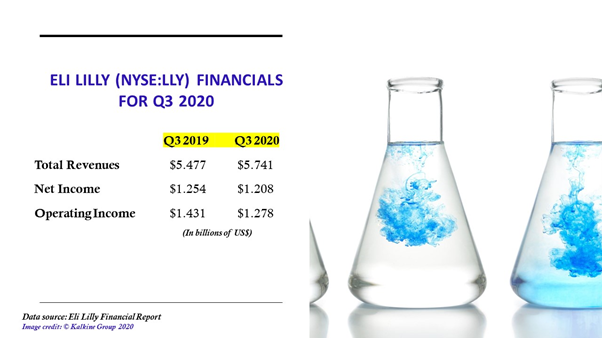
Revenues in the United States increased 3 per cent to US$3.161 billion, and outside US increased 7 per cent to US$2.579 billion. The gross margin increased by 3 per cent to US$4.414 billion in Q3 2020. The net income declined by 4 per cent from US$1.254 billion in Q3 2019 to US$1.208 billion in Q3 2020. Operating income in the third quarter of 2020 was US$1.278 billion, as compared to US$1.431 billion in Q3 2019. Total operating expenses which is the sum of R&D, SG&A expenses was up 9 per cent to US$3.035 billion in third quarter of 2020.
The stock currently trading at US$144.
GlaxoSmithKline PLC (NYSE:GSK)
GlaxoSmithKline PLC is one of the largest global healthcare company that researches and develops drugs, vaccines, and other consumer healthcare products. Recently GSK and Sanofi made collaborative efforts to develop an adjuvanted recombinant COVID-19 vaccine. They have entered into an agreement with the Government of Canada to supply up to 72 million doses of the vaccine, and up to 300 million doses to European countries following a deal with the European commission.
Current market capitalization of the company is US$97.14 billion, and earnings per share (EPS) is US$2.00. Quarterly dividend payout of US$0.496 is declared by the company, and the dividend yield is 5.109 per cent.
The stock gained 3.16 per cent in three months. The stock holds P/E ratio of 11.20, price-to-book (P/B) ratio of 5.177, price-to-cash flow (P/CF) ratio of 8.90 and debt-to-equity (D/E) ratio of 1.98. The stock has return on equity (RoE) of 48.90 per cent and return on assets (RoA) of 7.76 per cent.
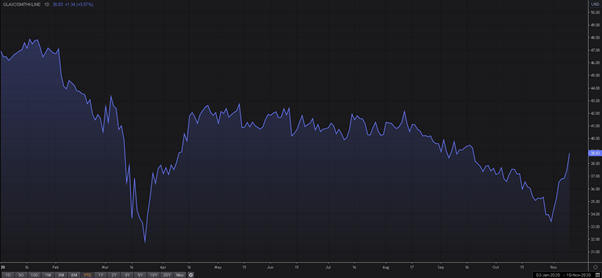
Data source: EODHD/Others, Thomson Reuters
In the third quarter of 2020, GSK group sales declined by 8 per cent to £8.6 billion, of which pharmaceuticals sales saw 7 per cent decline to £4.2 billion, vaccine sales declined 12 per cent to £2.0 billion and consumer healthcare declined 4 per cent to £2.4 billion. The company recorded strong performance from oncology, HIV, respiratory and consumer healthcare which was partially offset due to Covid-19 disruption.
The net cash flow from operation in the third quarter of 2020 was £0.9 billion, and free cash flow loss of £0.2 billion.
The stocks is trading at US$38.67.
