
 AUS
AUS
 NZ
NZ
 UK
UK
 CA
CA
 USA
USA
 IND
IND







Highlights:
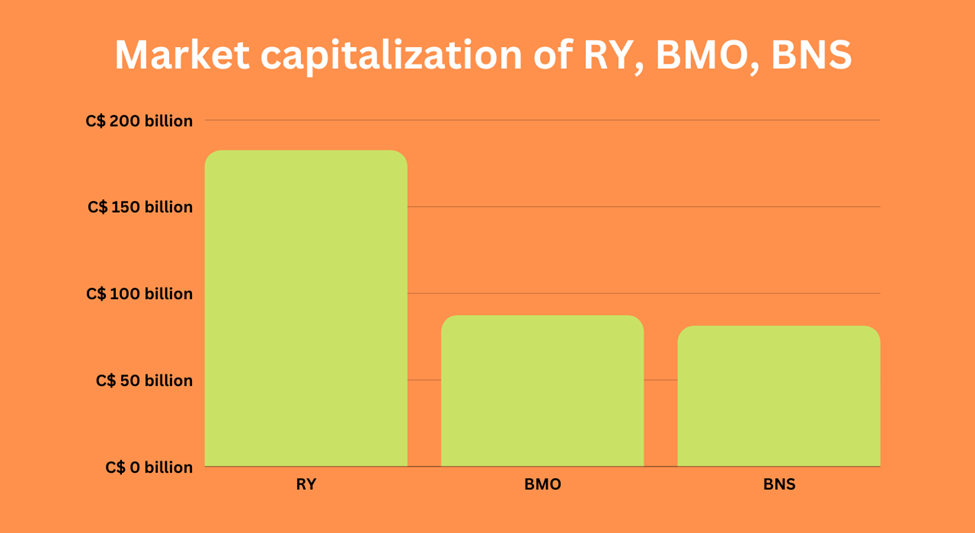
- Royal Bank of Canada has a market cap of C$ 182.38 billion.
- Royal Bank of Canada paid a quarterly dividend of C$ 1.32 per share.
- Bank of Nova Scotia reported a net income of C$ 2,093 million in Q4 2022.
Inflation and economic uncertainties are high globally, and growth has become laggard. The Bank of Canada raised the overnight rate on Wednesday, December 7, to 4.25 per cent, with the bank rate remaining at 4.5 per cent and the deposit rate at 4.25 per cent. Additionally, the Bank is keeping up its quantitative tightening strategy.
The central bank said that Canada’s GDP fared a little better in the third quarter of fiscal 2022.
Historically, rising interest rates have benefited financial companies but this year has been full of surprises as various macroeconomic factors impacted the overall economy and equity markets.
Amid these developments, we take a look at three TSX financial stocks- Royal Bank of Canada (TSX:RY), Bank of Montreal (TSX:BMO), and Bank of Nova Scotia (TSX:BNS) and analyze their recent performances:
Royal Bank of Canada (TSX:RY)
One of the two largest Canadian banks, Royal Bank of Canada, is also a diversified financial services company. It offers various services like personal and commercial banking, insurance, wealth management, corporate banking, and capital markets services.
The bank has a dividend yield of 4.003 per cent and distributed a quarterly dividend of C$ 1.32 per share. The next payable date is February 24, 2023. The EPS of the C$ 182.38 billion company is 11.08 and P/E ratio is 11.9.
In its Q4 2022 results, the Royal Bank of Canada’s net income was reported at C$ 3.9 billion. Its diluted EPS in the reported quarter was C$ 2.74, which was up two per cent year-over-year (YoY).
The bank said that its net income for the year ending October 31, 2022, was C$15.8 billion, down two per cent YoY.
Bank of Montreal (TSX:BMO)
Bank of Montreal has four business segments being a diversified financial services provider.
The EPS of the Bank of Montreal was 20.1 and P/E ratio was 6.4 at the time of writing. The bank paid a quarterly dividend of C$ 1.43, which is slated to be paid next on February 28, 2023.
Notably, the dividend yield of the company stands at 4.45 per cent,and the market cap is C$ 87.03 billion. In Q4 2022, the bank’s net income was C$ 4,483 million, compared to C$ 2,159 million in the year-ago quarter.
Meanwhile, the adjusted net income in the reported quarter was C$ 2,136 million versus C$ 2,226 million in Q4 2021.
Bank of Montreal posted Q4 2022 earnings per share (EPS) of C$ 6.51 against C$ 3.23 in the same comparable quarter in 2021.
Kalkine Media® / Source: ©Kalkine Media®; © Canva via Canva.com
Bank of Nova Scotia (TSX:BNS)
Bank of Nova Scotia is a Canadian bank offering global financial services. The bank has five business segments offering a gamut of services, including advice on personal and commercial banking, products, and services related to wealth management and private banking.
The total market valuation of the bank is C$ 80.97 billion. It paid a quarterly dividend of C$ 1.03, and its dividend yield is 6.061 per cent. The bank posted a Q4 2022 net income of C$ 2,093 million compared to C$ 2,559 million in the year-ago quarter. Its earnings per share (diluted) in the fourth quarter of 2022 was C$ 1.63 versus C$ 1.97 in Q4 2021.
Bottom line
As an investor, these are trying times with market volatility and a bearish trend since the start of 2022. Rather than investing in some big stocks, analyze the companies’ performances over a year and wait for the right time to invest. Always adopt a long-term strategy when the market conditions are not favourable.
Please note, the above content constitutes a very preliminary observation based on the industry and is of limited scope without any in-depth fundamental valuation or technical analysis. Any interest in stocks or sectors should be thoroughly evaluated taking into consideration the associated risks.
