
 AUS
AUS
 NZ
NZ
 UK
UK
 CA
CA
 USA
USA
 IND
IND

.png)





The TSX Composite Index fell again Friday, November 19, by 82.51 points, 0.38 per cent. In all, the benchmark index lost 213.5 points, nearly one per cent, in the week. It was only its second weekly loss since the beginning of October as the index closed at 21,555.03 points.
British Columbia saw devastating floods during this time, which could likely exasperate the inflation situation. Energy lost 3.23 per cent and the financial sector, oddly, saw its third consecutive day in the red. That’s not very typical of what is arguably the index’s strongest sector. Brent and crude oil have been witnessing price declines which may make the OPEC+ countries more reluctant to increase supplies.
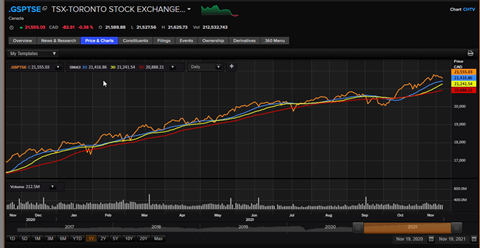
One-year price chart (November 19). Analysis by Kalkine Group
Volume active
Manulife Financial Corporation was again the most traded stock with 11.75 million shares exchanging hands. It was followed by Suncor Energy Inc with nearly 9.11 million shares exchanging hands. In third place was Cenovus Energy Inc with seven million shares exchanging hands. All three ended the day in the red.
Movers and laggards
Nasdaq breaches 16,000 point-mark for new record closing
As the AAPL stock soared on news that Apple is pursuing a fully autonomous self-driving car, Nasdaq breached the 16,000 points by close mark, growing to a new record high for the second consecutive day. The index gained 63.73 points, 0.4 per cent, to 16,057.44.
The Dow dropped 268.97 points, 0.75 per cent, to 35,601.98 points and the S&P 500 was down 6.58 points, 0.14 per cent, to 4,697.96.
Oil prices plummet
Gold fell 0.53 per cent to US$ 1,851.60. Brent oil was down 2.89 per cent to US$ 78.89/bbl, while crude oil fell by 3.68 per cent to US$76.10/bbl.
Loonie down
The loonie fell 0.3 per cent while USD/CAD was up to 1.2638. The US Dollar Index grew 0.55 per cent against the basket of major currencies Friday and ended at 96.07.
Money market
The US 10-year bond yield ended lower by 2.48 per cent Friday to 1.548 while the Canada 10-year bond yield fell 2.03 per cent to 1.666.
