
 AUS
AUS
 NZ
NZ
 UK
UK
 CA
CA
 USA
USA
 IND
IND


_11_13_2025_18_02_02_174695.jpg)



Canada’s main index felt the heat on Wednesday, July 7, due to weakened financial and energy stocks.
The financial sector fell by 0.22% as the US Treasury Bond yields declined 1.32% amid rising concerns over the new Delta COVID-19 variant. The energy sector, on the other hand, posted a decline of 2.18% amid lower crude prices.
The fall was negated to a certain extent by a 1.03% rise in the industrials sector, as shares of Canada National Railway and Canadian Pacific Railway rose 1.9% and 1.8%, respectively.
The S&P/TSX Composite Index decreased by 0.05%, or 9.43 points, to settle at 20,290.60.
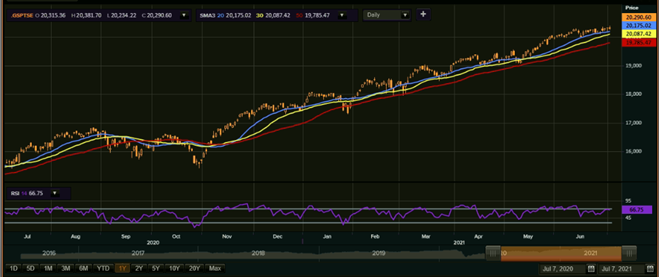
1-Year Price Chart. Analysis by Kalkine Group
Gainers and Losers
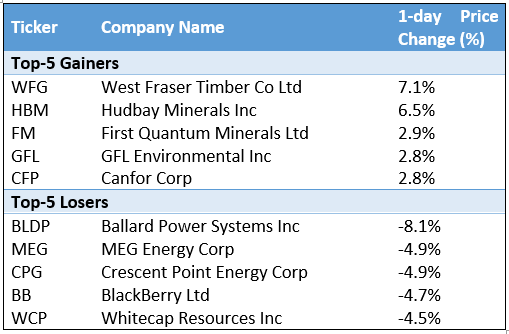
Actively Traded Stocks
The most actively traded stocks on the TSX on Wednesday were Bombardier Inc., with a trading volume of 19.33 million, followed by Toronto-Dominion Bank, with that of 10.75 million, and Crescent Point Energy Corp, with that of 6.54 million.
Wall Street Update
US stocks fluctuated throughout Wednesday before finishing the day slightly higher. After minutes from the most recent Federal Reserve meeting showed that policymakers may not be tightening policies yet, the S&P 500 and the Nasdaq set fresh closing highs.
The Dow climbed 104.42 points to 34,681.79 and the S&P 500 rose 14.59 points to 4,358.13, while the Nasdaq inched up 1.42 points to 14,665.06.
Commodity Update
Gold gained 0.44% to US$ 1,802.10, extending its positive streak to five days, the most since May 20.
Crude continued its bearish momentum as Brent Oil dipped 1.48% to US$ 73.43/bbl, and WTI Crude Oil slipped by 1.59% to US$ 72.20/bbl.
Currency News
The Canadian Dollar stood weak against the US greenback on Wednesday, while USD/CAD closed in green at 1.2477, up 0.12%.
The US Dollar was up against the basket of major currencies for the second straight session, up 0.18% to 92.71.
Money Market
The US 10-year bond yield lost its ground for the second straight session, down 2.12% to 1.323.
The Canada 10-year bond yield also corrected sharply on Wednesday, sliding 1.59% to 1.296.
