
 AUS
AUS
 NZ
NZ
 UK
UK
 CA
CA
 USA
USA
 IND
IND






Highlights
- Kazia Therapeutics’ lead drug candidate, Paxalisib, secures ODD from the FDA for the treatment of a kind of brain cancer.
- Kazia will save over US$3 million in fees related to a future regulatory filing in atypical rhabdoid/teratoid tumors (AT/RT).
- ODD will defend Kazia from the competition by securing its data to develop generic versions of Paxalisib
Australian oncology company Kazia Therapeutics Limited (ASX:KZA) has shared an upbeat update regarding the company’s lead drug candidate, Paxalisib. Paxalisib has secured Orphan Drug Designation (ODD) from the United States Food and Drug Administration (FDA). The ODD designation is for treating atypical rhabdoid/teratoid tumors (AT/RT), a rare and highly aggressive childhood brain cancer.
Triggered by the announcement, KZA shares gained over 4%, and were trading at AU$0.770 today. Kazia has a market capitalisation of AU$99.60 million.
Perks of receiving ODD

Image source: © Michalsuszycki | Megapixl.com
An Orphan Drug Designation (ODD) is a special designation provided to drugs that are promising potential treatments for rare (‘orphan’) diseases - particularly those with less than 200,000 cases per year in the United States.
Kazia will save over US$3 million in fees related to a future regulatory filing in AT/RT for seeking approval in this indication.
Kazia will also get seven years of Orphan Drug Exclusivity (ODE), which will exclude competitors from depending on Kazia’s data to develop generic versions of Paxalisib. It will extend the effective life of the drug and will provide scope for grant funding, protocol assistance, and tax credits.
Previously, Paxalisib was granted ODD in malignant glioma, a type of brain cancer including glioblastoma (adult brain cancer) and diffuse intrinsic pontine glioma (DIPG). Glioblastoma is the major disease in which study of Paxalisib is being carried out.
Do read: Healthcare value stocks from ASX All Ordinaries: HLS, MVF, SHL, ANN
The road ahead
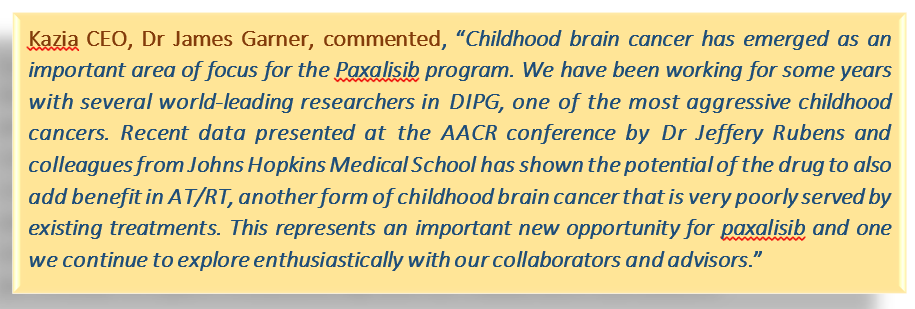
Currently, Kazia is undertaking a phase II clinical trial of several drug therapies, including Paxalisib, under the sponsorship of the Pacific Pediatric Neuro-Oncology Consortium. Data from this study is expected in CY2023.
Similarly, phase I study of Paxalisib in DIPG, led by St Jude Children’s Research Hospital in Memphis, is about to conclude, and the final data is expected by the end of CY2022.
Also read: CSL, RHC, VRT: ASX healthcare stocks with sustainable returns
