
 AUS
AUS
 NZ
NZ
 UK
UK
 CA
CA
 USA
USA
 IND
IND


_07_03_2026_03_50_21_133108.jpg)



Summary
- With lockdown measures in force in Q2 2020, a record 19.8 per cent contraction in Britain’s economy has been reported
- The prevailing economic condition and volatility in the stock market has forced the investors to think twice before investing in any kind of stock
- Having proper knowledge and right usage of strategy can help in mitigating risk, reducing loss, and thereby winning over the situation
When we are yet to recover from the first, various countries around the globe have reported fears of a second wave of coronavirus. In the wake of a second spike of infection which has been hitting the recovery in the UK, Prime Minister Boris Johnson had set out a fresh set of restrictions for the next few months. The fears mounting over the second wave, has wiped billions of pounds off the value of the stock market. The leading benchmark of the UK stock market, FTSE 100, had slumped by 3.5 per cent to below 6,000 points, following speculation that the government could impose tougher restrictions on business and social life. Other markets all over the world have also sold-off sharply.
With lockdown measures in force in Q2 2020, a record 19.8 per cent contraction in Britain’s economy has been reported, which is less than the estimated 20.4 per cent fall. Brexit uncertainty along with rising Covid-19 cases has created further economic stress, washing out gains accumulated over the last few months and risk sentiments have been dampened.
The prevailing economic condition and volatility in the stock market has forced the investors to think twice before investing in any stock. Having proper knowledge and right usage of strategy can help in mitigating risk, reducing loss, and thereby winning over the situation. Stock picking is an essential part of an investor’s journey and it is very important for an investor to be aware of the different kind of stocks available in the stock market. In this article, we will be dealing with the cyclical and defensive stocks.
Cyclical and Defensive Stocks a brief comparison
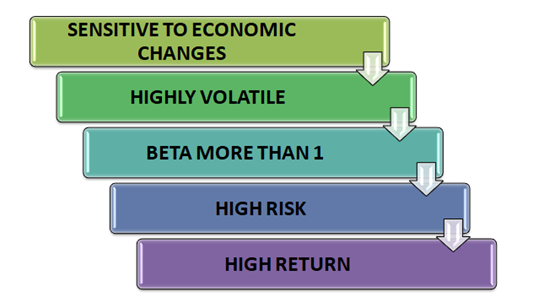
Cyclical stocks are those stocks which perform in accordance to the performance of the economy, i.e., cyclical stocks tend to give better returns with the growth in economy, whereas these stocks deliver negative returns when the economy is in recession. For example, stocks belonging to the automobile and infrastructure sectors, which tend lower when the economy is not performing well.
Features of Cyclical Stocks
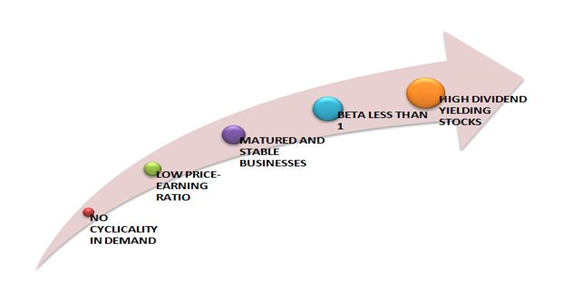
Defensive stocks, also known as non-cyclical stocks are those stocks that are relatively stable regardless of the current state of the economy, i.e., these stocks are less prone to economic cycle, with a more constant share price and a steady dividend payment. For example, stocks belonging to the utility sector.
Characteristics of Defensive Stocks
Cyclical or Defensive which one to choose?
Cyclical stocks are highly volatile and are associated with high risk and high returns as well. During a bull run, they outperform the market and during a bear phase, they underperform the market. An investor can choose to buy these stocks if he/she is a high-risk taker and intend to have high returns. However, one should be very cautious while choosing to invest in cyclical stocks as it cannot be predicted when there will be an economic upturn or downturn. The investors either get high returns or negative returns from these stocks.
Defensive stocks provide regular dividend income irrespective of the performance of economy. During times of recession, these stocks help in protecting your investments. For a conservative investor whose main priority is safety, he/she can choose to invest in defensive stocks. Extraordinary returns cannot be expected from defensive stocks as they simply function as safe haven stocks. Additionally, if one is looking for a regular dividend income, defensive stocks give stable returns at most of the times. For a newcomer to the market, in the initial phase usually it is advised by market experts start investing in these stocks as volatility is less.
Top Cyclical Stocks to Focus On?
The movement of stock in cyclical industries provides a great opportunity to earn profit on the stock for many investors, by buying during downturn and selling during an up-trend. This strategy works well for a new investor, but he/she must be watchful because predicting the timing of a future recession (or expansion) is almost impossible.
Ocado Group PLC- 1 year return of 118.90 per cent
The business model of the company provides customers with unique and best customer experience. Ocado Retail with M&S products transformed into Ocado.com, providing online services during the tough times of the Covid-19 pandemic. The retail revenue for the Q3 2020 grew 52 per cent to £587.3 million driven by the continuous channel shift to online grocery in the UK.
Ocado Group PLC (LON: OCDO) stocks traded at GBX 2,822.00 on 30 September 2020 at 2:13 PM, down by 2.52 per cent from its previous close of GBX 2,895.00. The stock’s 52-week low/high price range was GBX 1,064.00/2,895.00, and was having a market capitalisation (Mcap) of £21,655.03 million.
Halma PLC- 1 year return of 18.47 per cent
Despite the operational challenges arising from the Covid-19 pandemic, the company has been successful in delivering a resilient performance with revenue trends improving gradually. The financial position of the company also remains strong, recording committed facilities totalling approximately £750 million at current exchange rates.
Halma PLC (LON: HLMA) stocks traded at GBX 2,334.00 on 30 September 2020 at 2:40 PM, down by 0.04 per cent from its previous close of GBX 2,335.00. The stock’s 52-week low/high price range was GBX 1,667.00/2,338.00, and was having a market capitalisation (Mcap) of £8,864.72 million.
AstraZeneca PLC- 1 year return of 17.60 per cent
The company has been in news since the start of the pandemic as it is involved in the development of vaccine for coronavirus. In early September, it had paused its stage-3 vaccine trial because of safety concerns, but it has now resumed its clinical trials.
AstraZeneca PLC (LON: AZN) stocks traded at GBX 8,542.00 on 30 September 2020 at 2:29 PM, up by 0.04 per cent from its previous close of GBX 8,539.00. The stock’s 52-week low/high price range was GBX 6,221.00/9,320.00, and was having a market capitalisation (Mcap) of £112,056.25 million.
Conclusion
If an investor is of the mindset to mitigate risk and reduce loss, his/her portfolio can have a mix of both cyclical and defensive stocks, it will prove to be a smart idea. When the economy is in good shape, cyclical stocks tend to outperform the market and under-perform when the economy faces a downturn. On the other hand, in all type of economic and market conditions, defensive stocks give stable returns. Choice of stock is very essential and should be made on the basis of the investment objective.
