
 AUS
AUS
 NZ
NZ
 UK
UK
 CA
CA
 USA
USA
 IND
IND







Summary
- Since the lockdown in March, the FTSE All-Share index has risen by more than 22 per cent and some stocks have delivered more than 500 per cent price returns
- The businesses included in the FTSE 100 index have a global footprint and are ranked in order of their market capitalisations.
- Though the markets are not always efficient, stock prices of businesses, which are constituent of the FTSE 100 index usually reflect the strength of their fundamentals.
The FTSE All-share index comprises of large-cap, mid-cap, and small-cap listed companies on the London Stock Exchange. On the contrary, the FTSE 100 index consists of large-cap companies ranked in order of their market capitalisation. As the novel coronavirus washed up the shores of the UK, both indices fell by more than 30 per cent along with other global indices.
Since the lockdown in March, the FTSE All-Share index has risen by more than 22 per cent till Friday i.e. 21 August 2020. However, London’s broader equity benchmark index, FTSE 100 has recovered by 20 per cent since lockdown.
On Friday, the FTSE 100 last traded at 6,001.89 points, marginally down by 0.19 per cent. However, FTSE All-Share index fell by just 0.06 per cent to 3,352.18 points.
FTSE All-Share versus FTSE 100 investments
The FTSE All-Share stocks can be bought in bulk quantities as they are relatively cheaper. During the unprecedented crisis, some of these stocks have yielded gigantic returns. However, FTSE All-Share stocks generally carry higher risks against large-cap and mid-cap stocks because they might lack liquidity due to the smaller number of shareholders, limited information availability and large spreads between bid and ask.
Liquidity which is defined as the number of shares available for trading in the market daily is one of the most important factors in equity investment, and many investors ignore it quite often when it is said that higher the liquidity there would be lower spread between the bid and ask quotes. On the other hand, lower the liquidity means the higher spread between the bid and ask quotes. Also, illiquid stocks can be manipulated easily by a bunch of traders through the placement of a large order, which is also known as market-making.
On the flip side, FTSE 100 index or Footsie intends to portray a broader picture of the UK market. The businesses included in the FTSE 100 index have a global footprint and are ranked in order of their market capitalisations. FTSE 100 index has premium listings, in which chances of price manipulations and other malpractices are significantly less.
FTSE 100 index attracts most of these investors due to liquidity. Adequate liquidity in the market ensures buying and selling of securities easily. Though the markets are not always efficient, stock prices of businesses, which are constituent of the FTSE 100 index usually reflect the strength of their fundamentals. Therefore, FTSE 100 investments have a clear advantage of liquidity over other indices.
Let us discuss some of FTSE All-Share stocks-
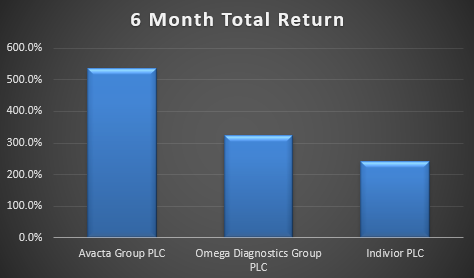
(Source: EODHD/Others, Thomson Reuters)
- Avacta Group Plc (LON:AVCT)
United Kingdom-based Avacta Group Plc (LON:AVCT) is a Biotechnology and Medical Research Company. It also develops UCB celltech that is an analytical instrument. The company has recently collaborated with Liverpool School of Tropical Medicine to develop an antigen test to guard against the coronavirus pandemic.
- Omega Diagnostics Group Plc (LON:ODX)
In the realm of contagious diseases, allergies, and food intolerance, Omega Diagnostics Group Plc facilitates comprehensive testing, which is of key importance in the present scenario. The company seems to have a differentiated product in comparison to its competition which could help it in gaining a lot of market share.
Omega has been well placed and highly proactive in playing a key role in developing and manufacturing much needed COVID-19 tests. In FY20, the company’s revenue from continuing operations increased by 12.1 per cent year-on-year to £9.82 million, due to the performance in the Food intolerance division which benefited from sales of the Food Detective® kit in the Chinese market.
- Indivior Plc (LON:INDV)
Indivior Plc facilitates drug development to cure for disorders caused by alcohol and opioid; it is the UK based Pharmaceuticals & Biotechnology company. The company operates in a very niche segment and has a lot of potential to grow further.
|
FTSE All Share companies |
AVCT |
ODX |
INDV |
|
CMP (GBX) after market close as on 21 August 2020 |
193.00 |
59 |
122.2 |
|
Marker Capitalisation (£ million) |
460.94 |
103.36 |
880.18 |
|
52 weeks High (GBX) |
202 |
73.5 |
142.4 |
|
52 weeks Low (GBX) |
14 |
6.75 |
34 |
|
Price Change -6 Month (%) |
536.8% |
324.0% |
242.3% |
As on 21 August 2020 after market close (Source: London Stock Exchange)
Also Read - One Can Think of Investing with Even 2 Pounds in Pocket Rather Than Keeping Cash Idle
- FTSE 100 stocks
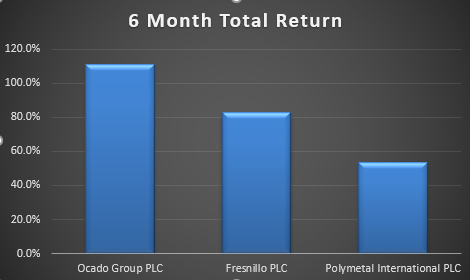
(Source: EODHD/Others, Thomson Reuters)
- Ocado Group Plc (LON:OCDO)
Ocado Group Plc is an online grocery retailer, based in the United Kingdom. The company saw a growth of 27 per cent in the retail revenue for the half-year ending on 31 May 2020, resulting from Ocado's ability to meet unprecedented, and sustained, demand for online grocery in the UK. The retail sector has been up and running throughout the unprecedented crisis.
- Fresnillo Plc (LON:FRES)
Fresnillo Plc is a holding company, engaged in the mining and beneficiation of non-ferrous minerals, and the sale of related production. The production includes primary contents such as silver, gold, lead, and zinc. It has seven operating mines. The company generated a gross profit of US$321.2 million, increasing 56.3 per cent. An increase of 232.1 per cent and 52.6 per cent respectively were recorded in the operating profit and EBITDA of US$216.9 million and US$469.9 million. Gold had recently touched a nine-year high, crossed US$2000 per ounce.
- Polymetal International Plc (LON:POLY)
Polymetal International Plc (LON:POLY) is a Cyprus-based precious metals mining group with operations in Kazakhstan and Russia and having a high-quality and low-cost asset base of assets.
In the second quarter of 2020, the Company delivered a strong performance, with an increase in revenue and gold equivalent production. The Group confirmed the full-year 2020 production guidance of 1.5 Moz of gold equivalent. For 2020, the Group maintains a positive outlook, both in terms of free cash flow and earnings.
|
FTSE 100 companies |
OCDO |
FRES |
POLY |
|
CMP (GBX) after market close as on 21 August 2020 |
2428 |
1234.00 |
1960.5 |
|
Marker Capitalisation (£ million) |
18084.99 |
9174.33 |
9278.03 |
|
52 weeks High (GBX) |
2428 |
1340 |
2050 |
|
52 weeks Low (GBX) |
1,064.00 |
527 |
1039.5 |
|
Price %Change -6 Month |
111.2% |
82.6% |
53.7% |
As on 21 August 2020 after market close (Source: London Stock Exchange)
If we consider the above comparison, the FTSE All Share companies have delivered far better returns than the blue-chip companies. But FTSE All-Share investments are not for the faint- hearted, even though higher the risk, higher the return. Investors need to thoroughly analyse the stocks before putting any bet on any of the index stocks.
