
 AUS
AUS
 NZ
NZ
 UK
UK
 CA
CA
 USA
USA
 IND
IND







The British economy continues to gain strength as it moves forward in 2020. One after other several economic indicators have now started their northward journey, indicating towards a strong revival after the treacherous pre-Brexit onslaught. The latest among those indicators are the CPI and CPIH data. As per the Office of National Statistics (ONS) Report published on 19 February 2020, the consumer price inflation rate for the month of January 2020 stood at 1.8 per cent. This is the highest rise in value in percentage points, during the past one year with the CPI growth rate for December 2019 standing at 1.3 per cent. Along with CPI the ONS report also contains the Consumer Prices Index including owner occupiersâ housing costs (CPIH) along with the basic Consumer Price Index (CPI) which stated the CPIH to have risen by 1.8 per cent in January 2020 against a 1.4 rise in December 2019. CPIH is regarded as a broader measure of inflation compared to the basic Consumer Price Inflation. The value consists of expenses associated with owning, maintaining and living in oneâs own home, known as owner-occupiers' housing costs (OOH), along with Council Tax, both of which are critical expenses for any household and are not part of CPI. The Largest contributors in CPIH growth between December 2019 and January 2020 were fuels & lubricants, gas & electricity prices, clothing and airfares.
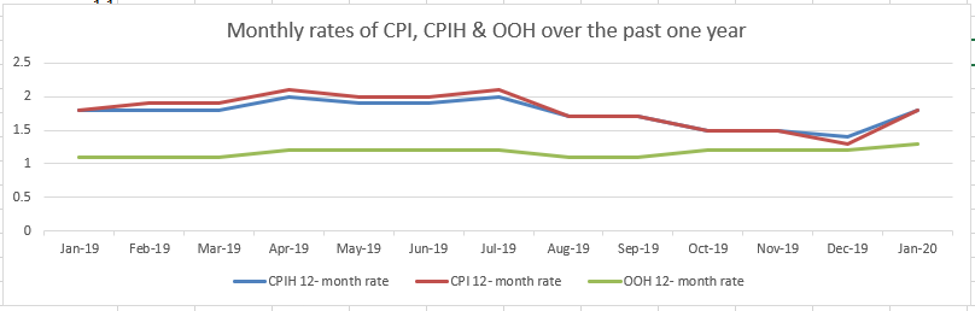
Data source â Office of National Statistics (rates in percentage points)
Looking back to a two-year period, from January 2018 to January 2020, the largest contributor in CPIH growth has been the household and household services sector while the second-highest contributor has been the transport sector. The largest constituents of the Household and household services sector were gas and electricity which were responsible for most of the CPIH growth for the month of January 2020 as price reductions initiated from the month of January 2019 culminated in December 2019.
The contribution of the transportation sector in the overall inflation towards the end of the period has come down on account of falling contributions from motor fuels and transport services excepting for a flip in the month of January 2020 on account of rising airfares and pump prices. The share of the recreation and culture sector in CPIH during the period has progressively come down along with the contributions from the food and non-alcoholic beverages sectors and alcohol and tobacco sectors. The contributions made by the restaurant and hotel sectors in the inflation growth over the period has been fairly stable, and the contribution made by other goods and service sectors in the overall inflation growth has been increasing progressively.
For the Month of January 2020, the largest contributor in CPIH was Household and Household Services sector followed by the other goods and service sectors, followed by the transport sector with the rest of the sectors having minimal contributions. Given the trend and the developments with gas and electricity prices, Household and household services sector shall continue to be the largest contributors of CPIH in the foreseeable feature.
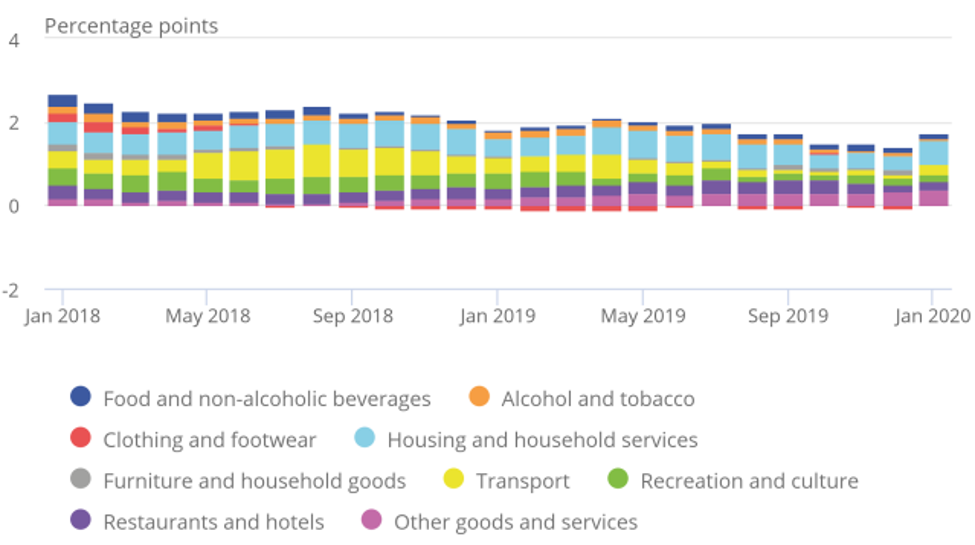
Picture Source - Office of National Statistics publication
The differentiating factor between CPI and CPIH; owner-occupiers' housing costs (OOH) has a special significance in determining the actual state of inflation faced by the average household. Major components of OOH are regular maintenance and repairs costs incurred by households, electricity gas and other fuel costs, water and sewage-related expenditures, rents paid by households, owner-occupiers housing costs and rentals paid by occupants.
During the periods between January 2015 and January 2020, the contribution of owner-occupiers housing costs has come down progressively while still being the largest component of OOH. Electricity gas and other fuel costs registered a negative contribution in OOH growth from January 2015 to January 2017 period but were its second-largest components on an average from January 2017 till January 2020. Council taxes are the third most important components of OOH, which at the beginning of the January 2015 period had a relatively low contribution to the overall OOH growth but has increased in its contribution thereafter till the end of January 2020 period. Rents paid by house occupants used to be a significant component of OOH during the periods starting from January 2015 with its importance getting significantly reduced till July 2018, after which its contribution in OOH has started to increase progressively. The contributions of water and sewage expenditure and regular maintenance and repair costs incurred by households to the OOH have not been significant over the years.
During the Month of January 2020, the largest contributor to owner-occupiers' housing costs (OOH) has been owner occupancy housing costs, followed by council tax costs, followed by electricity gas and other fuel costs, followed by rentals paid by occupants costs, followed by regular maintenance and repair costs incurred by households and water and sewage costs. In the forthcoming periods, the council tax costs, and electricity gas and other fuel costs are going to be the major contributors to the OOH growth rate.
Over the years, it has been observed that OOHÂ constitutes 17 per cent of the CPIH inflation rates.
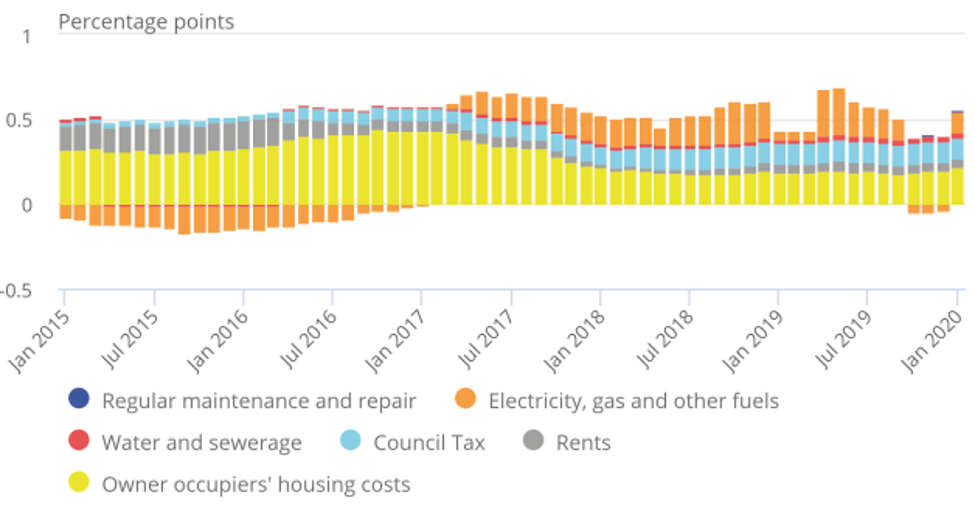
Picture Source - Office of National Statistics publication
The CPI (Consumer Price Index), CPIH (Consumer Prices Index including owner occupiersâ housing costs) and OOH (owner-occupiers' housing costs) are important leading indicators that indicate towards the heath of the British economy. The rise in inflation at healthy rates are a good sign for an economy as it signals growing demand which eventually leads to a growth in the GDP of the country. Inflation growing at excessive rates would put un-necessary hardships on citizens who would then curtail their spending, leading to a decrease in demand and overstocking of unsold goods by manufacturers and suppliers.
The United Kingdom on 31 January 2020 withdrew from the European Union after being together for nearly forty-seven years. The country is now about to chart for itself a new course of action on how it wants to rebuild its economy; the start it has got so far from the year 2020 is encouraging and should provide a strong grounding for its journey further.
